San Esteban Cemetery
For decades, a physical barrier within Salamina's cemetery reflected a stark social divide.
Full story unlocks in the tour
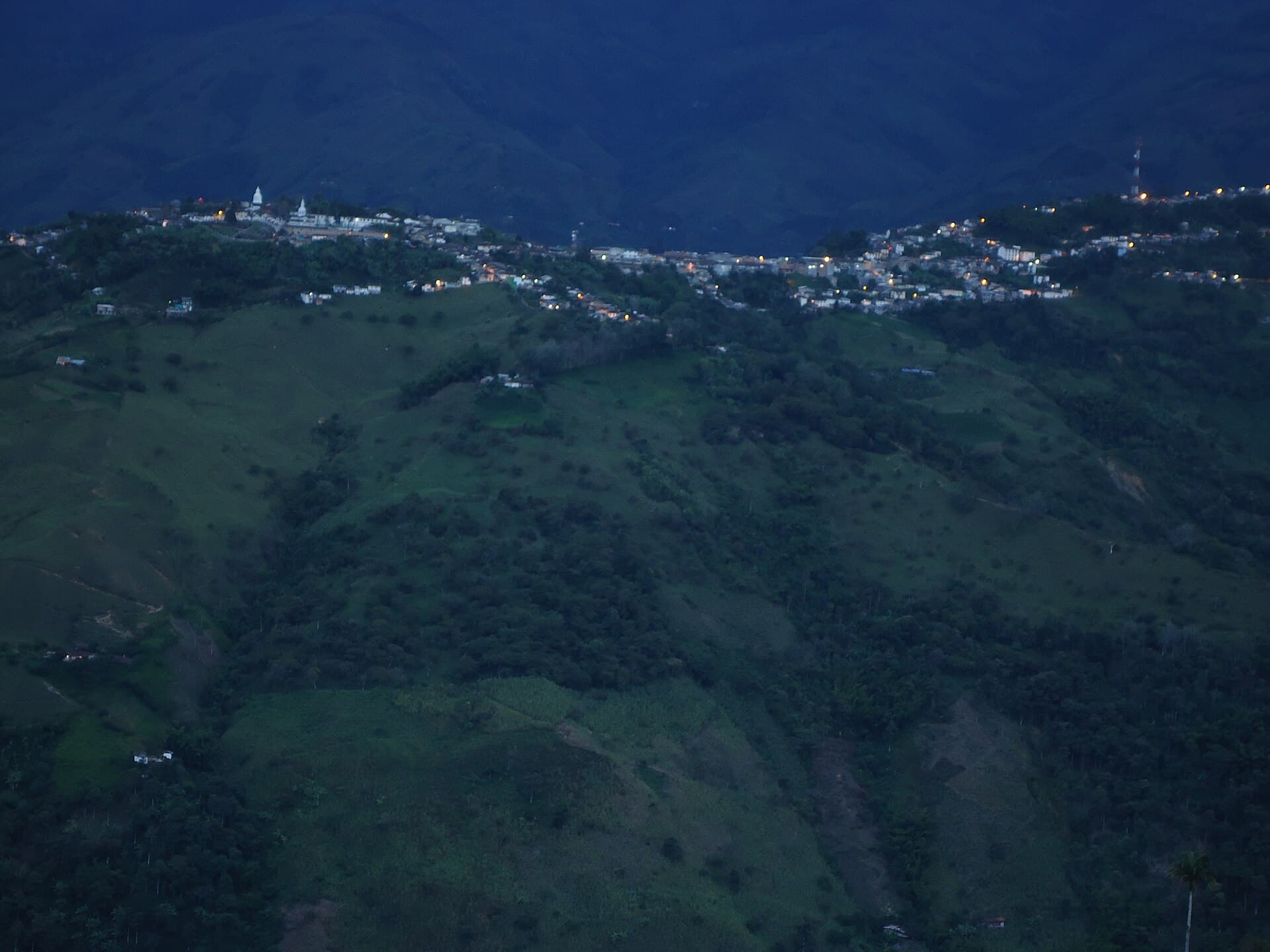 Samacar / CC BY 3.0, via Wikimedia Commons
Self-guided audio walking tour of Salamina — GPS route, offline playback, story-driven narration in 32 languages.
“Step into Salamina, where time slows, and every carved balcony tells a story.”
Not the postcards. The stories even locals don't know — whispered in your ear, right where they happened.
For decades, a physical barrier within Salamina's cemetery reflected a stark social divide.
The grand bronze fountain in Salamina's main square has a surprising Parisian twin and a remarkable journey.
At a humble café on Calle Real, two unique local delicacies were born.
Discover every secret of Salamina
Every address, every reveal in full — in your ear, right where it happened.
You pick your stops. You walk. The voice reveals what the others miss.
Your self-guided audio tour of Salamina is ready — pick your landmarks, choose your language, and start the moment you arrive.
BuyLume has a built-in augmented-reality guide. Hold your phone up and its camera shows the street ahead of you, with a glowing arrow laid over the real view that always points to your next stop — no map to puzzle over, no wrong turns. Like everything in Lume, it works fully offline.
Salamina, often called the "City of Light," is a captivating town in the Caldas department of Colombia, renowned for its remarkably preserved 19th-century Antioquian architecture. A designated Pueblo Patrimonio (Heritage Town) and part of the UNESCO Coffee Cultural Landscape, Salamina offers a glimpse into a bygone era, less touched by mass tourism than some of its regional counterparts. Its streets are a living museum, lined with whitewashed houses, intricate wooden balconies adorned with flowers, and carved doors that speak to an artisanal past.
Beyond its architectural charm, Salamina is a place where coffee culture runs deep, with surrounding hillsides blanketed in coffee plants. The town's identity is also rooted in its history of producing poets, writers, and intellectuals, earning it its luminous nickname. Visitors can experience a peaceful atmosphere, connect with friendly locals, and explore a region where traditional crafts and customs are actively maintained.
Salamina was founded in 1825 by settlers from Antioquia during the 19th-century 'paisa colonization,' a movement that saw people move south into the mountains of Caldas, Quindío, and Risaralda. Unlike other municipalities in Caldas that focused on coffee, mining, or panela, Salamina's identity was shaped by religion, poetry, and architecture. The town quickly gained a reputation as a center for art and culture, leading to its moniker, "Ciudad de Luz" or "City of Light," due to the notable number of poets, writers, priests, and intellectuals it produced.
The search for silver, gold, and fertile land fueled this colonial expansion, leaving behind haciendas, churches, and plazas that define the region's landscape. Salamina became a vital hub on La Ruta del Arriero, the Muleteer's Route, where goods were transported by mules and oxen in pre-industrial Colombia. This rugged terrain helped preserve many colonial crafts and traditions, which are still conserved today.
Salamina's architectural heritage is a testament to the wealth generated by coffee in the late 19th and early 20th centuries. Coffee merchants commissioned master carpenters, most notably Eliseo Tangarife, whose intricate woodwork on balconies, doors, and interior beams can still be admired throughout the historic center. The town's historic center, with its tapia pisada (rammed earth) and bahareque (wattle-and-daub) houses, whitewashed facades, and distinctive blue-painted door and window frames, was declared a National Monument in 1982. It is also one of Colombia's 17 Pueblos Patrimonio, a network recognizing towns with outstanding heritage value.
Begin your exploration in Parque Bolívar, the town's central square, shaded by tall trees and surrounded by historic buildings. Here, you'll find the Basilica of the Immaculate Conception, an imposing Romanesque structure with an altar carved from wood and gilded in gold leaf, and some of master carpenter Eliseo Tangarife's finest work. In the center of the square stands a bronze fountain, an imitation of one in Paris's Place de la Concorde, which arrived in Salamina via a remarkable journey.
Take a stroll down Calle Real, known for its well-preserved colonial architecture, adorned with colorful balconies and intricate wooden details. The Casa de la Cultura Rodrigo Jiménez Mejía is considered an architectural highlight, showcasing beautiful wooden finishes and housing local archives and exhibits. For a unique perspective on local history and social stratification, visit the San Esteban Cemetery, notable for its Gothic chapel and the historical division of burial plots.
Beyond the town, a short distance away lies the Valle de Samaria, a cloud forest valley home to the world's largest population of Quindío wax palms, Colombia's national tree. This peaceful natural area also provides opportunities for birdwatching, including sightings of the rare yellow-eared parrot. You can also visit local coffee farms to learn about the cultivation and processing of high-quality Arabica beans.
Salamina enjoys a temperate mountain climate with relatively stable, warm temperatures year-round, averaging around 23-25°C (73-77°F). While rain is possible any month due to its Andean location, the main dry seasons are from December to February and June to August. For general outdoor activities and pleasant weather, the best times to visit are mid-June to early September and mid-December to mid-February. Consider visiting in early December for the Noche de Velitas (Night of Fire) on December 7-8, when the town is illuminated by thousands of candles and lanterns.
Salamina is approximately 73-75 kilometers (45-47 miles) from Manizales, the capital of Caldas. Buses from Manizales to Salamina take about three hours, offering scenic views of the Eje Cafetero. From Medellín, direct buses to Salamina take around 4 hours and 11-12 minutes. Driving from Medellín takes approximately 3 hours and 15 minutes.
Accommodation options in Salamina are more limited than in more heavily touristed towns, with a selection of small boutique hotels and private homes for rent. It's advisable to book in advance, especially during the Noche de Velitas or Holy Week. While restaurant choices are mostly traditional, places like Café El Polo offer unique local dishes. It is recommended to carry cash, as ATMs can be limited and some smaller establishments may not accept cards.
Salamina in Korean, in Chinese or in Hebrew — and 29 more languages, every stop narrated by a native voice. The widest language range of any self-guided audio tour.
Available in: