The Collegiate Church of Saint-Christophe
Beyond its grand Gothic facade, the church once served a surprising dual purpose for the community.
Full story unlocks in the tour
 1gagnepetit / CC BY-SA 3.0, via Wikimedia Commons
Self-guided audio walking tour of Sauveterre-de-Rouergue — GPS route, offline playback, story-driven narration in 32 languages.
“Where medieval echoes meet living artistry.”
Not the postcards. The stories even locals don't know — whispered in your ear, right where they happened.
Beyond its grand Gothic facade, the church once served a surprising dual purpose for the community.
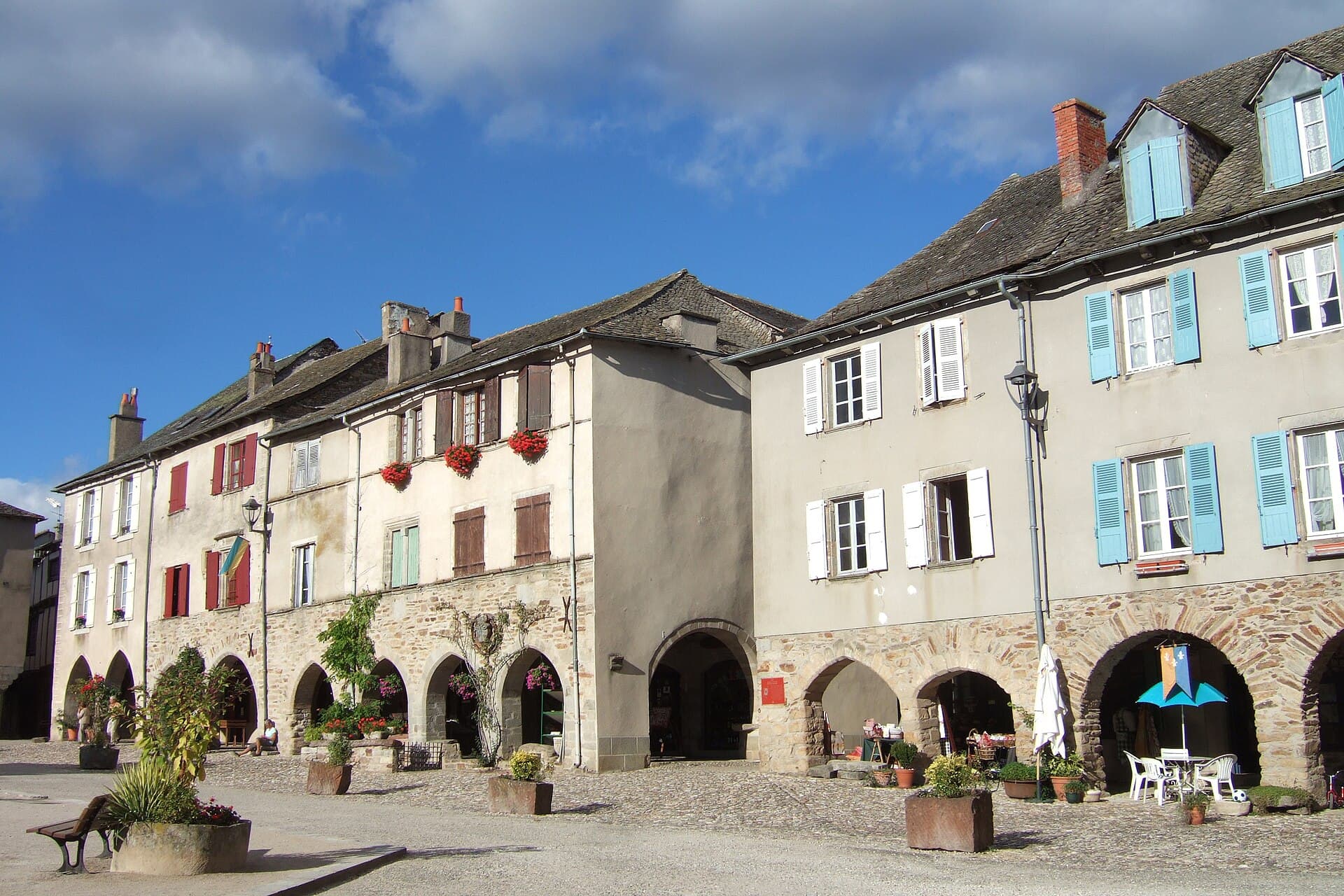
The impressive 47 arcades surrounding the main square hold a clue to the town's struggle against a devastating historical event.
The historic well in the heart of Sauveterre-de-Rouergue's main square might conceal more than just water.
Discover every secret of Sauveterre-de-Rouergue
Every address, every reveal in full — in your ear, right where it happened.
You pick your stops. You walk. The voice reveals what the others miss.
Your self-guided audio tour of Sauveterre-de-Rouergue is ready — pick your landmarks, choose your language, and start the moment you arrive.
BuyLume has a built-in augmented-reality guide. Hold your phone up and its camera shows the street ahead of you, with a glowing arrow laid over the real view that always points to your next stop — no map to puzzle over, no wrong turns. Like everything in Lume, it works fully offline.
Sauveterre-de-Rouergue, a designated "Most Beautiful Village in France," stands as a remarkably preserved 13th-century bastide in the Aveyron department of Occitanie. This royal fortified town, founded in 1281 by Guillaume de Mâcon, seneschal of Rouergue, on behalf of King Philip III the Bold, was designed with a precise checkerboard plan to foster community and commerce. Its enduring appeal lies in its harmonious architecture, featuring a grand central square framed by 47 arcades, stone-paved passages, and half-timbered houses that transport visitors to a bygone era.
Far from being a static relic, Sauveterre-de-Rouergue is a living village, where the echoes of its medieval past blend seamlessly with a thriving contemporary arts and crafts scene. Its strategic location, away from major roads, has been instrumental in safeguarding its exceptional architectural heritage. As you wander through its ancient gates and explore its picturesque alleys, you'll discover a town that has retained its authentic character, offering a tranquil escape in the heart of the Ségala region, often referred to as the "land of a hundred valleys."
Sauveterre-de-Rouergue served as a crucial administrative and economic hub in its early centuries, a legacy that continues today through its active artisan community. This blend of historical significance and lively local life makes it a compelling destination for those seeking to immerse themselves in French history and culture.
Sauveterre-de-Rouergue was established in 1281 by Guillaume de Mâcon, the seneschal of Rouergue, acting on behalf of King Philip III the Bold. This was part of a broader urbanization policy in the 13th and 14th centuries, aimed at settling a growing population and consolidating royal authority over ecclesiastical and feudal powers. The town's name, derived from salva terra or "safe land," reflects the charter of freedoms and protections granted to its inhabitants, encouraging settlement and trade.
The bastide's layout was meticulously planned, featuring a regular checkerboard street pattern converging on a spacious central square. This square, measuring approximately 60 by 40 meters, was designed for lively commercial activity, lined with arcades that housed merchant stalls and workshops. The initial settlement comprised around 60 families, drawn by the promise of peace and prosperity in a region often burdened by brigands and local lord disputes.
By 1319, Sauveterre was already encircled by ramparts, a necessary defense during turbulent times. The Hundred Years' War brought significant challenges, with the bastide falling under English control in 1362. Despite these conflicts, the town maintained its defenses, collecting taxes for its moats and instituting watch services. While much of the original enceinte walls were demolished in the 19th century, remnants like the Saint-Christophe and Saint-Vital gates, a southeast tower, and sections of the ramparts and moats still stand today.
Sauveterre-de-Rouergue flourished until the 16th century, largely due to its robust trade and craftsmanship. The town was particularly known for its metalworkers, with around thirty blacksmiths and cutlers in the 15th century. However, the 17th century brought a devastating blow when the plague ravaged the community. In 1628, a tragic 80% of the population, 800 out of 1000 inhabitants, succumbed to the disease, a profound loss that left a lasting mark on the town.
In more recent times, Sauveterre-de-Rouergue has revitalized its artisanal heritage. Today, it is recognized as a "Town of Art and Crafts" and hosts a dedicated Arts and Crafts Center. This center, housed in a renovated former convent and presbytery, provides exhibition spaces and workshops for a diverse range of artists and artisans, including ceramists, glassworkers, engravers, luthiers, and leatherworkers. This commitment to artistic craftsmanship ensures that the town's historical vocation as a hub of skilled exchange continues to flourish.
Begin your exploration in the Place des Arcades, the expansive central square, notable for its 47 arcades and historical well. This is the heart of the bastide, where you can admire the grand townhouses and half-timbered buildings. From here, wander through the surrounding medieval streets, many of which retain their original half-timbered features.
Visit the Collegiate Church of Saint-Christophe, a significant historical monument in the southern Gothic style. Inside, observe its 15th-century stalls, a flamboyant Gothic altarpiece from the early 17th century, and a sculpted pulpit from the late 17th to early 18th century. You can also see two of the original fortified entrances to the town: the Saint-Christophe and Saint-Vital gates, along with remnants of the ramparts and a corner tower.
Immerse yourself in the town's artistic spirit at the Centre for Art Professions, which showcases the work of local artisans. You can find workshops for leatherworkers, cutlers, luthiers, and ceramicists, and even arrange visits to their studios. Don't miss the "Art Trail," where works by artisans are displayed throughout the bastide and its surroundings.
For a broader historical perspective, the Heritage House (Maison du Patrimoine) in the historic center regularly hosts temporary exhibitions. Outside the bastide, the Viaur railway viaduct, an early 20th-century metal structure spanning the verdant Viaur Valley, is a notable sight 18 kilometers to the south.
The best time to visit Sauveterre-de-Rouergue for warm-weather activities is from late June to late August, when temperatures average above 80°F (27°C) and skies are clearest. July is the hottest month, with an average high of 87°F (31°C) and low precipitation.
Consider visiting during one of the town's frequent events, such as the Nocturnal Markets held every Friday evening in July and August, featuring local producers and live music. The Fête de la Lumière in early August offers a spectacular theatrical display and fireworks, while the Fête de la Châtaigne in late October celebrates chestnuts and local crafts.
Sauveterre-de-Rouergue is a small village, easily explored on foot. Comfortable walking shoes are recommended for navigating the stone-paved passages and historic alleys. The local Tourist Office, located on the Place des Arcades, is an excellent resource for visitor maps, audio-guided tours available on smartphones, and information on local events and hiking trails.
For those with accessibility needs, adapted materials in braille, raised reliefs, and high-contrast large print are available, along with an audio-described tour. The torchlight guided tours offered on Friday evenings in July and August are also fully accessible for people with reduced mobility, strollers, and wheelchairs. Free outdoor treasure hunts and sound walks featuring local anecdotes are also available.
Sauveterre-de-Rouergue is located approximately 30 minutes from Rodez and 15 minutes from Baraqueville. While the village itself is car-free, parking is available nearby. The currency used is the Euro, and French is the local language.
Sauveterre-de-Rouergue in Korean, in Chinese or in Hebrew — and 29 more languages, every stop narrated by a native voice. The widest language range of any self-guided audio tour.
Available in: