White Synagogue
This grand synagogue once served a surprising, utilitarian purpose during a dark chapter of history.
Full story unlocks in the tour
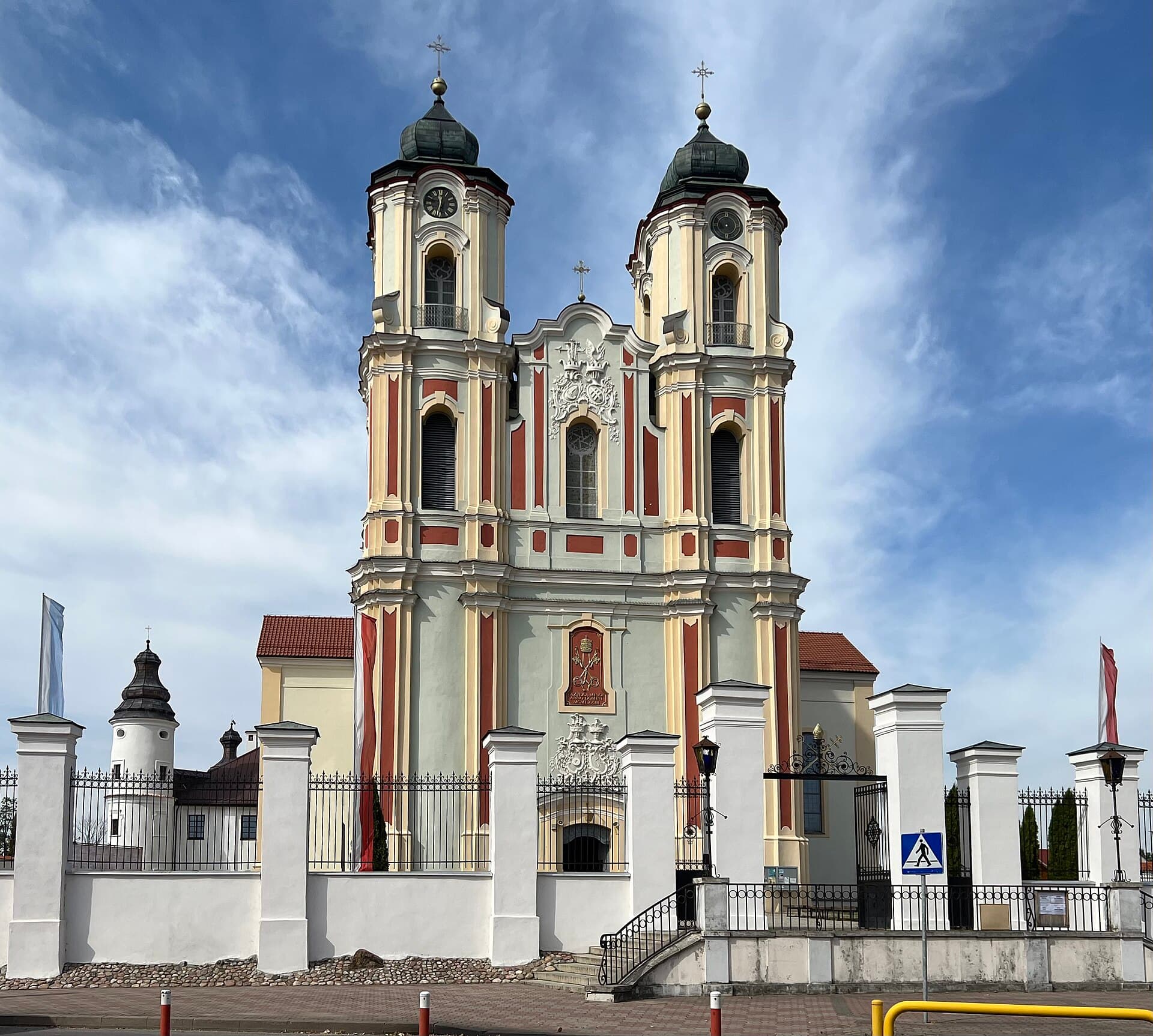 Lesnydzban / CC BY 4.0, via Wikimedia Commons
Self-guided audio walking tour of Sejny — GPS route, offline playback, story-driven narration in 32 languages.
“Where Polish, Lithuanian, and Jewish stories intertwine.”
Not the postcards. The stories even locals don't know — whispered in your ear, right where they happened.
This grand synagogue once served a surprising, utilitarian purpose during a dark chapter of history.
A future national hero was expelled from the Sejny seminary for lacking a 'calling for the priesthood.'
The monastery complex here holds a unique architectural distinction in northeastern Poland.
Discover every secret of Sejny
Every address, every reveal in full — in your ear, right where it happened.
You pick your stops. You walk. The voice reveals what the others miss.

Your self-guided audio tour of Sejny is ready — pick your landmarks, choose your language, and start the moment you arrive.
BuyLume has a built-in augmented-reality guide. Hold your phone up and its camera shows the street ahead of you, with a glowing arrow laid over the real view that always points to your next stop — no map to puzzle over, no wrong turns. Like everything in Lume, it works fully offline.
Sejny, a small town in northeastern Poland, rests within the Suwałki Lake Area, a landscape shaped by glaciers, featuring clear lakes and dense forests. Just 12 kilometers from the Lithuanian border, Sejny has long been a crossroads of cultures—Polish, Lithuanian, Jewish, German, Belarusian, and Russian influences have all left their mark, creating a distinctive historical fabric.
Today, with a population of just over 5,000, Sejny holds the distinction of being Poland's smallest county town. Yet, it remains a significant cultural center, particularly for the Lithuanian minority in Poland. The town's historical buildings, now thoughtfully repurposed for cultural and educational initiatives, recount a story of endurance and a dynamic, often challenging, multicultural past.
The earliest inhabitants of the Sejny area were the Yotvingians, a Baltic tribe whose presence dates back to the first millennium. Persistent conflicts between the Teutonic Order and Lithuania from the 13th century onward largely depopulated the region. The first written record of the area itself appeared in 1385.
Sejny's modern history began in 1522 when King Sigismund I the Old granted land along the Sejna (now Marycha) river to Hetman Iwan Wiśniowiecki. A wooden manor was constructed, and a settlement began to form. In 1593, the unnamed village was sold to Jerzy Grodziński, who transformed it into a town he called Juriewo, though the name Sejny ultimately endured.
A pivotal moment arrived in 1602 when Grodziński bequeathed his properties to the Dominican monastery in Vilnius. The Dominicans established a substantial monastery, completing its construction in 1619, followed by a new church by 1632, dedicated to Holy Mary, Saint George, and Saint Hyacinth. This church would later become the Basilica of the Visitation of the Blessed Virgin Mary.
Over centuries, Sejny's location near various borders meant it frequently changed hands. After the Third Partition of Poland in 1795, it was annexed by Prussia. In 1807, it became part of the short-lived Polish Duchy of Warsaw, and then, after Napoleon's defeat in 1815, it joined Congress Poland under Russian rule. During this period, in 1818, the bishopric was moved to Sejny from Wigry, and a priest seminary was established in 1826, contributing to the town's prosperity despite a major fire.
The 19th century also saw a significant Jewish community thrive in Sejny, comprising over 70% of the town's population by the mid-1800s. The White Synagogue, built in 1885, stands as a testament to this community. However, economic hardship at the turn of the 20th century led to a decline in population, particularly among the Jewish community, with many emigrating to the United States.
The 20th century brought immense upheaval. Following World War I, Sejny became a focal point of conflict between newly independent Poland and Lithuania, changing hands eleven times between 1919 and 1920. This culminated in the Sejny Uprising, a Polish revolt against Lithuanian authorities. World War II brought further devastation, with Soviet and then Nazi German occupation. The Jewish community was almost entirely destroyed, and many Poles and Lithuanians faced mass arrests, executions, and deportations.
After the war, Sejny slowly recuperated with an influx of Poles resettled from areas annexed by the Soviet Union. In 1990, a new chapter began with the establishment of the 'Borderland of Arts, Cultures, and Nations' Centre, transforming the former synagogue and yeshiva into a dynamic hub for cultural exchange and a reflection on the region's complex multicultural heritage.
Sejny offers a concentrated experience of its multicultural past, with several key sites telling compelling stories.
Begin at the Basilica of the Visitation of the Blessed Virgin Mary (Bazylika Nawiedzenia Najświętszej Maryy Panny) and the adjacent Dominican Monastery. The basilica, originally built between 1610-1619 in a late Renaissance style and later rebuilt in Vilna Baroque, is a valuable complex of sacred architecture. The monastery complex is notable as the only Renaissance defensive structure in northeastern Poland.
Just a short walk away is the White Synagogue (Biała Synagoga), a Neo-Baroque building completed in 1885. Once a vital center for Sejny's Jewish community, it now houses the 'Borderland – of Arts, Cultures, Nations' Centre, serving as a concert and exhibition hall and a hub for exploring the region's diverse heritage. Next to it, you'll find the former yeshiva and Hebrew gymnasium, also part of the 'Borderland' Centre's facilities.
The Sejny Land Museum, located in the Classicist Bishops' Palace, offers further insights into the region's history and culture. For those interested in the Polish-Lithuanian conflict, a memorial at the local cemetery commemorates the Polish insurgents executed by Russians during the January Uprising. You might also seek out the Church of Our Lady of Częstochowa, a small Gothic church built in 1844, which was formerly a Protestant church.
Sejny is best explored during the warmer months, from late spring to early autumn (May to September). The weather is generally pleasant for walking through the town and enjoying the surrounding natural beauty of the Suwałki Lake Area. While the town experiences an increase in visitors during the tourist season, it remains a relatively peaceful destination. Winter can be cold and snowy, limiting outdoor activities.
Sejny is located in the Podlaskie Voivodeship, close to the border with Lithuania. It is accessible by road, situated on national road no. 16, and has bus connections to nearby larger towns like Augustów and Suwałki. While Sejny is a small town, it offers several small hotels and restaurants. For a more immersive experience in the picturesque Suwałki Lake District, agritourism accommodation is readily available in the surrounding villages. The 'Borderland – of Arts, Cultures, and Nations' Centre at the White Synagogue is a key cultural institution, offering exhibitions, concerts, and information on local events. The town is also a notable center for the Lithuanian minority in Poland, hosting a Lithuanian consulate and schooling complex.
Sejny in Korean, in Chinese or in Hebrew — and 29 more languages, every stop narrated by a native voice. The widest language range of any self-guided audio tour.
Available in: