Einhard-Basilika
La basilique abrite les reliques de deux saints, mais c'est un voyage depuis Rome qui les a amenées ici, grâce à un érudit plutôt dévoué.
L'histoire complète se débloque dans le tour
 Maulaff at German Wikipedia / CC BY-SA 3.0, via Wikimedia Commons
Visite audio autoguidée de Seligenstadt — parcours GPS à pied, lecture hors ligne, narration en 32 langues.
“Là où l'héritage de Charlemagne rencontre l'étreinte bénédictine.”
Pas les cartes postales. Les histoires que même les habitants ignorent — soufflées à l'oreille, là où elles se sont passées.
La basilique abrite les reliques de deux saints, mais c'est un voyage depuis Rome qui les a amenées ici, grâce à un érudit plutôt dévoué.
Au-delà de ses murs monastiques, l'abbaye a jadis joué un rôle surprenant dans l'économie locale, bien avant la monnaie moderne.
Ce n'est pas une ruine romaine, mais une reconstitution du XIXe siècle. Pourtant, son bâtisseur avait une raison très personnelle, presque romantique, à son existence.
Découvrez tous les secrets de Seligenstadt
Chaque adresse, chaque révélation en entier — dans ton oreille, là où elle s'est passée.
Tu choisis tes lieux. Tu marches. La voix te révèle ce que les autres ignorent.

Votre visite audioguidée de Seligenstadt vous attend — choisissez vos lieux, votre langue, et lancez-vous dès votre arrivée.
AcheterLume intègre un guide en réalité augmentée. Levez votre téléphone : sa caméra montre la rue devant vous, avec une flèche lumineuse posée sur l'image réelle qui pointe toujours vers votre prochain arrêt — aucune carte à déchiffrer, aucun mauvais virage. Comme tout dans Lume, ça fonctionne entièrement hors-ligne.
Seligenstadt, une ville de Hesse, en Allemagne, est située le long du Main, mêlant avec grâce l'histoire impériale au charme d'une petite localité. Son nom, signifiant « ville des bienheureux », fait allusion à un passé significatif, enraciné dans l'ère carolingienne. La silhouette de la ville est façonnée par l'Einhard-Basilika, signe clair de son importance au début du Moyen Âge et point central pour ceux qui cherchent un lien avec l'époque de Charlemagne.
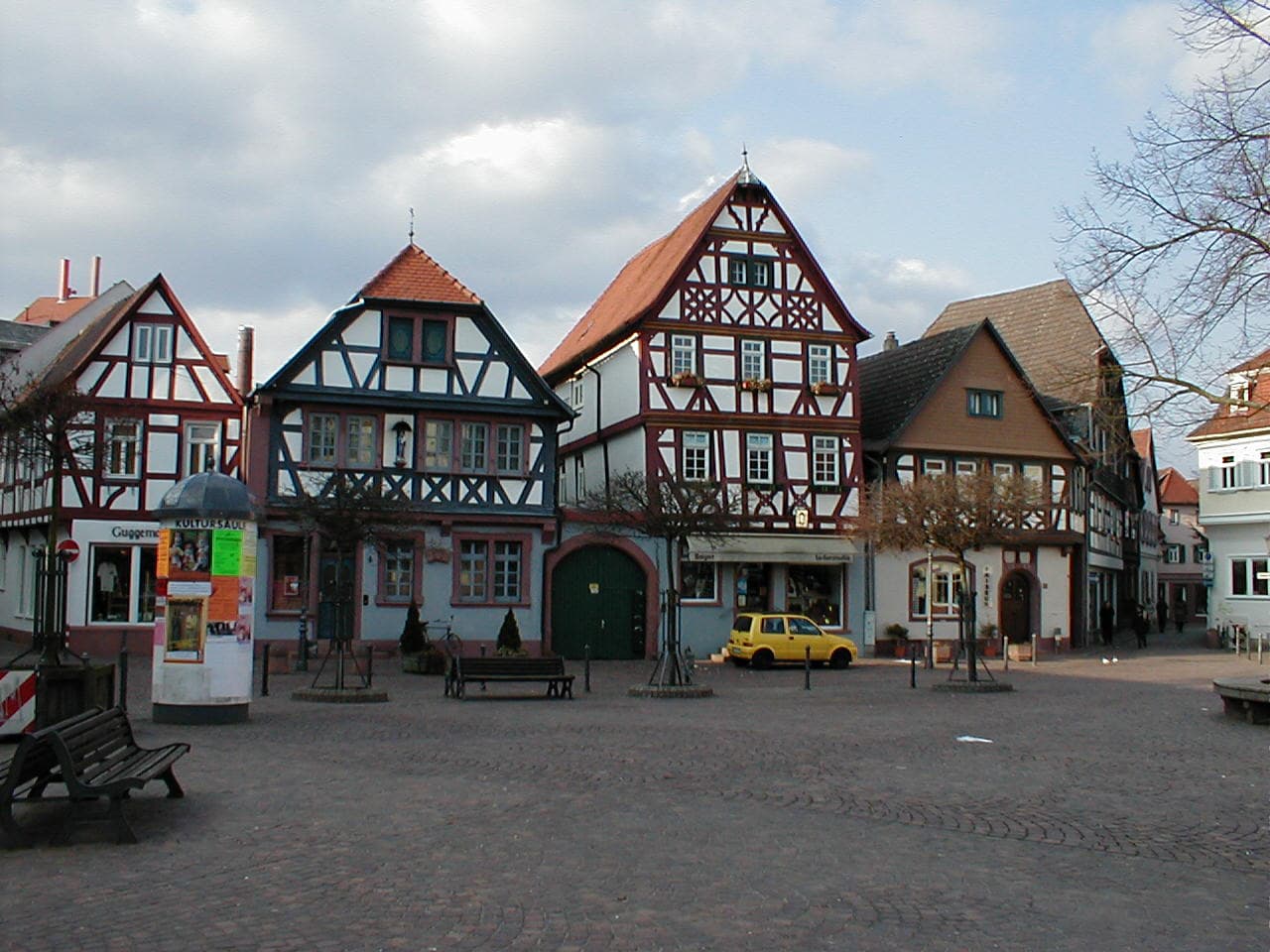
Au-delà de son cœur historique, Seligenstadt offre une atmosphère douce avec ses maisons à colombages, ses places accueillantes et ses promenades au bord de la rivière. Ici, l'histoire n'est pas seulement confinée aux musées, mais est tissée dans le tissu de l'existence quotidienne, des anciens terrains de son abbaye à ses festivals locaux animés. La ville offre une évasion tranquille, invitant les visiteurs à explorer à un rythme confortable.
## De l'établissement romain au centre carolingien Les origines de Seligenstadt remontent à un établissement romain nommé 'Obermühl' ou 'Mühlheim am Main', établi vers 100 après J.-C. Des preuves de la présence romaine, y compris un fort et divers artefacts, ont été découvertes dans la région. Les Romains ont utilisé l'emplacement stratégique le long du Main pour le commerce et la défense.
## Einhard et la fondation de l'abbaye Le moment décisif de la ville est arrivé au IXe siècle avec Einhard, le biographe de Charlemagne. Einhard a reçu le domaine royal d''Obermühl' de Louis le Pieux, fils de Charlemagne, en 815 après J.-C. Einhard, un chrétien dévot, cherchait un lieu de repos approprié pour les reliques des Saints Marcellin et Pierre, qu'il avait acquises à Rome. Selon la légende, les reliques ont miraculeusement indiqué Seligenstadt comme leur emplacement désiré.
Einhard a ensuite fondé un monastère bénédictin, l'Einhard-Basilika, vers 828 après J.-C., pour abriter ces reliques. Le monastère, initialement dédié aux Saints Marcellin et Pierre, a rapidement gagné en importance, attirant pèlerins et érudits. Einhard lui-même a été le premier abbé, et sa présence a élevé Seligenstadt au rang de centre spirituel et culturel significatif au sein de l'Empire carolingien. Le nom de la ville, 'Seligenstadt', signifiant 'ville bénie', proviendrait de la présence de ces saintes reliques.
## Prospérité médiévale et privilèges impériaux Tout au long du Moyen Âge, Seligenstadt a prospéré sous la protection et l'influence de l'abbaye. Le monastère a reçu de nombreux privilèges impériaux, y compris les droits de marché et le droit de frapper des monnaies, ce qui a encore stimulé la prospérité économique de la ville. Les terres de l'abbaye se sont étendues, et son influence s'est étendue sur une région considérable. La ville est devenue un centre de commerce et d'artisanat, son emplacement stratégique sur le Main facilitant le commerce.
## Déclin et sécularisation La Réforme a apporté des défis importants à l'abbaye catholique, bien que Seligenstadt soit restée largement catholique. Cependant, la Guerre de Trente Ans au XVIIe siècle a gravement affecté la ville et l'abbaye, entraînant destruction et dépopulation. L'abbaye s'est lentement rétablie mais n'a jamais retrouvé sa gloire d'antan. En 1803, lors de la sécularisation des biens de l'Église sous Napoléon, l'abbaye de Seligenstadt a été dissoute et ses biens confisqués.
## Époque moderne Malgré la perte de son institution monastique, Seligenstadt a conservé son caractère historique. Aux XIXe et XXe siècles, la ville s'est développée en tant que centre régional, préservant son patrimoine architectural et embrassant son passé. Aujourd'hui, Seligenstadt est une destination prisée des touristes, attirés par son paysage urbain médiéval bien conservé, l'impressionnante Einhard-Basilika et la beauté tranquille du Main.
Commencez votre exploration par l'Einhard-Basilika, un exemple frappant d'architecture carolingienne. Cette basilique, avec ses tours jumelles distinctives, abrite le sarcophage d'Einhard et les reliques des Saints Marcellin et Pierre. L'intérieur présente des fresques complexes et une atmosphère sereine.
Adjacent à la basilique se trouve le Kloster Seligenstadt (Abbaye de Seligenstadt). Bien que l'abbaye elle-même ait été sécularisée, ses terrains bien conservés, y compris le cloître, la salle capitulaire et le magnifique jardin de l'abbé de style baroque, offrent un aperçu de la vie monastique. Le jardin, avec ses parterres formels et ses sculptures, est particulièrement agréable pour une promenade.
Promenez-vous dans la vieille ville historique, caractérisée par ses charmantes maisons à colombages et ses rues étroites pavées de pierre. Ne manquez pas la Maison Romaine (Römisches Haus), une villa unique du XIXe siècle construite dans le style d'une maison de campagne romaine, avec une cour à péristyle.
Pour une expérience relaxante, promenez-vous le long de la promenade du Main. Vous pouvez profiter de la vue sur la rivière, regarder les bateaux passer, ou simplement trouver un banc pour vous imprégner de l'ambiance paisible. La promenade offre également des connexions à des sentiers de randonnée et de vélo le long de la rivière.
Seligenstadt offre son charme tout au long de l'année, mais les mois les plus chauds, de mai à septembre, offrent le temps le plus agréable pour explorer la ville à pied et profiter des bords de la rivière. Le printemps apporte des jardins en fleurs, tandis que l'automne pare le paysage de feuillages colorés. Le marché de Noël est également une attraction populaire en décembre.
Seligenstadt est facilement accessible en train, avec des liaisons régulières vers Francfort-sur-le-Main. La gare se trouve à quelques pas du centre-ville. Si vous venez en voiture, plusieurs parkings publics sont disponibles, bien que le centre historique soit mieux exploré à pied. De nombreux magasins et restaurants de Seligenstadt acceptent les principales cartes de crédit, mais il est toujours judicieux d'avoir quelques euros pour les petits achats ou les marchés locaux. La langue officielle est l'allemand, mais l'anglais est généralement compris dans les établissements accueillant des visiteurs.
Seligenstadt en coréen, en chinois ou en hébreu — et dans 29 autres langues, chaque étape narrée par une voix native. La plus large gamme de langues de tous les audioguides autoguidés.
Disponible en :