The Krönchen (Little Crown)
Siegen's skyline wears a golden crown, but the regal reason for this adornment remains a less-told story.
Full story unlocks in the tour
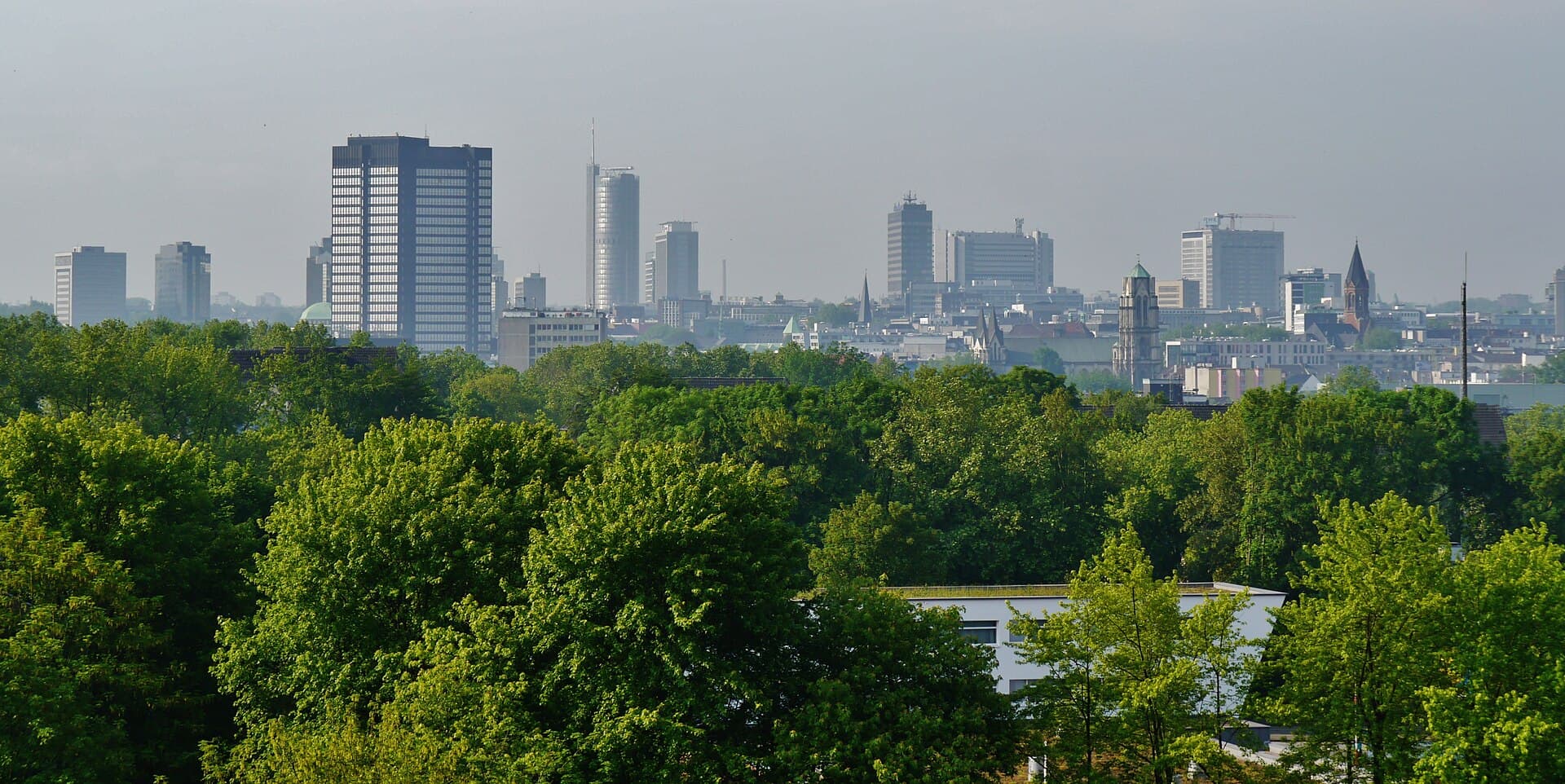 Photo of Essen, via Wikimedia Commons
Self-guided audio walking tour of Siegen — GPS route, offline playback, story-driven narration in 32 languages.
“Where verdant hills meet a golden crown, Siegen recounts eras of industry, artistry, and enduring spirit.”
Not the postcards. The stories even locals don't know — whispered in your ear, right where they happened.
Siegen's skyline wears a golden crown, but the regal reason for this adornment remains a less-told story.
Beyond its esteemed art collection, this castle museum conceals an unexpected secret beneath its foundations.
One of Siegen's districts harbors a world-record holder, though it is not what one might anticipate.
Discover every secret of Siegen
Every address, every reveal in full — in your ear, right where it happened.
You pick your stops. You walk. The voice reveals what the others miss.


Your self-guided audio tour of Siegen is ready — pick your landmarks, choose your language, and start the moment you arrive.
BuyLume has a built-in augmented-reality guide. Hold your phone up and its camera shows the street ahead of you, with a glowing arrow laid over the real view that always points to your next stop — no map to puzzle over, no wrong turns. Like everything in Lume, it works fully offline.
Siegen, a university city in North Rhine-Westphalia, Germany, is defined by its undulating landscape and expansive green areas, earning it the designation 'city on seven hills.' Situated in the scenic Siegtal valley, it presents a fusion of historical markers, cultural institutions, and proximity to the natural world. The city is also widely recognized as the birthplace of the Flemish Baroque painter Peter Paul Rubens.
With a population exceeding 100,000, Siegen functions as an important economic and educational center in the South Westphalia region, all while maintaining an inviting atmosphere. Its distinct topography affords sweeping views, and the city's dedication to preserving its natural environment is evident in its vast forested expanses. Siegen invites travelers to delve into its profound heritage, savor its active cultural life, and immerse themselves in its particular blend of tradition and contemporary spirit.
The city's architectural emblem, the gilded 'Krönchen' (Little Crown) atop St. Nicholas Church, stands as a testament to its historical connections and contributes to its appealing skyline, giving rise to its nickname 'Krönchenstadt' or 'Crown City.'
Siegen's narrative stretches back to ancient times, with its initial documented mention as 'Sigena' appearing in 1079. The city's name itself derives from the Sieg River, which flows through its heart. From its earliest days, mining played a central role in forging Siegen's identity, with evidence of the industry dating back to La Tène times and numerous old mines still found within the city limits.
By 1224, Siegen was acknowledged as a new town, initially under the shared ownership of the Count of Nassau and the Archbishop of Cologne. It secured its town rights in 1303, and by 1381, it was fully controlled by the Nassau family. The 16th century saw Siegen evolve into a formidable defensive settlement, shielded by sturdy walls, 16 towers, and three town gates, alongside a significant castle. The city, however, was not immune to catastrophe, enduring destructive fires in 1592 and 1695.
Education also has deep roots in Siegen, with a 'paedagogium' established in 1536 within a former Franciscan Monastery, which later transformed into today's Gymnasium at Siegen's Löhrtor. The Lower Castle (Unteres Schloss) was constructed on the site of another old Franciscan Monastery by John VII of Nassau-Siegen. In 1623, the House of Nassau-Siegen divided into Catholic and Protestant branches, influencing the city's religious landscape and leading to the establishment of a Jesuit monastery in 1626.
After becoming part of Prussia in 1815, Siegen thrived as the nucleus of South Westphalia. Despite being largely devastated during World War II, particularly from an Allied bombing raid on December 16, 1944, the city has meticulously rebuilt itself, safeguarding key historical structures like the Upper and Lower Castles. In 1975, municipal reforms considerably expanded Siegen's population beyond 100,000, solidifying its status as a major city.
Siegen presents a compelling blend of history, artistry, and nature. Begin your exploration at the Oberes Schloss (Upper Castle), a landmark dating back to 1259. Within its walls, the Siegerlandmuseum displays local history, art, and a notable collection of paintings by Peter Paul Rubens, a native son of Siegen. Make sure to experience the unique demonstration mine in the castle's dungeons. The castle grounds also feature lively gardens and an adventure playground.
Next, proceed to the Unteres Schloss (Lower Castle), which once served as the residence for the Protestant branch of the House of Nassau-Siegen and now houses part of the University of Siegen. Nearby, the Museum für Gegenwartskunst (Museum of Contemporary Art), situated in the former telegraph office, offers a contrasting modern art experience.
No visit to Siegen is complete without seeing the Nikolaikirche (St. Nicholas Church), with its distinctive hexagonal architecture and the golden 'Krönchen' (Little Crown) adorning its spire—a true emblem of the city. Wander through the narrow pathways of the old town to admire the heritage-protected half-timbered houses. For a distinct cultural detour, seek out the Beatles Museum in the Geisweid district, recognized as the smallest in the world.
Beyond the city center, explore the Energie-Garten, a peaceful green space. Siegen's extensive forests provide ample opportunities for walking and enjoying the natural surroundings.
The most agreeable time to visit Siegen for outdoor pursuits and sightseeing extends from May through September. During these months, the weather is generally comfortable, with average daytime temperatures in July and August reaching approximately 21-22°C (70-72°F). While summers are mild, Siegen experiences consistent cloud cover and regular precipitation throughout the year, so it is prudent to carry an umbrella or raincoat. For those seeking fewer crowds and potentially better value, the quieter months from November to February offer cooler weather. The coldest month is typically January, with average temperatures around 1.2°C (34°F).
Reaching Siegen is straightforward, despite the absence of a commercial airport within the city itself. The nearest major airports are Cologne/Bonn (CGN), approximately 63 km away, and Frankfurt am Main (FRA), about 101 km distant. From these airports, you can arrive in Siegen by train or bus. A train journey from Cologne takes about 1.5 hours, offering pleasant views.
Within Siegen, public transportation is primarily managed by a comprehensive bus network operated by Verkehrsbetriebe Westfalen Süd (vws), including CityBus routes and UniExpress lines connecting to the university campuses. Siegen Central Station (Siegen Hauptbahnhof) is a vital transport hub, linking to the local bus network and providing regional train services to major cities like Cologne, Dortmund, and Frankfurt. The Deutschlandticket, at €63 per month, permits unlimited use of public transportation across Germany (excluding ICE and IC trains). For long-distance travel, FlixBus also serves Siegen.
Siegen's hilly topography means comfortable walking shoes are highly recommended for traversing the city's pathways and inclined routes.
Siegen in Korean, in Chinese or in Hebrew — and 29 more languages, every stop narrated by a native voice. The widest language range of any self-guided audio tour.
Available in: