Singa Ambara Raja Monument
The winged lion at the city's core represents power, its wings marking a specific, pivotal date.
Full story unlocks in the tour
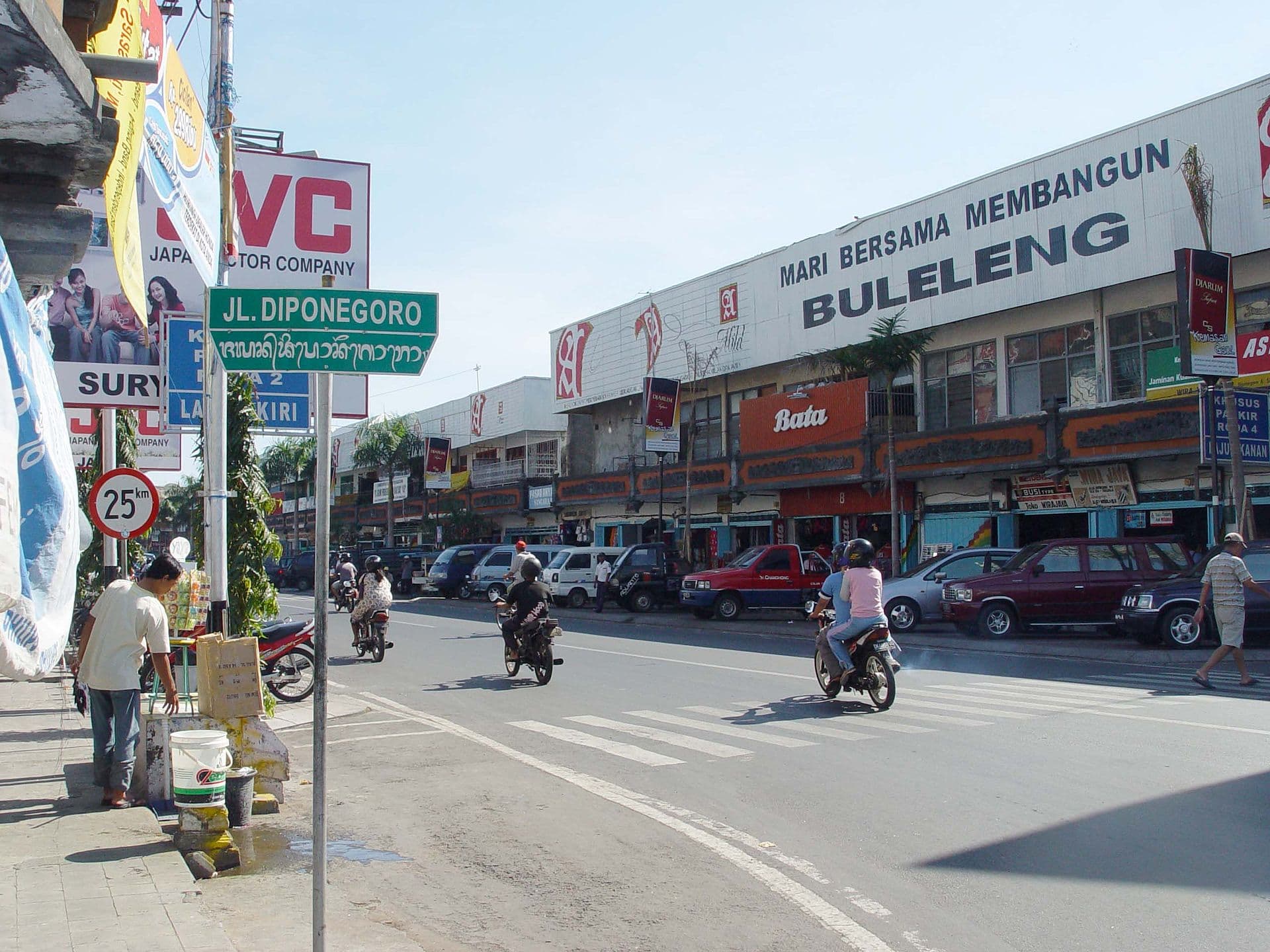 Wikimedia / cc by-sa 3.0, via Wikimedia Commons
Self-guided audio walking tour of Singaraja — GPS route, offline playback, story-driven narration in 32 languages.
“Where ancient manuscripts share their stories and colonial echoes linger on wide, tree-lined avenues.”
Not the postcards. The stories even locals don't know — whispered in your ear, right where they happened.
The winged lion at the city's core represents power, its wings marking a specific, pivotal date.
Beyond its colonial warehouses, the old harbor witnessed a defiant act of patriotism.
Near the old port, a Chinese temple stands as a testament to diverse faiths sharing a sacred space.
Discover every secret of Singaraja
Every address, every reveal in full — in your ear, right where it happened.
You pick your stops. You walk. The voice reveals what the others miss.


Your self-guided audio tour of Singaraja is ready — pick your landmarks, choose your language, and start the moment you arrive.
BuyLume has a built-in augmented-reality guide. Hold your phone up and its camera shows the street ahead of you, with a glowing arrow laid over the real view that always points to your next stop — no map to puzzle over, no wrong turns. Like everything in Lume, it works fully offline.
Singaraja, the second-largest city on Bali's northern coast, presents an experience distinct from the island's more frequently visited southern resorts. Once the Dutch colonial capital of Bali and the Lesser Sunda Islands, its wide, tree-lined streets and enduring colonial architecture offer a tangible connection to a deep, multicultural past.
Known as the 'City of the Lion'—a name derived from its 17th-century founder, Raja Panji Sakti—Singaraja served as Bali's primary seaport for centuries, drawing merchants from China, India, and Arabia. This historical role as a maritime gateway fostered a unique blend of Balinese, Dutch, Chinese, and Arab influences, evident in its architecture, customs, and diverse communities. For travelers seeking an authentic glimpse into Balinese life away from the busy tourist paths, Singaraja provides a compelling journey into the island's historical and cultural core.
Singaraja's origins trace back to March 30, 1604, when Raja Panji Sakti of the Buleleng kingdom laid the foundation for his royal palace, Puri Agung Buleleng. He named the city Singaraja, meaning 'Lion King,' a testament to his powerful authority. Before this, settlements on Bali's northern coast had existed for centuries, with merchants from India and China establishing trading posts as early as the common era.
Throughout the 17th and 18th centuries, Singaraja thrived as the capital and primary port of the Buleleng Kingdom. Its strategic location on the northern coast made it Bali's main seaport, facilitating extensive trade with other Indonesian islands, China, and Arab countries. This maritime activity cultivated a lively multicultural environment, with communities of Chinese and Arab traders settling in the city, leaving their mark on its architecture and traditions.
In 1849, following colonial incursions, the Dutch East Indies Company established control over northern Bali and designated Singaraja as the administrative center for not only Bali but also the Lesser Sunda Islands. This new status spurred significant urban development, including the construction of roads, modernization of the port, and the erection of numerous European-style buildings that form much of the city's historical core today. Iconic structures from this era include old government offices, warehouses in the port area, and the Gedong Kirtya library, founded in 1928 to preserve Balinese palm-leaf manuscripts.
Singaraja remained the capital of Bali until 1958, and the administrative center for the Lesser Sunda Islands until 1953, when the status was transferred to Denpasar. The port's importance also lessened with the development of the international airport in southern Bali, and the main harbor was eventually relocated 40 km west to Celukanbawang. Despite these changes, Singaraja continues to be an important cultural and educational hub, preserving its unique blend of historical influences.
Begin your exploration at the Singa Ambara Raja Monument, a winged lion statue at the city's 'zero point' that symbolizes the Buleleng Regency and commemorates Indonesia's independence. From there, wander through the Old Buleleng Harbor, where colonial-era warehouses and the Dutch bridge offer glimpses into Singaraja's past as a bustling trading port. Nearby, the Ling Gwan Kiong Chinese Temple, constructed in 1873, displays intricate Chinese architecture and serves as a unique multi-faith worship space.
Delve into Balinese intellectual history at the Gedong Kirtya Library, home to thousands of ancient lontar palm-leaf manuscripts. Adjacent to it, the Buleleng Museum provides further insights into North Bali's heritage with its collections of archaeological discoveries and historical artifacts. For a taste of royal history, admire the traditional Balinese architecture of Puri Agung Buleleng, the former royal palace.
Beyond the city center, consider a visit to Pura Beji Sangsit, located east of Singaraja, to marvel at its distinctive and richly detailed North Balinese carvings. For a tranquil escape, the Busungbiu Rice Terrace offers picturesque views away from the crowds. If you're looking for local life, explore Banyuasri Market or Pasar Anyar for fresh produce, local foods, and everyday items.
Singaraja experiences a tropical monsoon climate with consistently warm temperatures throughout the year, averaging between 24-32°C. The most favorable time to visit for comfortable weather and outdoor activities is during the dry season, from April to October. During these months, expect less humidity, more sunshine, and minimal rainfall, making it ideal for exploring the city and surrounding attractions. While the wet season, from November to March, brings heavier but often brief downpours, the scenery becomes lush and lively, and many activities remain enjoyable.
Ngurah Rai International Airport (DPS) in South Bali is the nearest international hub, approximately 90 km from Singaraja. The winding mountain roads mean a taxi or private transfer can take 2.5 to 4 hours. Arranging airport transfers in advance is highly recommended. Within Singaraja, ride-sharing apps like Gojek or Grab are convenient for getting around, or you can opt for a private car and driver to explore North Bali more extensively. Walking is also feasible in the city center.
Light clothing made of natural fabrics is advisable due to the hot and humid climate. When visiting Hindu temples, remember to bring a sarong and sash, which can often be rented at the entrance. Comfortable footwear is essential for walking the city's streets. While Singaraja's dining scene primarily serves locals, you can find authentic Balinese food and the city's signature Syobak pork dish.
Singaraja in Korean, in Chinese or in Hebrew — and 29 more languages, every stop narrated by a native voice. The widest language range of any self-guided audio tour.
Available in: