Grote Markt (Market Square)
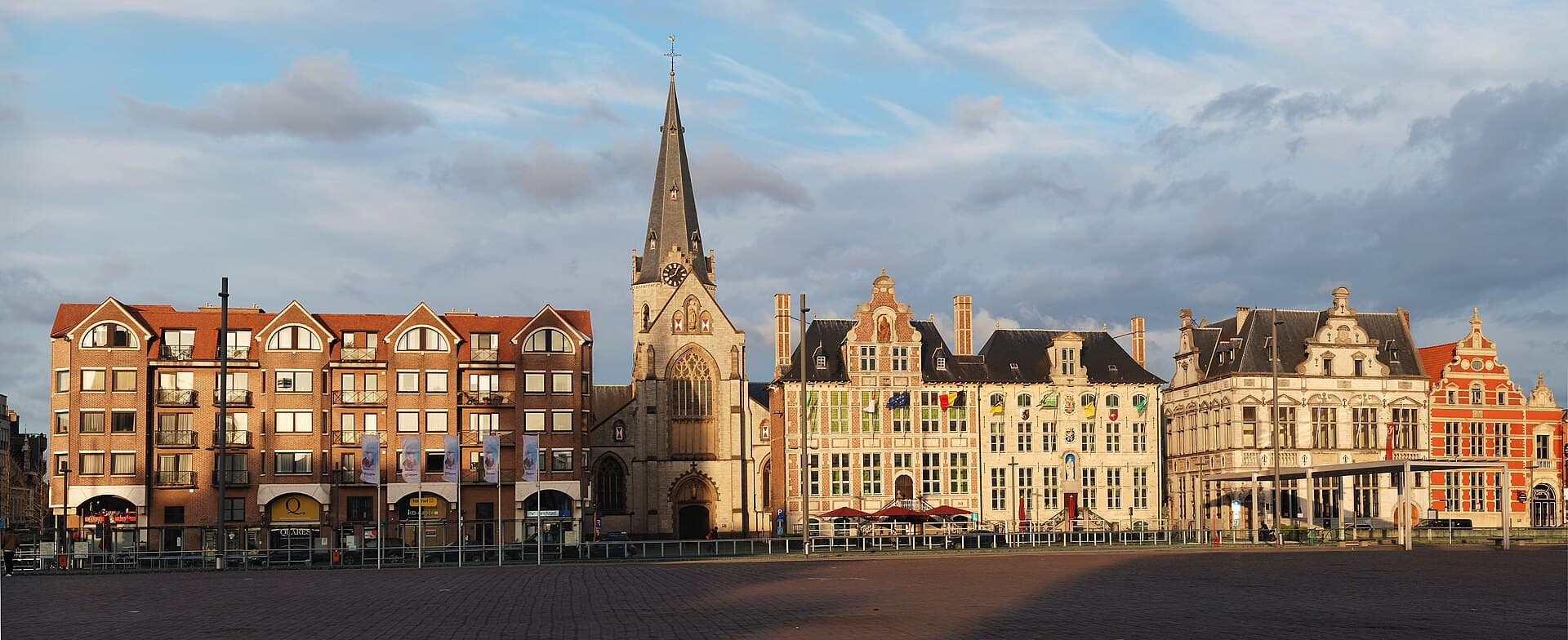
This expansive square, the largest in Belgium, owes its existence to a centuries-old stipulation that was, in a subtle yet significant way, set aside.
Full story unlocks in the tour
 Alvesgaspar / CC BY-SA 3.0, via Wikimedia Commons
Self-guided audio walking tour of Sint-Niklaas — GPS route, offline playback, story-driven narration in 32 languages.
“Where Belgium's grandest square unfolds centuries of narratives, from bustling trade to quiet defiance of ancient decrees.”
Not the postcards. The stories even locals don't know — whispered in your ear, right where they happened.
This expansive square, the largest in Belgium, owes its existence to a centuries-old stipulation that was, in a subtle yet significant way, set aside.
The striking neo-Gothic City Hall you observe today is not the initial civic structure to grace this spot, and its erection was met with considerable discussion.
The prominent statue of Saint Nicholas before the City Hall emerged from a surprisingly collaborative effort, and once endured a moment of misfortune.
Discover every secret of Sint-Niklaas
Every address, every reveal in full — in your ear, right where it happened.
You pick your stops. You walk. The voice reveals what the others miss.


Your self-guided audio tour of Sint-Niklaas is ready — pick your landmarks, choose your language, and start the moment you arrive.
BuySint-Niklaas, a city within Belgium's East Flanders province, holds the distinction of possessing the country's largest market square. This expansive central area, the Grote Markt, is more than simply a public space; it stands as a living testament to centuries of commerce, community life, and even the quiet defiance of ancient land-use decrees. Strategically positioned between the larger cities of Antwerp and Ghent, Sint-Niklaas serves as the capital of the Waasland region, an area defined by its proximity to the Scheldt river.
Beyond its impressive square, Sint-Niklaas reveals itself as a city with a compelling narrative, shaped by its industrial past, a destructive fire, and a dedication to cultural vitality. From its neo-Gothic City Hall to its distinctive Art Deco architecture and the annual spectacle of the Vredesfeesten hot air balloon festival, Sint-Niklaas offers a blend of historical intrigue and contemporary appeal. It is a city that invites exploration, whether on foot through its pedestrian-friendly avenues or by bicycle along its dedicated paths.
As you wander through Sint-Niklaas, you will uncover layers of its identity, from its beginnings as a resting place for traders to its current role as a center for commerce and culture. The city's commitment to sustainable urban development is also evident, positioning it as a forward-thinking destination within Belgium.
The history of Sint-Niklaas formally commences in 1217 with the establishment of a church dedicated to Saint Nicholas, the city's namesake and patron saint. This new parish fell under the authority of the See of Tournai, though politically, it was part of the County of Flanders. The burgeoning power of Flanders at this time spurred the city's swift economic development, leading to its designation as the administrative center of the region by 1241.
A pivotal moment in the city's growth occurred in 1248 when Margaret II, Countess of Flanders, granted additional land to the parish. This donation arrived with a crucial condition: the land was to remain undeveloped, forever serving the common good. This decree accounts for the unusually vast size of the Grote Markt, Belgium's largest market square, which spans 3.19 hectares.
Despite its advantageous location between Ghent and Antwerp, Sint-Niklaas remained unwalled, leaving it susceptible to attacks. In 1381, the city endured a fire and was plundered. However, its strategic position continued to foster expansion, and by 1513, Emperor Maximilian granted Sint-Niklaas the right to host a weekly market, a tradition that persists to this day with around 150 traders gathering every Thursday.
The 17th century brought a period of prosperity, largely fueled by the flax and wool industries. This era also saw the creation of administrative buildings and several cloistered communities providing essential services. However, a devastating fire in 1690, originating from a gin distillery, reduced most of the ancient city to ashes. This catastrophic event, while destructive, cleared the way for a new architectural legacy, with many 18th and 19th-century buildings, including notable Art Nouveau and Art Deco structures, shaping the city's appearance.
Sint-Niklaas experienced a second significant period of expansion during the Industrial Revolution, becoming an important center for textile and brick production. The late 19th century witnessed the emergence of a geometric street pattern in the northern city center, lined with the elegant Art Nouveau and Art Deco homes of the new bourgeoisie.
In the 20th century, the City Hall was extended with modern wings to accommodate demographic growth. Today, Sint-Niklaas is a city of approximately 82,000 people, recognized for its dedication to sustainable urban development and its lively cultural scene, including the internationally renowned Vredesfeesten hot air balloon festival.
Begin your journey at the Grote Markt, Belgium's largest market square. This expansive space, an example of urban planning, is framed by historic facades and forms the core of the city's activity. Be sure to observe the impressive neo-Gothic Sint-Niklaas City Hall and Belfry, with its 40-meter tower housing 49 bells. Before the City Hall, you will discover the distinctive 4.5-meter-high ceramic Statue of Saint Nicholas, a unique piece of public art.
Just beyond the square, uncover the Sint-Nicolaaskerk (Saint Nicholas Church), the city's oldest church, with origins tracing back to the 13th century. For those intrigued by cartography, the Mercator Museum (currently closed for renovation until 2025) displays fascinating maps and two original globes belonging to the celebrated cartographer Gerardus Mercator, who was born nearby.
Explore the city's architectural heritage with an Art Deco walking tour, which highlights the elegant buildings constructed during the textile industry's peak in the interwar years. Maps are available from the tourism office. Seek out the preserved interior of the old De Walvis pharmacy on Ankerstraat for a glimpse into early 20th-century commerce. For a touch of green, the Stadspark & Castle Walburg offers a pleasant park with a moated castle, now home to a bar-restaurant.
Art enthusiasts should also watch for the city's expressive street art, including Belgium's longest graffiti wall. The Onze-Lieve-Vrouwekerk (Church of Our Lady), built in the 19th century, is notable for its Byzantine revival interior and a 6-meter-tall, gold-covered statue of Our Lady.
The ideal time to experience Sint-Niklaas is during the months of May, June, July, August, and September. Throughout this period, temperatures are pleasant, ranging between 19°C and 24°C (66°F and 75°F), making it perfect for exploring the city on foot or by bicycle. Rainfall is moderate, ensuring agreeable conditions for outdoor pursuits and enjoying the city's many outdoor cafes.
Early September is particularly special due to the Vredesfeesten (Peace Festival), an international hot air balloon festival that paints the sky with colorful balloons ascending from the Grote Markt. The summer months of July and August also present "Summer on the Square" events, including concerts and children's entertainment, and the "Parkies" live music series in the city park.
Sint-Niklaas is conveniently situated on the main railway line connecting Antwerp and Ghent, with frequent train services ensuring easy access. From Antwerp and Ghent, trains depart three to four times an hour, with journey times of 20-30 minutes. For those arriving from Brussels, direct trains are available hourly, though connecting via Antwerp-Berchem or Mechelen can often be quicker. The city is also well-connected by road, with the E17 motorway passing nearby and the N16 dual carriageway leading to Mechelen and Brussels.
Once in Sint-Niklaas, the city is best discovered on foot. Following a significant renovation of the Market Square and main thoroughfares, Sint-Niklaas has been recognized as the "Most Pedestrian Friendly City" in Belgium. The distance from the railway station to the Grote Markt is approximately 850 meters. The city also features excellent new bicycle lanes with right-of-way at most intersections, and local buses operate on designated lanes. The main bus terminal is conveniently located adjacent to the railway station. The Tourist Office, situated at Grote Markt 45, can provide maps and further information.
Sint-Niklaas in Korean, in Chinese or in Hebrew — and 29 more languages, every stop narrated by a native voice. The widest language range of any self-guided audio tour.
Available in: