Sioux City Stockyards
At one point, Sioux City hosted one of the nation's largest livestock markets. Yet, the 'smell of money' was not always as it appeared.
Full story unlocks in the tour
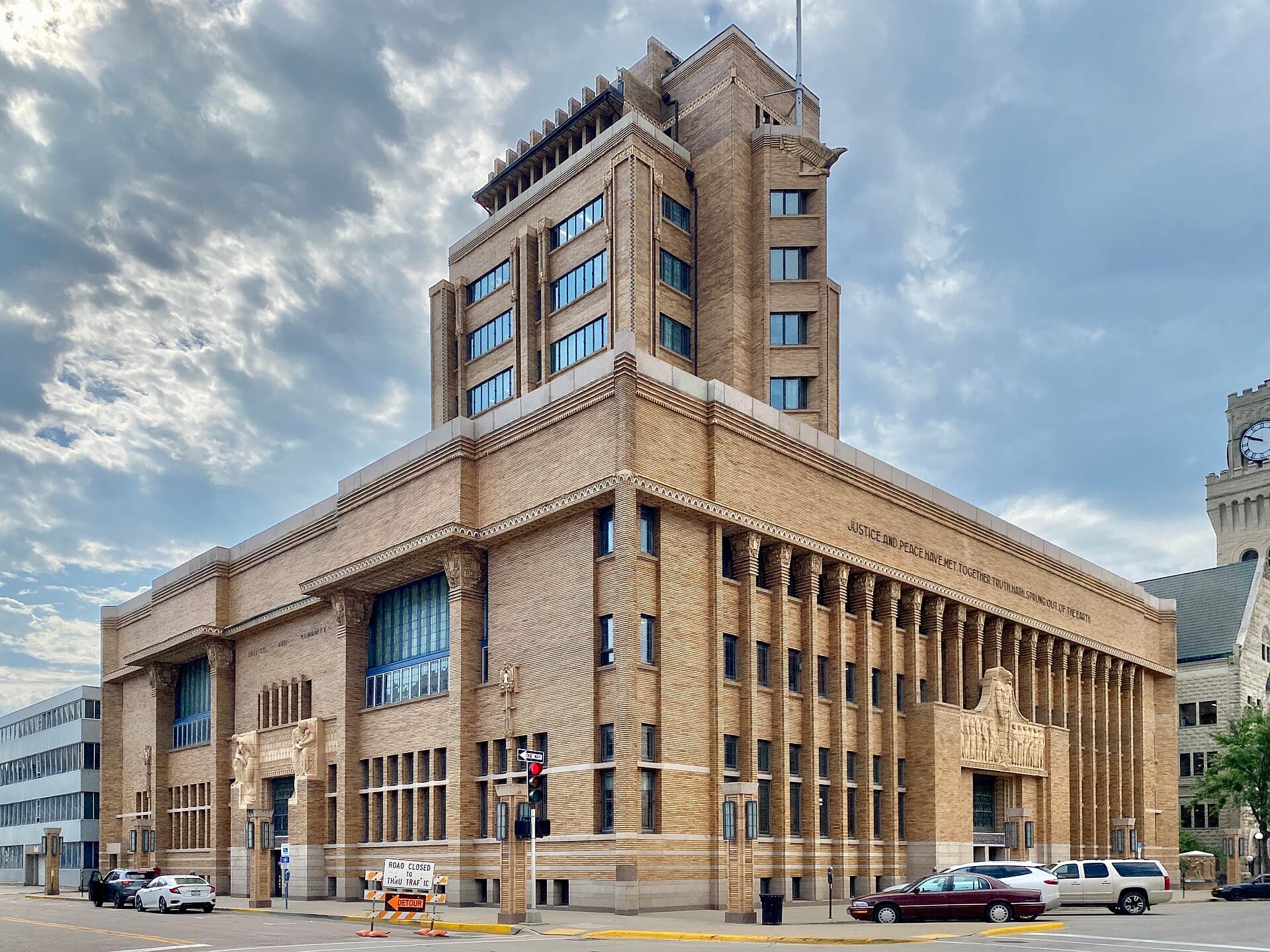 w_lemay / CC BY-SA 2.0, via Wikimedia Commons
Self-guided audio walking tour of Sioux City — GPS route, offline playback, story-driven narration in 32 languages.
“Where the Missouri River meets the Loess Hills, a community thrives.”
Not the postcards. The stories even locals don't know — whispered in your ear, right where they happened.
At one point, Sioux City hosted one of the nation's largest livestock markets. Yet, the 'smell of money' was not always as it appeared.
Sioux City once featured a pioneering transportation system, a world-first, that disappeared almost as swiftly as it emerged.
Before South Dakota's renowned Corn Palace, Sioux City constructed its own, even grander, structure built entirely from corn.
Discover every secret of Sioux City
Every address, every reveal in full — in your ear, right where it happened.
You pick your stops. You walk. The voice reveals what the others miss.

Your self-guided audio tour of Sioux City is ready — pick your landmarks, choose your language, and start the moment you arrive.
BuyLume has a built-in augmented-reality guide. Hold your phone up and its camera shows the street ahead of you, with a glowing arrow laid over the real view that always points to your next stop — no map to puzzle over, no wrong turns. Like everything in Lume, it works fully offline.
Sioux City, Iowa, serves as the anchor for the tri-state area known as Siouxland. Here, the Missouri River converges with the Big Sioux and Floyd Rivers, marking the borders of Iowa, Nebraska, and South Dakota. This pivotal location has shaped its identity as a historical center for westward expansion and a continuing hub for commerce and culture. With a population of approximately 86,875 in 2024, Sioux City stands as Iowa's fourth-most populous city.
Beyond its geographical significance, Sioux City is a community that harmonizes urban amenities with Midwestern hospitality. It offers a varied cultural landscape, from its historical connections to the Lewis and Clark expedition to its contemporary arts and entertainment scene. The city is also notable for its distinctive Loess Hills formations, a geological marvel that provides a unique backdrop to its outdoor spaces.
## Early Exploration and Settlement Sioux City's narrative begins long before its official platting, with the Yankton Sioux and Omaha communities flourishing along the Missouri River. In the 18th century, Spanish and French fur trappers were among the first Europeans to arrive in the area. The Lewis and Clark Expedition passed through in the summer of 1804, marking the first documented U.S. citizens to explore the region. It was here, on August 20, 1804, that Sergeant Charles Floyd, a member of the expedition, died—the only fatality of the entire two-and-a-half-year journey. His burial site, offering views of the Missouri River, is now a National Historic Landmark.
The city was formally surveyed in the winter of 1854–1855, named in reverence of the Sioux communities and the Big Sioux River. French-Canadian trader Theophile Bruguier, who settled with Chief War Eagle's family in 1849, contributed to establishing the permanent trading and farming community that would become Sioux City. The arrival of steamboats in 1856 and railroads in 1868 transformed Sioux City into a major transportation and commercial center for the western Plains.
## Industrial Growth and Challenges Sioux City's placement at the navigational head of the Missouri River proved essential for its development. In the early 20th century, it grew to become the nation's tenth largest railroad center. The Sioux City Stockyards, established in 1884, further solidified its economic prowess, becoming the third largest in the United States at their peak and driving the meatpacking industry. This period of industrial growth earned Sioux City the moniker "Little Chicago" during Prohibition, given its reputation as a source of alcoholic beverages.
The city has also navigated significant challenges, including a devastating flood of the Floyd River in 1892 that displaced over three thousand people. In 1949, a tragic explosion at the Swift & Company packing house claimed the lives of 21 employees. The Missouri River also inundated downtown Sioux City during a major flood in 1952, followed by a severe polio epidemic in the tri-state area. More recently, on July 19, 1989, United Airlines Flight 232 crash-landed at Sioux Gateway Airport; despite the tragedy, 184 people survived due to the swift response of local emergency teams. Throughout its existence, Sioux City has demonstrated resilience, with new residents and businesses contributing to its post-war economic expansion and enduring civic pride.
Begin your exploration at the Sergeant Floyd Monument, a National Historic Landmark that provides expansive views of the Missouri River and the surrounding landscape. Nearby, the Sergeant Floyd River Museum & Welcome Center, housed in a dry-docked riverboat, presents engaging exhibits on the Lewis and Clark expedition and the region's riverine history. Continue your journey into the past at the Lewis & Clark Interpretive Center, where interactive displays and films illuminate the Corps of Discovery's journey, with a focus on Native American heritage.
For those interested in art, the Sioux City Art Center displays a collection of regional and globally recognized artists within its striking glass atrium. The Sioux City Public Museum offers a comprehensive look at the city's history, from prehistoric times to its industrial past, with hands-on exhibits. Consider the architectural grandeur of the Woodbury County Courthouse, a significant example of Prairie School design. For outdoor recreation, Stone State Park and the Dorothy Pecaut Nature Center offer miles of walking paths through the distinctive Loess Hills, alongside educational exhibits and a butterfly garden. Families can enjoy Cone Park for snow tubing and ice skating in winter, or a splash pad and walking paths in warmer months. Finally, explore Historic Fourth Street and the Pearl Street Entertainment District for diverse dining, shopping, and evening options.
Sioux City experiences a humid continental climate, with warm, humid summers and cold, dry winters. The most comfortable time to visit for warm-weather activities spans from mid-June to early September, with July being the warmest month, averaging 74.2°F (23.4°C). During this period, expect around 25 days with temperatures reaching 90°F (32°C) or higher. September generally offers the most pleasant weather conditions overall. Winters are cold, with January being the coldest month, averaging 20.0°F (-6.7°C), and approximately 17 days annually with lows of 0°F (-18°C) or below. Precipitation is highest in June, while January is typically the driest month.
Sioux City is served by Sioux Gateway Airport (SUX), also known as Brigadier General Bud Day Field, situated about seven miles south of the city center. The airport offers daily nonstop flights to major hubs like Chicago and Denver via United Express, operated by SkyWest Airlines. The terminal provides amenities such as free Wi-Fi, work stations, and an onsite café and gift shop.
Within the city, the Sioux City Transit System offers public bus transportation across the metropolitan area, including routes to Sergeant Bluff, South Sioux City, and North Sioux City. The main transfer point is the Martin Luther King Jr. Transportation Center downtown. Riders can utilize the Passio GO! mobile app to track buses in real-time and access route information. Bus services operate Monday through Saturday, with no service on Sundays or major holidays.
When preparing for your trip, consider Sioux City's distinct seasonal weather. Layers are recommended, with heavy coats, gloves, and boots for winter, and breathable fabrics for hot, humid summers. Accommodation options primarily consist of dependable mid-range chain hotels and budget-friendly motels.
Sioux City in Korean, in Chinese or in Hebrew — and 29 more languages, every stop narrated by a native voice. The widest language range of any self-guided audio tour.
Available in: