Wiesenkirche
Examinez les vitraux de la Wiesenkirche, et vous y découvrirez une représentation de la Cène pas comme les autres.
L'histoire complète se débloque dans le tour
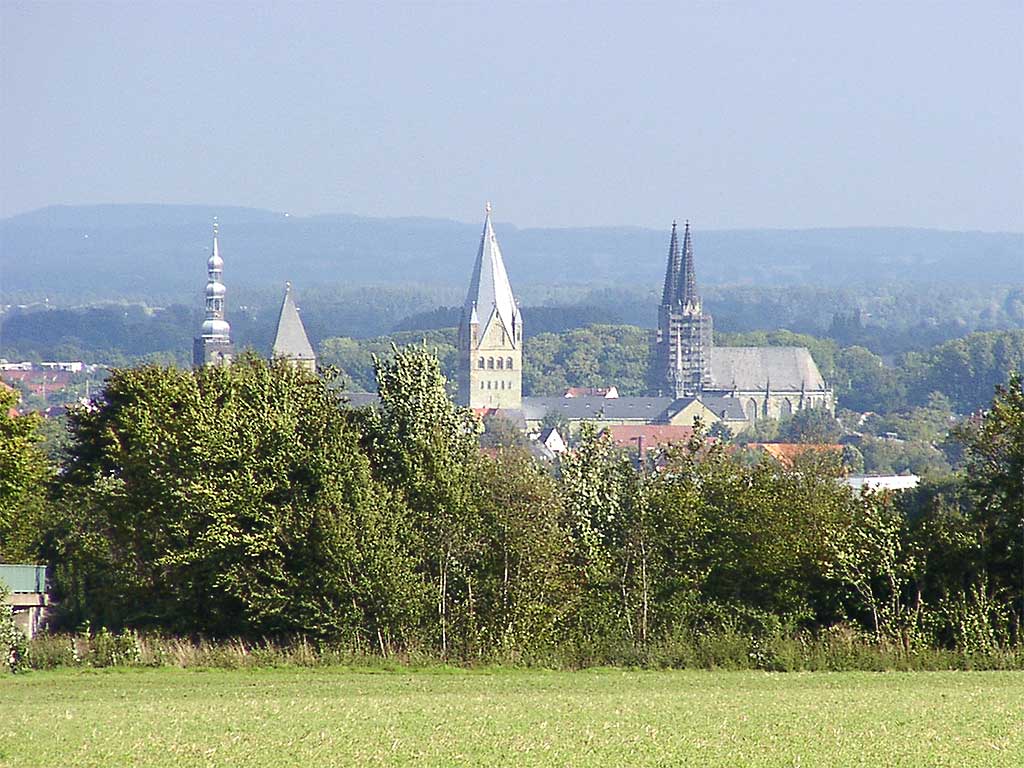 Unknown author / CC BY-SA 3.0, via Wikimedia Commons
Visite audio autoguidée de Soest — parcours GPS à pied, lecture hors ligne, narration en 32 langues.
“Là où le grès vert résonne des siècles de puissance hanséatique.”
Pas les cartes postales. Les histoires que même les habitants ignorent — soufflées à l'oreille, là où elles se sont passées.
Examinez les vitraux de la Wiesenkirche, et vous y découvrirez une représentation de la Cène pas comme les autres.
Soest possède un rempart médiéval qui offre bien plus qu'une simple perspective défensive.
Avant que l'Allemagne ne devienne une nation unifiée, le code juridique d'une petite ville a servi de modèle à des dizaines d'autres.
Découvrez tous les secrets de Soest
Chaque adresse, chaque révélation en entier — dans ton oreille, là où elle s'est passée.
Tu choisis tes lieux. Tu marches. La voix te révèle ce que les autres ignorent.


Votre visite audioguidée de Soest vous attend — choisissez vos lieux, votre langue, et lancez-vous dès votre arrivée.
AcheterLume intègre un guide en réalité augmentée. Levez votre téléphone : sa caméra montre la rue devant vous, avec une flèche lumineuse posée sur l'image réelle qui pointe toujours vers votre prochain arrêt — aucune carte à déchiffrer, aucun mauvais virage. Comme tout dans Lume, ça fonctionne entièrement hors-ligne.
Soest, une ville de Rhénanie-du-Nord-Westphalie, en Allemagne, offre un voyage à travers le temps. Avec des racines remontant à plus de 4 000 ans, elle est l'une des plus anciennes villes de Westphalie. Le centre historique de la ville présente un ensemble captivant de bâtiments en grès vert, de maisons à colombages et de ruelles sinueuses. Soest, avec une population d'environ 48 000 habitants, conserve une atmosphère agréable tout en servant de centre administratif.
Souvent décrite comme un musée à ciel ouvert, la structure urbaine médiévale de Soest a largement perduré à travers les siècles. Son grès vert distinctif, extrait localement, confère aux bâtiments une teinte reconnaissable et élégante. Ce caractère architectural unique, combiné à son importance historique, fait de Soest une destination fascinante pour ceux qui cherchent à apercevoir le passé de l'Allemagne.
## D'ancien établissement à puissance hanséatique L'histoire de Soest commence avec des preuves d'habitation remontant à plus de 4 000 ans, ce qui la place parmi les plus anciennes villes de Westphalie. La première mention écrite officielle de la ville, sous le nom de « villa Sosat », est apparue en 836 après J.-C. Sa situation stratégique sur la route commerciale du Hellweg, une artère vitale reliant le Rhin aux terres de l'Est, a alimenté sa prospérité précoce. Les sources de sel locales, souvent appelées « or blanc », ont encore stimulé sa puissance économique grâce à l'extraction et au commerce.
Aux XIe et XIIe siècles, Soest a prospéré, devenant l'une des plus grandes villes de Westphalie avec environ 10 000 habitants. Elle est devenue un membre important de la Ligue hanséatique, une puissante confédération commerciale médiévale. L'influence de Soest s'étendait au-delà du commerce ; son code municipal, le « Droit municipal de Soest », élaboré au XIIe siècle, a servi de modèle juridique à des dizaines d'autres communautés allemandes. Cette période de croissance a également vu la construction d'importantes églises romanes et gothiques, dont beaucoup ont été construites avec le grès vert local distinctif.
## La querelle de Soest et le déclin Entre 1444 et 1449, Soest a affirmé son indépendance vis-à-vis de l'archevêque de Cologne dans un conflit connu sous le nom de querelle de Soest. Bien que la ville se soit libérée avec succès, s'alignant sur le duc de Clèves, cela s'est avéré être une victoire à la Pyrrhus. Coupée de son ancien arrière-pays, Soest a connu une perte significative de population et d'influence au cours des siècles suivants, exacerbée par la guerre de Trente Ans. En 1756, sa population avait diminué pour atteindre seulement 3 600 habitants.
## L'ère moderne et la préservation Malgré son déclin, Soest a conservé une grande partie de son caractère médiéval et de la Renaissance, car elle n'a pas subi l'industrialisation extensive observée dans la région voisine de la Ruhr au XIXe siècle. La ville a subi des dommages lors des raids de bombardement alliés pendant la Seconde Guerre mondiale, ciblant particulièrement sa gare de triage, et a connu de violents combats début avril 1945. Cependant, de nombreuses maisons à colombages, de vieux bâtiments et des portions importantes des remparts de la ville ont survécu. Aujourd'hui, Soest est célébrée pour sa vieille ville remarquablement préservée, avec environ 600 bâtiments classés, offrant un lien tangible avec son passé glorieux.
Une visite à Soest est une immersion dans le charme médiéval, défini par son architecture unique en grès vert et ses sites historiques bien conservés. Commencez par une promenade le long du rempart de Soest, une fortification médiévale presque entièrement préservée qui entoure une grande partie de la vieille ville. Ce rempart bordé d'arbres offre des vues panoramiques sur le centre historique et est l'un des deux seuls remparts urbains praticables de ce type en Europe.
Dominant l'horizon se trouve la cathédrale Saint-Patrocle (St.-Patrokli-Dom), un exemple exceptionnel d'architecture romane. Sa puissante tour occidentale, souvent appelée la « Tour de Westphalie », sert de repère proéminent. À proximité, explorez la Wiesenkirche (église Sainte-Marie-des-Prés), un chef-d'œuvre de l'architecture gothique tardive, connue pour ses colonnes élancées et ses impressionnants vitraux, y compris la célèbre « Cène westphalienne ». Ne manquez pas l'Osthofentor, la seule porte de ville originale subsistante, qui abrite aujourd'hui un musée d'histoire de la ville.
Promenez-vous dans les ruelles étroites pour découvrir des centaines de maisons à colombages, dont beaucoup datent des XVe au XIXe siècles, contribuant au caractère pittoresque de la ville. Pour un moment de tranquillité, visitez le Bergenthalpark ou le Theodor-Heuss-Park, tous deux offrant des espaces verts dans le centre-ville. Le Burghofmuseum, situé dans l'un des plus anciens bâtiments résidentiels de la ville, offre un aperçu plus approfondi de l'histoire et de la culture de Soest.
La période idéale pour visiter Soest et profiter des activités par temps chaud s'étend de fin juin à début septembre. Pendant ces mois d'été, les températures diurnes moyennes varient de 22,5 °C à 23,4 °C (72,5 °F à 74,1 °F), avec des nuits apportant une fraîcheur agréable. Juillet est généralement le mois le plus chaud, avec une moyenne maximale de 23 °C (73 °F). Le printemps (mars à mai) et l'automne (septembre à novembre) offrent un temps doux et transitoire, parfait pour explorer avec moins de monde. Bien que les précipitations soient réparties tout au long de l'année, décembre a tendance à être le mois le plus humide et avril le plus sec.
Soest est située dans l'État de Rhénanie-du-Nord-Westphalie, à environ 50 kilomètres à l'est de Dortmund. L'aéroport international le plus proche est Düsseldorf (DUS), qui propose des liaisons ferroviaires directes vers Soest, d'une durée d'environ une heure. Francfort et Amsterdam sont d'autres aéroports internationaux, bien que plus éloignés. Le centre historique de Soest est compact et se prête le mieux à l'exploration à pied, vous permettant d'apprécier son architecture médiévale et ses charmantes rues. Les transports en commun sont disponibles dans la ville, bien que moins fréquents le week-end.
Les options d'hébergement vont des hôtels aux maisons d'hôtes. Pour les repas, explorez la cuisine westphalienne locale ; pendant la foire d'Allerheiligen Kirmes, essayez la spécialité locale, le Bullenauge. La ville offre une scène de pub animée, en particulier dans l'Altstadt, avec de nombreuses auberges historiques. Le coût de la vie mensuel moyen à Soest est d'environ 861 €, hébergement compris, ce qui est généralement plus abordable que dans d'autres régions d'Allemagne.
Soest en coréen, en chinois ou en hébreu — et dans 29 autres langues, chaque étape narrée par une voix native. La plus large gamme de langues de tous les audioguides autoguidés.
Disponible en :