Triangle of Three Emperors (Trójkąt Trzech Cesarzy)
Imagine standing at a single point where three of Europe's most powerful empires once converged.
Full story unlocks in the tour
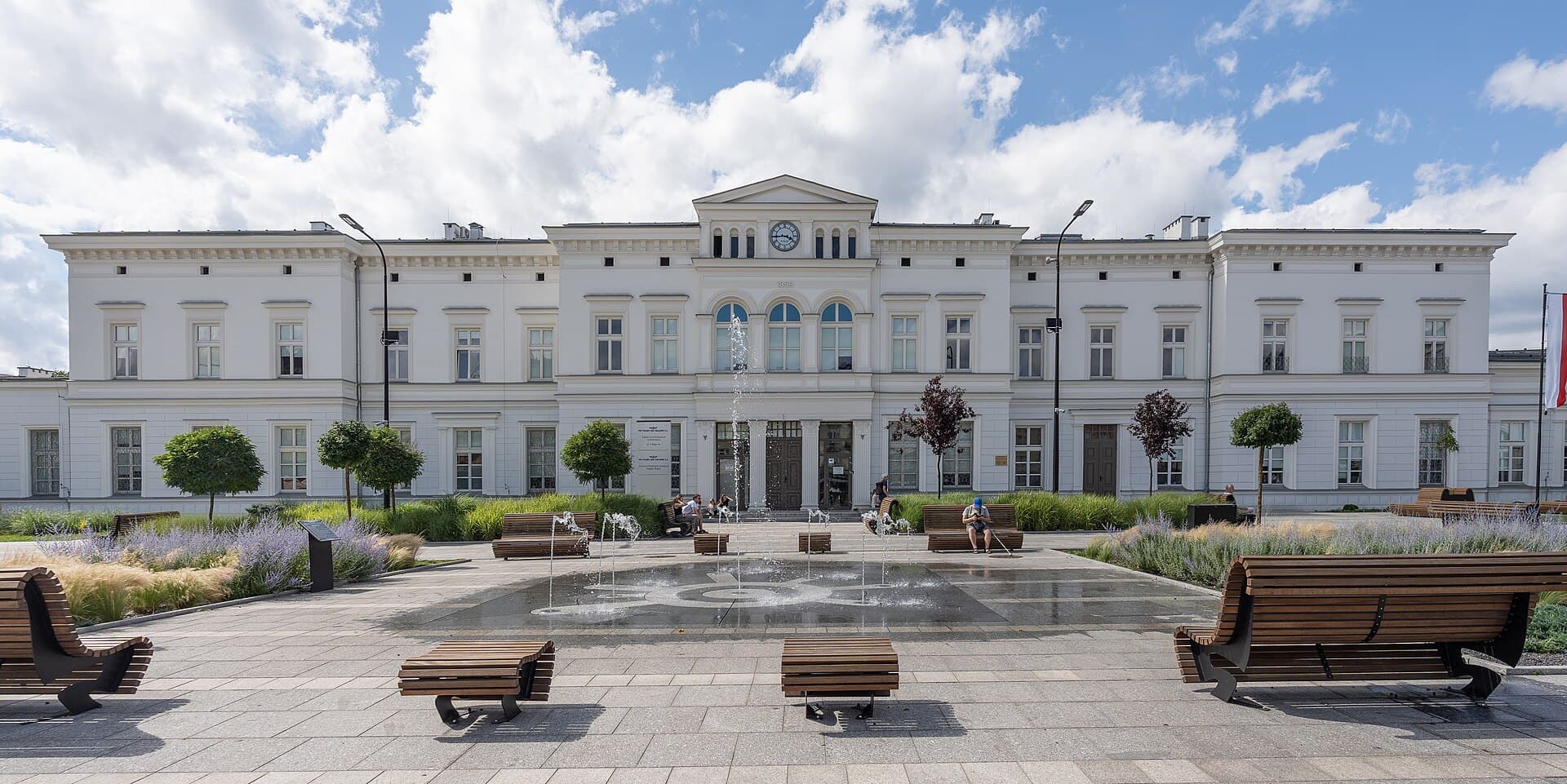 Krzysztof Popławski / CC BY 4.0, via Wikimedia Commons
Self-guided audio walking tour of Sosnowiec — GPS route, offline playback, story-driven narration in 32 languages.
“Where industrial might forged a city of unexpected elegance and a crossroads of empires.”
Not the postcards. The stories even locals don't know — whispered in your ear, right where they happened.
Imagine standing at a single point where three of Europe's most powerful empires once converged.
One of Poland's most opulent industrialist palaces conceals a surprising, world-renowned feature.
The oldest brick building in Sosnowiec holds a medieval secret within its walls.
Discover every secret of Sosnowiec
Every address, every reveal in full — in your ear, right where it happened.
You pick your stops. You walk. The voice reveals what the others miss.

Your self-guided audio tour of Sosnowiec is ready — pick your landmarks, choose your language, and start the moment you arrive.
BuyLume has a built-in augmented-reality guide. Hold your phone up and its camera shows the street ahead of you, with a glowing arrow laid over the real view that always points to your next stop — no map to puzzle over, no wrong turns. Like everything in Lume, it works fully offline.
Sosnowiec, in southern Poland's Dąbrowa Basin, is a city forged by industry and shaped by its unique position at the crossroads of historical empires. Often characterized by its industrial past, the city reveals a surprising blend of elegant palaces, green spaces, and a resilient spirit born from centuries of transformation. Once a collection of smaller settlements, Sosnowiec rapidly evolved into an industrial powerhouse in the 19th and early 20th centuries, driven by rich coal deposits and the arrival of the Warsaw-Vienna Railway.
Today, Sosnowiec is part of the larger Upper Silesian-Zagłębie Metropolis, a dynamic urban region that has diversified beyond heavy industry into education, logistics, healthcare, and services. While the towering factory chimneys and mines no longer dominate the skyline as they once did, their legacy is etched into the city's architecture, museums, and collective memory. This city offers a compelling narrative of ambition, resilience, and continuous reinvention, inviting visitors to explore its layered history and modern identity.
The earliest historical records mention Sosnowiec as a small rural settlement in 1227, part of the Polish Duchy of Kraków. For centuries, it remained a collection of independent villages like Sielce, Zagórze, and Milowice, with its location near the Przemsza rivers serving as an important local crossing point. The area's fortunes began to shift dramatically with the discovery of rich coal deposits in the early 19th century, transforming it into a burgeoning industrial center.
Rapid industrialization was further fueled by the construction of the Warsaw-Vienna Railway, a monumental project completed by 1869 that linked Sosnowiec with major markets across the Russian Empire. This railway not only transported coal but also attracted investment, encouraged migration, and spurred the development of ironworks, steel production, glassworks, and engineering factories. By the late 19th century, Sosnowiec found itself in a remarkable geopolitical position, at the "Triangle of Three Emperors," where the borders of the Russian, German, and Austro-Hungarian Empires converged. This unique location fostered a lively mix of cultures and languages, contributing to the city's distinctive identity.
Despite its rapid growth and a population of 60,000, Sosnowiec was only officially granted city rights in 1902 by Tsar Nicholas II, a delay attributed by some to local support for the Polish January Uprising of 1863-64. The interwar period saw intense development of its mining and steel industries.
The Second World War brought immense tragedy to Sosnowiec. German forces occupied the city in September 1939, initiating years of persecution and destruction. The city had a substantial Jewish population, approximately 26,000 to 29,000 people, who contributed significantly to its economic and cultural life. Under Nazi occupation, Jewish property was confiscated, and residents were forced into labor. The Sosnowiec Ghetto was established, and its inhabitants, along with Jews from neighboring Będzin, were subjected to horrific conditions and mass deportations to Auschwitz. By January 1944, the pre-war Jewish population had been almost entirely annihilated.
Following the war, Sosnowiec once again became a driving force of heavy industry during the communist era, attracting thousands of new residents and reaching its peak population of 259,000 in 1987. The political and economic changes of the 1990s marked another turning point, as many traditional industries declined. Sosnowiec has since diversified its economy, embracing education, logistics, healthcare, and retail, and continues to reinvent itself as a modern urban center within the Upper Silesian-Zagłębie Metropolis.
Sosnowiec offers a compelling blend of industrial heritage and unexpected architectural beauty. Begin at the Sielecki Castle, the city's oldest brick building, now home to the Sosnowiec Centre for Art, offering a glimpse into medieval history and contemporary exhibitions. Nearby, explore the grand residences of 19th-century industrialists. The Schoen Palace Museum, a magnificent Neo-Baroque mansion, showcases the city's past and the lives of its textile magnates. Do not miss the equally impressive Dietel Palace, known for its opulent interiors and a famously beautiful bathroom.
For a unique historical perspective, visit the Triangle of Three Emperors, a monument marking the former convergence of the Russian, German, and Austro-Hungarian Empires. The city also offers several green spaces, including Leon Kruczkowski Park with its Exotarium, recently modernized to feature diverse flora and fauna. The Zagłębie Mediateka offers a modern cultural hub with a vast collection of resources and events. Wander through the city center around Sosnowiec Główny, 3 Maja, and Modrzejowska streets to appreciate the mix of historic commercial buildings and modernist public architecture.
The best time to visit Sosnowiec for pleasant weather and outdoor activities is from May through September. During these months, temperatures are mild, and days are long, ideal for exploring the city's parks and architectural sights. For fewer crowds and potentially better value, consider visiting in May, early June, or September. July and August offer the warmest temperatures and a lively atmosphere, though popular areas might be busier. Winter, from November to February, brings cooler, sometimes snowy conditions, offering a different, quieter experience and often lower prices.
Sosnowiec is well-connected and easy to navigate. The city is part of the Upper Silesian-Zagłębie Metropolis and benefits from excellent transport links, including train services that connect various parts of the city and its surroundings. Sosnowiec Główny Station is a key hub for local and regional travel. Public transport, including trams and buses, provides convenient ways to get around.
For those arriving by air, Katowice Airport (Pyrzowice) is approximately 20 km away. Accommodation options range from hotels to guesthouses. The local cuisine offers traditional Polish dishes, and the city center, particularly around Małachowskiego Street, has a growing number of cafés, bars, and restaurants. While Polish is the official language, English may be understood in tourist-oriented establishments. The currency is the Polish Złoty (PLN).
Sosnowiec in Korean, in Chinese or in Hebrew — and 29 more languages, every stop narrated by a native voice. The widest language range of any self-guided audio tour.
Available in: