The Old Hanseatic Harbour
The grand wooden crane isn't merely a landmark; it's a portal to Stade's compelling past.
Full story unlocks in the tour
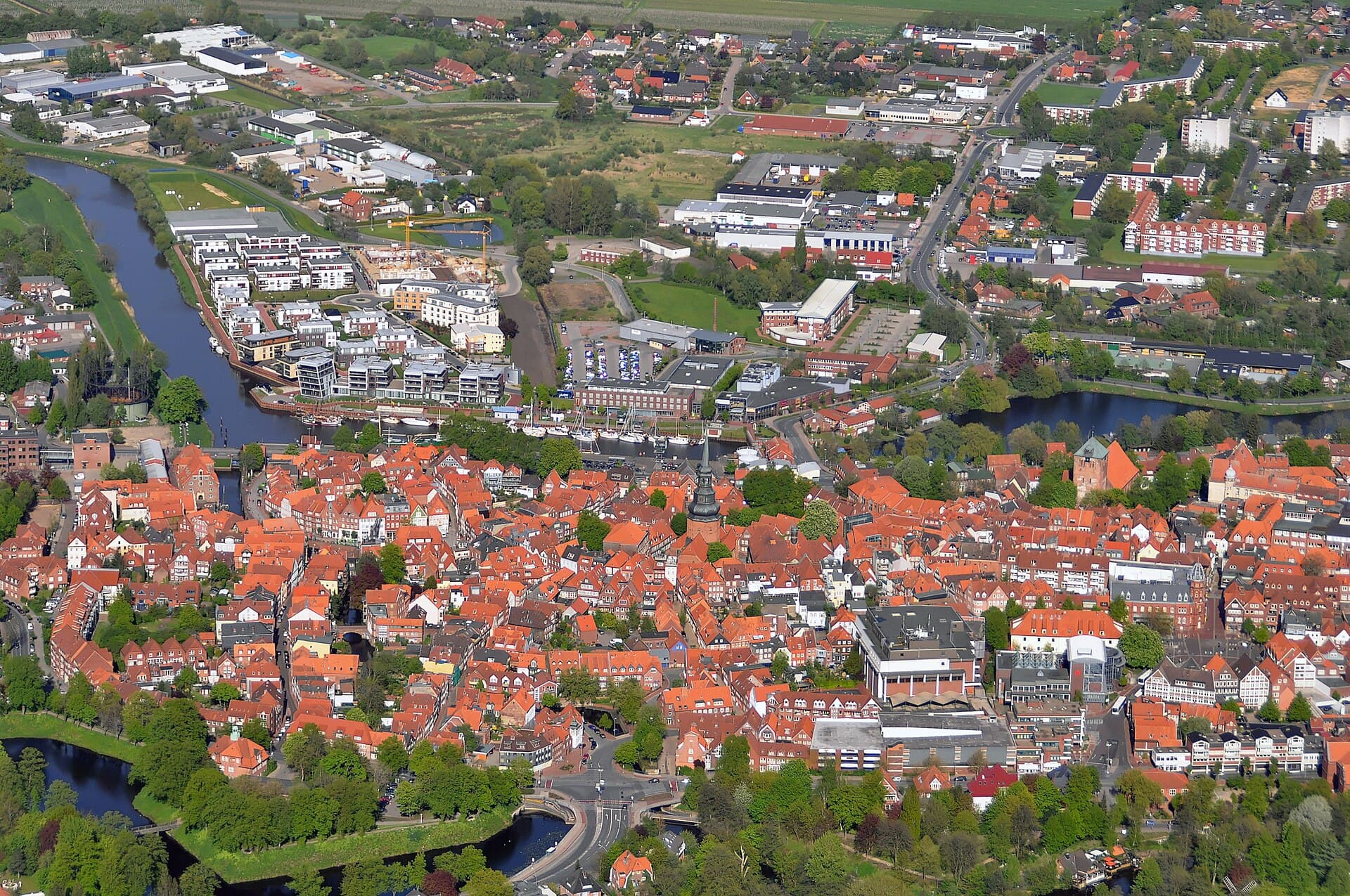 © Ra Boe / Wikipedia / CC BY-SA 3.0 de, via Wikimedia Commons
Self-guided audio walking tour of Stade — GPS route, offline playback, story-driven narration in 32 languages.
“Where Hanseatic history breathes through half-timbered lanes.”
Not the postcards. The stories even locals don't know — whispered in your ear, right where they happened.
The grand wooden crane isn't merely a landmark; it's a portal to Stade's compelling past.
Ascending the tower of St. Cosmae offers more than an expansive vista; it uncovers a secret about Stade's enduring spirit.
The 'Swedish Warehouse' safeguards more than artifacts; it narrates a story of shifting loyalties.
Discover every secret of Stade
Every address, every reveal in full — in your ear, right where it happened.
You pick your stops. You walk. The voice reveals what the others miss.


Your self-guided audio tour of Stade is ready — pick your landmarks, choose your language, and start the moment you arrive.
BuyLume has a built-in augmented-reality guide. Hold your phone up and its camera shows the street ahead of you, with a glowing arrow laid over the real view that always points to your next stop — no map to puzzle over, no wrong turns. Like everything in Lume, it works fully offline.
Stade, officially recognized as the Hanseatic City of Stade, is a city in Lower Saxony, Germany, positioned approximately 45 kilometers west of Hamburg. Situated along the Schwinge River, about 5 kilometers from its convergence with the Elbe River, Stade possesses a profound maritime legacy. The city offers an engaging destination for those seeking to immerse themselves in history and discover the allure of northern Germany.
The historic core of Stade is encircled by ramparts and moats, featuring narrow passageways and meticulously preserved half-timbered houses, some dating back to the 15th and 16th centuries. This evocative setting, often described as an 'extraordinary historic village,' invites visitors to wander at a relaxed pace, exploring its stone-paved streets and numerous points of interest. Stade's connection to the Elbe River via the Schwinge established it as an important trading port for over a thousand years.
Beyond its architectural splendor, Stade presents a lively cultural landscape with festivals, inviting cafés, and traditional shops. It provides an ideal counterpoint to the bustling metropolis of Hamburg, offering a memorable day trip or a tranquil extended stay. Stade is also a stop on the German Timber-Frame Road, underscoring its collection of historic timber-frame buildings.
The history of Stade extends to early settlements around 30,000 BC. The area evolved into an important trading location on the Schwinge River between the 7th and 10th centuries, with an early medieval castle, the Schwedenschanze, and a market featuring a jetty emerging in the 8th century. The first written mention of Stade, then named 'Stethu,' appears in 994 AD, following an attack by Vikings.
In the 10th century, the counts of Harsefeld constructed a castle on Spiegelberg hill, establishing a significant regional center. Stade's strategic position on the Elbe River swiftly transformed it into a major maritime hub. By the middle of the 13th century, a fixed harbor basin was created, and in 1267, Stade became an early member of the Hanseatic League. During its Hanseatic zenith, Stade was a thriving trading town, even surpassing Hamburg in significance for a period, and was integrated into Europe-wide trade networks.
The city's prosperity encountered difficulties, particularly during the Thirty Years' War. After various occupations, Stade came under Swedish administration from 1645 to 1712, becoming the capital of the Swedish province of Bremen-Verden. This era left an enduring architectural impression, with distinctive buildings like the Schwedenspeicher (Swedish Warehouse) still standing today. A catastrophic town fire in 1659 consumed more than two-thirds of Stade, but the city was reconstructed according to its original plan under Swedish governance.
Following Swedish administration, Stade passed to Denmark in 1712 and then to the Electorate of Hanover in 1715. It continued to serve as a regional capital. The city experienced further setbacks, including plague epidemics in 1355 and 1712, which significantly reduced its population. In the 20th century, Stade was connected to the national electricity supply in 1920 and largely spared from bombing raids during World War II, being liberated by British troops in May 1945.
In recent decades, Stade has seen growth in industries such as chemicals and aerospace, with companies like Dow Chemical and Airbus maintaining facilities in the area. Agriculture also remains an important sector, particularly in the nearby Altes Land, known as Central Europe's largest fruit-producing region.
Stade's historic Old Town (Altstadt) offers a delightful experience for exploration on foot, with its stone-paved streets and preserved half-timbered houses. The Old Hanseatic Harbour serves as a central point, lined with cafés, pubs, and shops, and features a replica of a medieval wooden crane. Here, you can also find the historic fish market square (Fischmarkt).
Explore the Schwedenspeicher Museum (Swedish Warehouse), a substantial red-brick edifice that once served as a garrison and now houses a museum dedicated to the city's history, including an exhibition on the Hanseatic League. For sweeping views of the timber-frame rooftops and the surrounding Altes Land, ascend the tower of the Church of St. Cosmae et Damiani, a 13th-century church with an impressive octagonal crossing tower. Another notable church is St. Wilhadi Church, with its leaning tower.
Beyond the city center, consider an excursion to the Altes Land, Central Europe's largest fruit-producing region, especially appealing during apple harvest season in autumn or when the orchards are in bloom in spring. Boat tours on the Schwinge and Elbe rivers provide a distinct perspective of Stade and its maritime surroundings.
The most agreeable time to visit Stade for warm-weather activities extends from late June to early September. During these months, average high temperatures hover around 71°F (22°C), and skies are clearest. Spring (April–June) and fall (September–October) also present pleasant weather, fewer crowds, and various local festivals. Rainfall occurs throughout the year, with July typically being the wettest month and April the driest. Winters are cold, with average lows around 31°F (0°C) in February.
Stade is readily accessible, situated approximately an hour northwest of Hamburg. You can reach it by car, via the S-Bahn (S3 line), or by regional trains. For those arriving by air, Hamburg Airport (HAM) is the closest option, about 34.5 km away, with taxi or transfer services available. The city is compact, and its historic center is best explored on foot. Bicycles also offer a popular way to explore, especially for venturing into the Altes Land.
Complimentary Wi-Fi is often available in cafés and hotels. Public transportation within the Hamburg Transport Association (HVV) network, which includes Stade, can be managed with the HVV app. When interacting with locals, a simple 'Moin' (a local greeting) is customary in shops and cafés. It's wise to carry an umbrella or raincoat, as rain can occur throughout the year.
Stade in Korean, in Chinese or in Hebrew — and 29 more languages, every stop narrated by a native voice. The widest language range of any self-guided audio tour.
Available in: