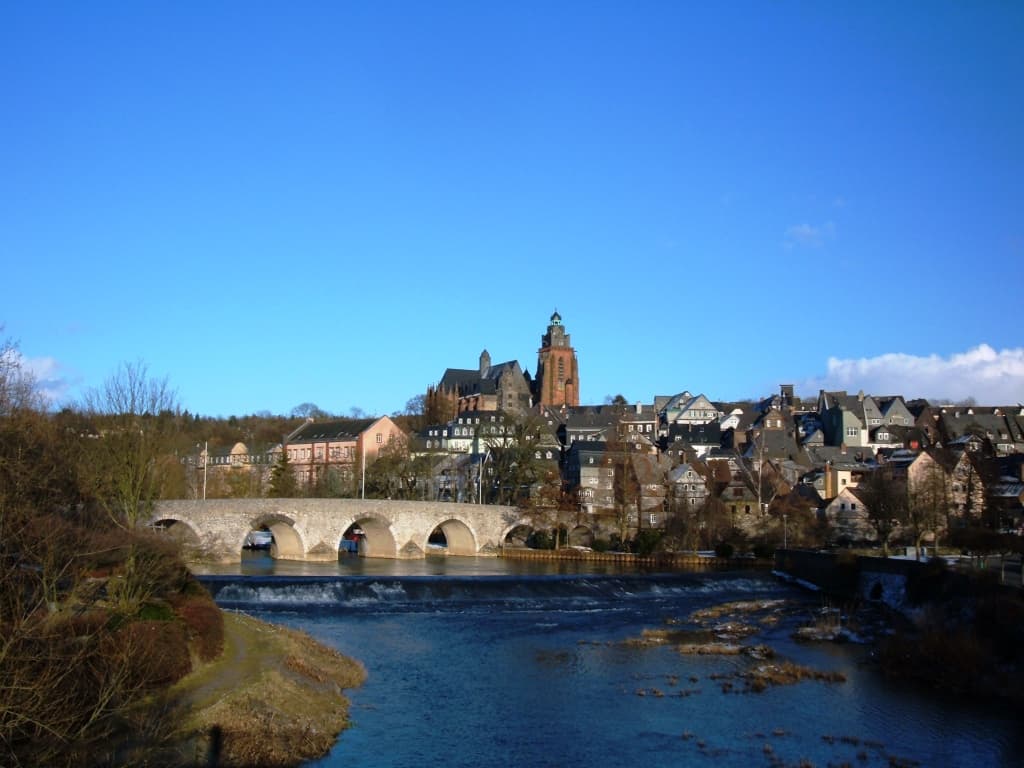
Before he became a titan of letters, a youthful Goethe found himself in Wetzlar, caught in a romantic entanglement that would spark one of his most celebrated works. Yet, the true narrative of his muse is more intricate than the novel suggests.
Krusto / CC BY 2.0 de, via Wikimedia CommonsWetzlar
Self-guided audio walking tour of Wetzlar — GPS route, offline playback, story-driven narration in 32 languages.
“Where precision lenses illuminate ancient stones, and every corner holds a quiet revelation.”
Wetzlar, as no one tells it.
Not the postcards. The stories even locals don't know — whispered in your ear, right where they happened.
The charming half-timbered houses of Wetzlar's Old Town conceal a peculiar detail about their construction, a testament to the resourcefulness of medieval builders and the difficulties they navigated.
The calm Lahn River, flowing through Wetzlar, maintains an unexpected link to the city's industrial past, showcasing how natural resources were harnessed in inventive ways.
Discover every secret of Wetzlar
Every address, every reveal in full — in your ear, right where it happened.
You pick your stops. You walk. The voice reveals what the others miss.
How long do you have in Wetzlar?
Your self-guided audio tour of Wetzlar is ready — pick your landmarks, choose your language, and start the moment you arrive.
BuyThe story of Wetzlar
Wetzlar, a city in the German state of Hesse, offers a compelling blend of historical depth and optical innovation. Situated along the Lahn River, it reveals an inviting Altstadt (Old Town) with winding lanes and beautifully preserved half-timbered houses. The city is widely recognized as a cradle of modern optics, home to pioneering companies like Leica Camera. This singular combination of a medieval past and a technologically advanced present cultivates a distinct atmosphere, inviting visitors to uncover its many layers of history and discovery.
Beyond its architectural and industrial heritage, Wetzlar also occupies a significant position in German literature. It was here that Johann Wolfgang von Goethe, during his time as a young intern at the Imperial Chamber Court, found the inspiration for his influential novel, The Sorrows of Young Werther. This literary connection adds another dimension to the city's allure, drawing those interested in the origins of romanticism and German cultural history.
From Imperial Court to Optical Hub
Wetzlar's documented history reaches back to the 9th century, with its first mention in 897. Its strategic location at the confluence of the Lahn and Dill rivers, and at the crossing of important trade routes, contributed to its early development. By 1180, Emperor Frederick I Barbarossa granted Wetzlar the designation of a Free Imperial City, a status that afforded it considerable autonomy and direct allegiance to the Holy Roman Emperor. This era saw the construction of its impressive cathedral, the Wetzlarer Dom, a testament to its medieval prosperity and influence.
The city's importance reached its zenith between 1693 and 1806, when it served as the seat of the Imperial Chamber Court (Reichskammergericht), one of the two supreme courts of the Holy Roman Empire. This brought a considerable influx of legal professionals, administrators, and their entourages, profoundly shaping Wetzlar's urban fabric and intellectual life. It was during this period that a young Johann Wolfgang von Goethe spent time in Wetzlar, an experience that would later fuel his literary masterpiece, The Sorrows of Young Werther.
With the dissolution of the Holy Roman Empire in 1806, Wetzlar lost its status as an Imperial City and the Imperial Chamber Court was disbanded. The city experienced a period of decline before a new chapter unfolded in the 19th century with the rise of industrialization. The development of precision mechanics and optics became a defining characteristic of Wetzlar. Ernst Leitz established his optical workshop in 1869, which would later become Leica Camera, transforming photography with the introduction of the 35mm camera. Other optical companies followed, solidifying Wetzlar's standing as a global center for optical technology. This industrial transformation revitalized the city, blending its deep historical foundations with cutting-edge innovation that continues to this day.
Begin your exploration at the Wetzlarer Dom, a singular cathedral that displays a compelling fusion of Romanesque and Gothic architectural styles, a consequence of centuries of construction and modification. Stroll through the Altstadt (Old Town), where narrow, uneven lanes lead past beautifully preserved half-timbered houses, many dating back to the Imperial Chamber Court era. Visit the Lottehaus, the former residence of Charlotte Buff, which now functions as a museum dedicated to her life and Goethe's time in Wetzlar. The Stadtmuseum (City Museum) offers a thorough overview of Wetzlar's history, from its medieval origins to its industrial development. For those intrigued by the city's optical heritage, the Leica Welt (Leica World) provides insights into the history of photography and the iconic camera brand, including a museum and factory tours.
Wetzlar offers a pleasant experience throughout the year, but the spring (April to June) and autumn (September to October) months provide the most comfortable weather for exploring the Old Town and enjoying walks along the Lahn River. During these periods, temperatures are mild, and the city's parks and surrounding landscapes are particularly inviting. Summer (July and August) can be warm, ideal for outdoor activities, while winter (November to March) brings a quieter atmosphere, with potential for festive markets around the holidays.
Wetzlar is readily accessible by train, with regular connections to major German cities. The main train station is a short walk or bus ride from the Altstadt. For those driving, several parking garages are available on the periphery of the Old Town. The city center is largely designed for pedestrians, making it ideal for walking tours. Public transportation within Wetzlar consists primarily of a bus network. Most shops and restaurants accept major credit cards, though it is always prudent to carry some cash for smaller purchases. English is spoken in establishments catering to tourists, but learning a few basic German phrases will enrich your journey.
- What is Wetzlar most recognized for?
- Wetzlar is most recognized for its optical industry, particularly as the home of Leica Camera, and for its historical significance as the seat of the Imperial Chamber Court and an inspiration for Goethe's 'The Sorrows of Young Werther'.
- Is Wetzlar a city where one can walk easily?
- Yes, Wetzlar's Old Town is very walkable, with most major attractions within convenient walking distance of each other.
- What is the Wetzlarer Dom?
- The Wetzlarer Dom is the city's cathedral, notable for its unique architectural blend of Romanesque and Gothic styles due to its long construction period.
- Are there any literary connections in Wetzlar?
- Yes, Wetzlar is famously connected to Johann Wolfgang von Goethe, who was inspired to write 'The Sorrows of Young Werther' during his time in the city. The Lottehaus museum commemorates this connection.
- What can I experience at Leica Welt?
- Leica Welt offers a museum detailing the history of photography and Leica cameras, a retail space, and opportunities for factory tours to observe the production process.
- What kind of food should I seek out in Wetzlar?
- While Wetzlar does not have a specific regional dish, you can find traditional Hessian cuisine, including 'Ahle Wurst' (cured sausage), 'Handkäse mit Musik' (sour milk cheese with onions), and various substantial meat dishes.