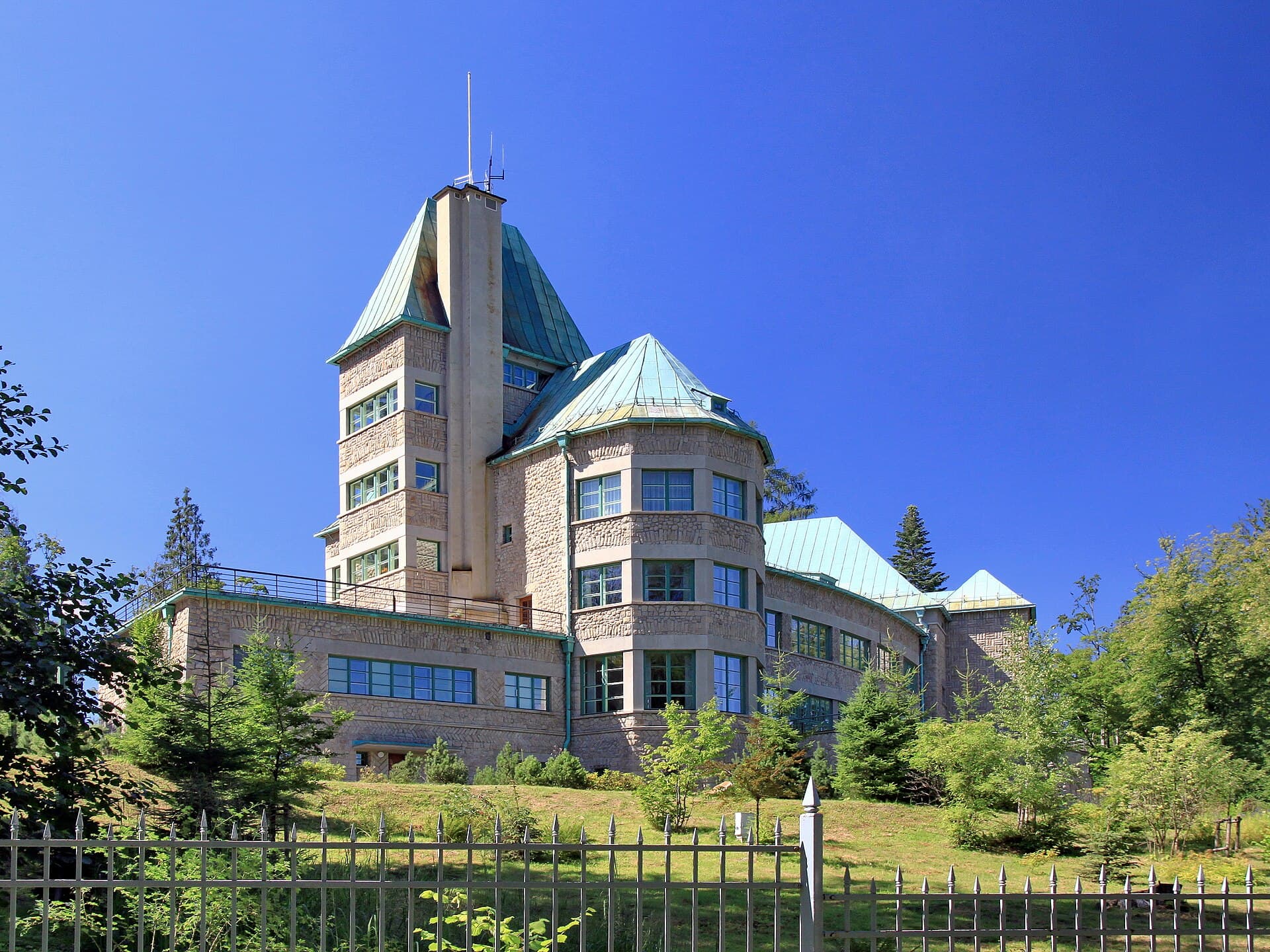
Source of the Vistula River on Barania Góra
The mighty Vistula River, the longest in Poland, doesn't begin with a grand gush, but something far more humble and surprising.
Full story unlocks in the tour
 Hons084 / CC BY-SA 3.0 pl, via Wikimedia Commons
Self-guided audio walking tour of Wisła — GPS route, offline playback, story-driven narration in 32 languages.
“Where Poland's longest river begins, and a champion's legend was forged.”
Not the postcards. The stories even locals don't know — whispered in your ear, right where they happened.
The mighty Vistula River, the longest in Poland, doesn't begin with a grand gush, but something far more humble and surprising.
Before it became a modern arena for international competitions, the famous Malinka ski jump had a quirky safety feature.
Amidst the highland pubs and local crafts, you might encounter a surprising figure, crafted from an unexpected medium.
Discover every secret of Wisła
Every address, every reveal in full — in your ear, right where it happened.
You pick your stops. You walk. The voice reveals what the others miss.
Your self-guided audio tour of Wisła is ready — pick your landmarks, choose your language, and start the moment you arrive.
BuyLume has a built-in augmented-reality guide. Hold your phone up and its camera shows the street ahead of you, with a glowing arrow laid over the real view that always points to your next stop — no map to puzzle over, no wrong turns. Like everything in Lume, it works fully offline.
Wisła, often called the "Pearl of the Beskid Mountains," is a picturesque town in southern Poland, cradled within the Silesian Beskids range. It is known for being the origin of Poland's longest river, the Vistula (Wisła in Polish), which begins its journey from the slopes of Barania Góra. This mountain town, close to the Czech Republic and Slovakia, is a popular year-round destination, offering both serene natural beauty and a lively atmosphere.
Beyond its landscapes of forests, meadows, and gentle mountain slopes, Wisła is a hub for outdoor enthusiasts. In winter, it transforms into a bustling ski resort with numerous lifts and slopes, while in warmer months, it is a paradise for hikers and cyclists. The town's unique character is also shaped by its strong Silesian highlander culture and a distinctive religious heritage, being the only town in Poland with a majority Lutheran population.
The history of Wisła is intimately linked with its namesake, the Vistula River. The first documented mentions of the settlement date back to the early 17th century, around 1615, appearing in the land registers of the Duchy of Teschen. The town emerged as a small village during the colonization of mountain valleys, with legends suggesting early settlers chose the location due to its proximity to the Vistula's clear springs.
Wisła's location deep within the Silesian Beskids meant it remained relatively isolated for a considerable period. This geographical remoteness played a crucial role in preserving a unique way of life among its residents, known as Vistula Highlanders. Their distinct culture is evident in their traditional wooden architecture, folk costumes, and folklore. The harsh climate and rocky soil limited agriculture, making logging and sheep farming the primary occupations.
A significant and distinguishing cultural feature of early Wisła was the prevalence of Protestantism, specifically Lutheranism. Despite centuries of rule by the Catholic Habsburgs, the local population, aided by their isolation, maintained their faith. This shaped a unique mentality and fostered a high level of literacy, as reading the Bible was a central practice in every household. Even today, Wisła remains the only town in Poland with a majority Lutheran population.
The town's transformation into a popular tourist destination began in the second half of the 19th century. The arrival of ethnographer Bogumił Hoff and the subsequent work of Julian Ochorowicz were catalysts, leading to the construction of the first wooden villas in styles inspired by Swiss and Zakopane architecture. In 1915, Wisła was officially designated a summer resort by the national government, and during the interwar period (1918-1939), it quickly grew into a fashionable holiday spot. The opening of a railway line in 1929 further enhanced its accessibility for tourists. Following World War II, the development continued, boosted by improved infrastructure like gas, electricity, and better road and rail connections. Wisła was finally granted civic rights in 1962.
In recent decades, Wisła has gained international recognition as the hometown of Adam Małysz, one of Poland's most successful ski jumpers. His phenomenal achievements, particularly in the early 2000s, sparked "Małyszomania" across Poland and significantly contributed to the town's fame and development, attracting both tourists and investors. The Adam Małysz Ski Jumping Hill in Malinka, originally built in 1933, was completely reconstructed and named in his honor in 2008.
Wisła offers a blend of natural beauty and cultural attractions. Begin your exploration at the Market Square (Plac Hoffa), a lively area with highland pubs, stalls selling local handicrafts, and the Spa House, where you can marvel at the unique white chocolate sculpture of ski jumper Adam Małysz.
For history buffs, the Presidential Castle in Wisła is a modernist architectural marvel from the 1930s, offering insights into Polish heritage. Nearby, the Habsburg's Hunting Castle houses the local tourist information office and even an escape room. Delve into local traditions at the Beskid Museum, showcasing agricultural tools, folk costumes, and traditional instruments like goatskin bagpipes.
Nature lovers will be drawn to the source of the Vistula River on Barania Góra, a significant natural landmark. The scenic Kaskady Rodła, often called the "Vistula Niagara," are impressive waterfalls on the Biała Wisełka River, accessible via hiking trails. For expansive views, take a chairlift to Skolnity or a cable car to Stożek.
Sports enthusiasts shouldn't miss the Adam Małysz Ski Jumping Hill in Malinka, a modern facility that hosts international competitions. You can also visit the Adam Małysz Trophy Gallery to see his impressive collection of medals and memorabilia.
Wisła is a year-round destination, with its appeal shifting with the seasons. For warm-weather activities like hiking and cycling, the best time to visit is from May through September, with peak tourism in early July to late August when the weather is most favorable for outdoor activities. During these months, you can enjoy cultural events like the Beskid Culture Week.
For winter sports enthusiasts, December to March offers ideal conditions for skiing and snowboarding, with over 20 ski lifts and well-maintained slopes. The quieter months of November through February can also offer fewer crowds and better value, along with a chance for snow.
Wisła is well-connected and offers a variety of accommodation options. You can reach Wisła by train, with two main stations: Wisła Uzdrowisko and Wisła Głębce. Direct bus connections are available from cities like Bielsko-Biała, Katowice, and Kraków. If flying, John Paul II Kraków Airport (KRK) is the closest major airport, approximately 82 km away, from which you can rent a car or take ground transport.
The town offers a wide range of lodging, from hotels and guesthouses to boarding houses and private accommodations, with over 12,000 beds available in more than 400 locations. While the town center is walkable, a rental car can provide flexibility for exploring the wider Beskid region and its numerous valleys. Local transportation options are also available.
Wisła in Korean, in Chinese or in Hebrew — and 29 more languages, every stop narrated by a native voice. The widest language range of any self-guided audio tour.
Available in: