Wodzisław Śląski's Founding
The precise moment Wodzisław Śląski became a city remains a historical puzzle.
Full story unlocks in the tour
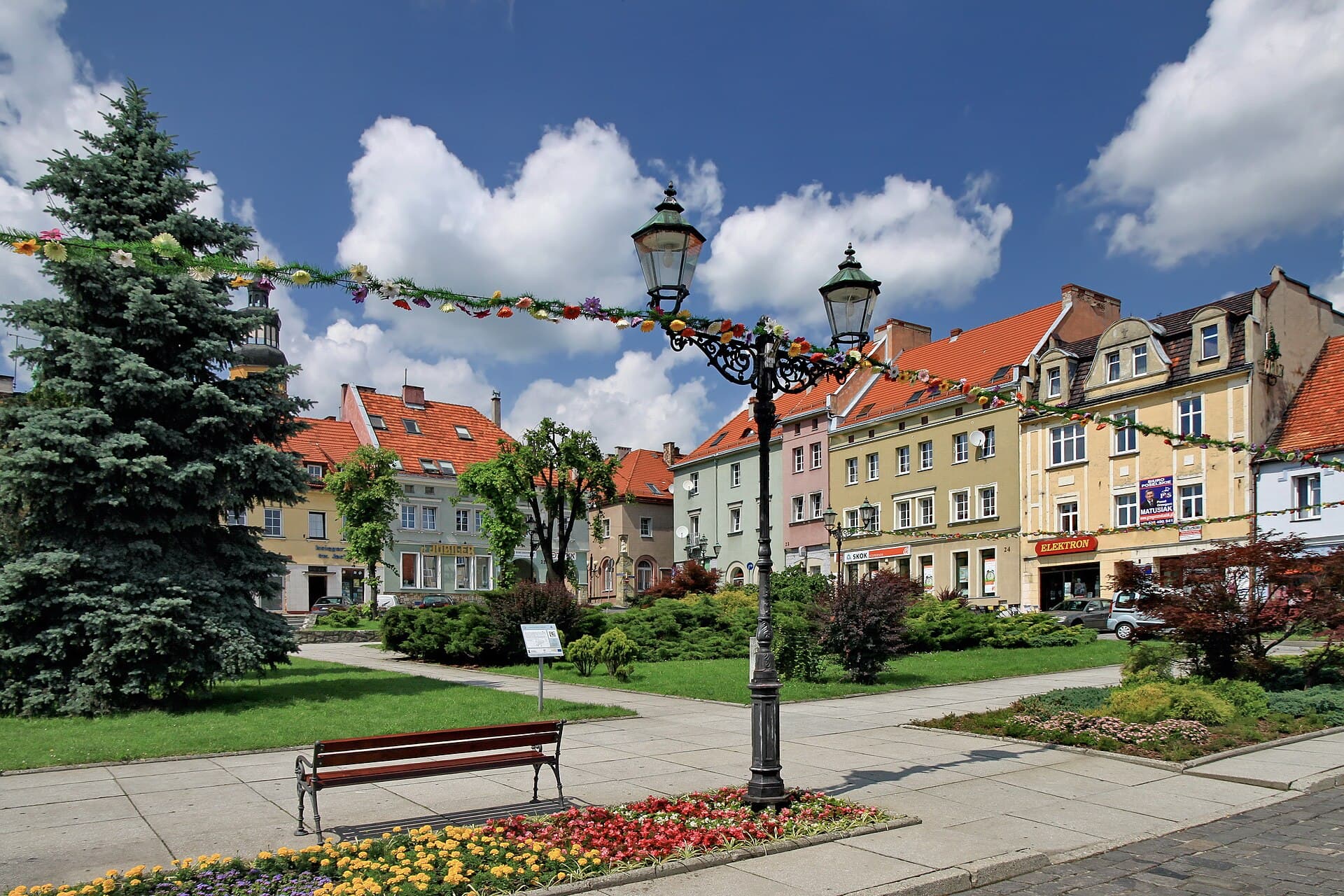 Hons084 / CC BY-SA 3.0 pl, via Wikimedia Commons
Self-guided audio walking tour of Wodzisław Śląski — GPS route, offline playback, story-driven narration in 32 languages.
“Where Silesian resilience meets medieval origins and unexpected green expanses.”
Not the postcards. The stories even locals don't know — whispered in your ear, right where they happened.
The precise moment Wodzisław Śląski became a city remains a historical puzzle.
Discover every secret of Wodzisław Śląski
Every address, every reveal in full — in your ear, right where it happened.
You pick your stops. You walk. The voice reveals what the others miss.
Your self-guided audio tour of Wodzisław Śląski is ready — pick your landmarks, choose your language, and start the moment you arrive.
BuyLume has a built-in augmented-reality guide. Hold your phone up and its camera shows the street ahead of you, with a glowing arrow laid over the real view that always points to your next stop — no map to puzzle over, no wrong turns. Like everything in Lume, it works fully offline.
Wodzisław Śląski, a city in southern Poland's Silesian Voivodeship, offers a compelling blend of deep history and unexpected green spaces. Situated near the Czech border, it's a place where medieval origins, chronicled as early as the 12th century, intertwine with the industrial legacy of the Upper Silesian Coal Basin. While its past is marked by significant events, from Tatar incursions to periods of Prussian rule, the city today presents a welcoming atmosphere with a well-preserved historic core.
Often overlooked in favor of larger Polish destinations, Wodzisław Śląski holds its own with a unique urban layout, including one of the largest market squares in the Silesian region. Beyond its historical landmarks, the city is surrounded by picturesque landscapes and offers various recreational opportunities, inviting visitors to explore its cultural heritage and enjoy active leisure.
The origins of Wodzisław Śląski can be traced back to the 10th and 11th centuries, when three distinct Slavic settlements occupied its present-day territory. These eventually merged, laying the groundwork for the town's future. The city's name is derived from the Piast Duke Władysław of Opole, who played a pivotal role in its development. He established a monastery around 1257 and, at some point before this year, Wodzisław was incorporated under Magdeburg Law, granting it city status.
As a borderland town, Wodzisław Śląski's history is a complex narrative shaped by various influences and challenges. In 1241, the area faced a Tatar attack, which likely resulted in the burning of the former settlement. Despite this, local legends recount how peasants successfully repelled a Tatar unit, a testament to the community's resilience. A significant fire in 1280 destroyed many of the city's wooden houses, but Wodzisław was rebuilt by 1299, with craftsmen and traders forming the backbone of its economy.
Over the centuries, Wodzisław Śląski experienced numerous shifts in power. From 1327, it became a county under the Czech crown, later passing through the hands of various Czech and German officials. In 1740, much of Silesia, including Wodzisław, was annexed by the Kingdom of Prussia, a change recognized by Austria in 1763. The 19th century marked the growing importance of coal mining for the city's economy. After World War I, following the Silesian Uprisings, Wodzisław was returned to a newly independent Poland in 1922.
The outbreak of World War II saw Wodzisław invaded and occupied by Germany in 1939. The war left much of the city's industrial infrastructure destroyed. A particularly dark chapter in its history is the "death march" from Auschwitz concentration camp in January 1945, which ended in Wodzisław Śląski, where prisoners were then transported by freight trains to other camps. Post-war, extensive reconstruction efforts transformed Wodzisław Śląski into a significant industrial and transportation hub once again, with its economy rooted in coal mining, coke production, and food processing.
Begin your exploration at the Market Square (Rynek), one of the largest in Silesia, where historic tenement houses, reconstructed after an 1822 fire, frame a lively public space. Adjacent to the square, you'll find the Dietrichstein Palace, a striking example of Classicist architecture from the 18th century, which now houses the City Museum. Observe the Church of the Assumption of the Blessed Virgin Mary, rising above the market square, its current Neo-Gothic form dating from 1909-1911 on the site of earlier churches.
For a touch of local legend and expansive views, make your way to the Grodzisko and its Knight's Tower (Baszta Rycerska). This Neo-Gothic tower, once part of a hunting lodge, offers a vantage point from which, on a clear day, you can discern the Sudetes mountains. The area itself is tied to ancient Slavic settlements and a local account of repelling a Tatar invasion. For outdoor recreation, explore the Family Amusement Park 'Trzy Wzgórza' (Three Hills) or cycle along sections of the Iron Bicycle Trail, which utilizes former railway lines.
The most agreeable weather for exploring Wodzisław Śląski typically occurs from May through September, offering warm days ideal for outdoor activities and sightseeing. July is generally the sunniest month. For those preferring fewer crowds and potentially better value, the quieter months of December through March offer a chance to experience the city with cooler temperatures. Winters are cold, with freezing nights in January.
Wodzisław Śląski is well-connected by train, with Wodzisław Śląski Station serving as a main hub for exploring the city and its surroundings. The city is also conveniently located near three international airports: Katowice-Pyrzowice (about 80 km), Kraków-Balice (about 100 km), and Ostrava-Mošnov (about 45 km). The city itself has 8 roundabouts, indicating a modern road network. For local information and promotional materials, visit the Tourist Information Point. While many hotels offer flexible booking options, it's always advisable to check cancellation policies. The local currency is the Polish Złoty (PLN).
Wodzisław Śląski in Korean, in Chinese or in Hebrew — and 29 more languages, every stop narrated by a native voice. The widest language range of any self-guided audio tour.
Available in: