Bancroft Tower
A miniature feudal castle watches over Worcester, but it wasn't built for a king or queen.
Full story unlocks in the tour
 Quintin Soloviev / CC BY 4.0, via Wikimedia Commons
Self-guided audio walking tour of Worcester — GPS route, offline playback, story-driven narration in 32 languages.
“Beyond the triple-deckers and industrial grit, Worcester holds a surprising collection of American firsts and curious tales.”
Not the postcards. The stories even locals don't know — whispered in your ear, right where they happened.
A miniature feudal castle watches over Worcester, but it wasn't built for a king or queen.
The spark of the American Revolution might have ignited here, not Lexington or Concord.
The father of modern rocketry and the father of psychoanalysis both found a home here.
Discover every secret of Worcester
Every address, every reveal in full — in your ear, right where it happened.
You pick your stops. You walk. The voice reveals what the others miss.
Your self-guided audio tour of Worcester is ready — pick your landmarks, choose your language, and start the moment you arrive.
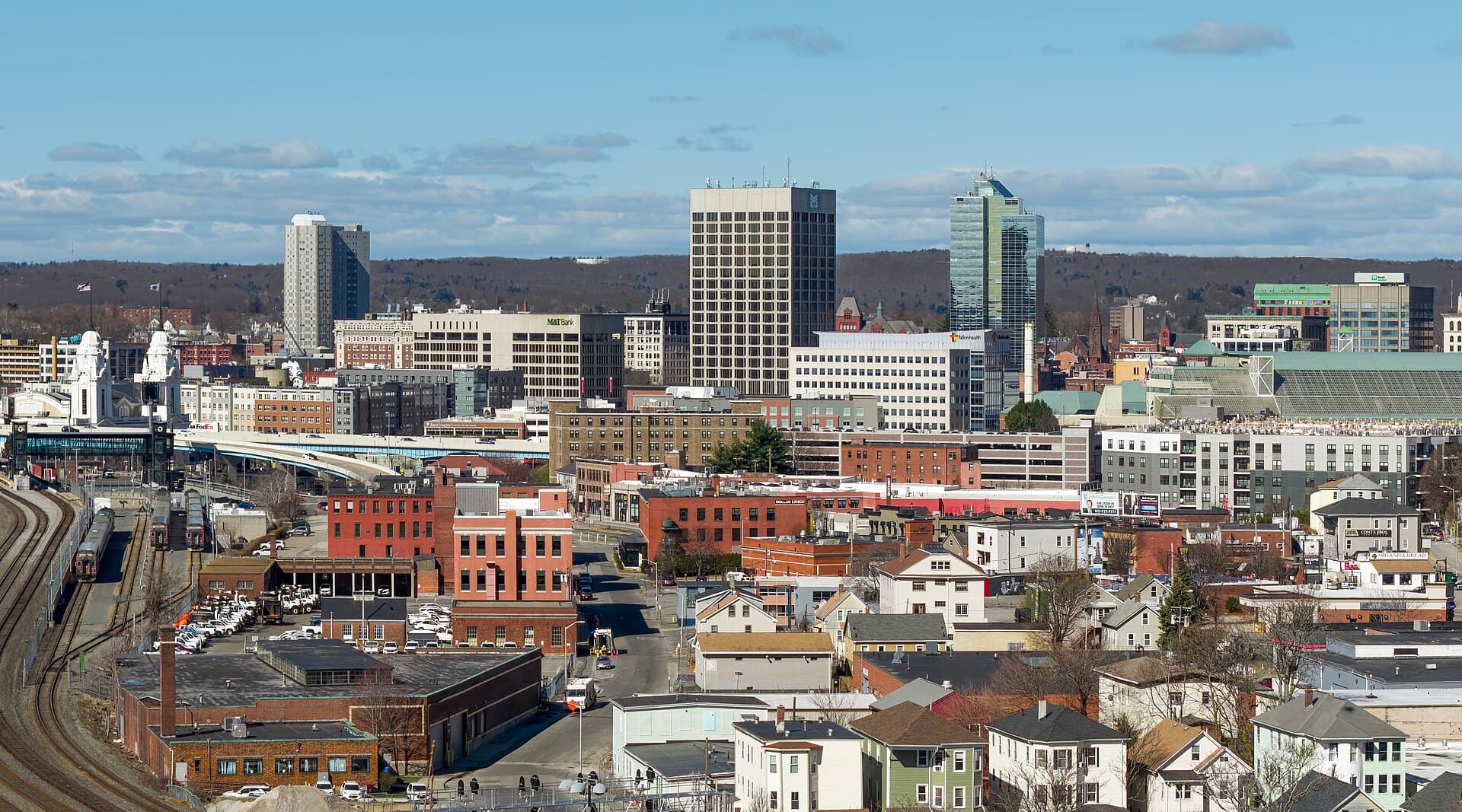
BuyWorcester, often called the "Heart of the Commonwealth" due to its central location in Massachusetts, is the state's second-most populous city. While its name might be a bit of a tongue-twister for outsiders (locals pronounce it 'WUSS-ter'), this dynamic city is far more than just a waypoint between Boston and Springfield.
Beyond its industrial past, Worcester is reinventing itself as a hub for healthcare, biotechnology, and higher education, supporting an array of colleges and research institutions. From significant historical "firsts" to unexpected cultural contributions, Worcester offers a rich array of experiences for those willing to look beyond the surface.
The area now known as Worcester was originally the ancestral homeland of the Nipmuc people, who lived in scattered villages. The first European settlement attempts, initially named Quinsigamond Plantation in 1673 and later Worcester in 1684, were twice abandoned due to hostility from the Nipmuc people during conflicts like King Philip's War. The third and permanent colonization began in 1713, and the town was officially incorporated in 1722.
Worcester played a pivotal role in the political development of the United States. In July 1776, the Declaration of Independence was first publicly read in Massachusetts in Worcester by pamphleteer Isaiah Thomas, whose words helped unite opposition to the British. The city was also active in Shays' Rebellion, a revolt against excessive land taxation that contributed to the creation of the U.S. Constitution. Notably, some historians argue that the first true revolt against British authority in the American Revolution occurred in Worcester in September 1774, when thousands of residents peacefully seized control of the government, effectively ending Royal authority in the county.
Major industrial development began in Worcester after the opening of the Blackstone Canal in 1828, which linked the city to Providence, Rhode Island. This, along with the arrival of the railroad in 1835, transformed Worcester into a bustling transportation and manufacturing hub. The city flourished with factories producing textiles, wire, machinery, and envelopes, attracting waves of European immigrants. By the early 20th century, Worcester was a significant manufacturing center, with companies like Washburn & Moen becoming the largest wire manufacturer in the country.
After World War II, manufacturing declined, leading to an economic and population downturn. However, Worcester began a resurgence in the 1990s, driven by growth in higher education, medicine, and biotechnology, with the establishment of the Massachusetts Biotechnology Research Park in 1987. Today, Worcester continues to evolve, balancing its historical legacy with a forward-looking focus on innovation and education.
Worcester has been a hotbed of invention and social reform. The city hosted the first national women's rights convention in 1850, an event that attracted over 1,000 suffrage supporters and featured prominent figures like Susan B. Anthony. Inventions originating in Worcester include the monkey wrench (1840), the first commercial valentine card (1847), the steam calliope (1855), and even the iconic smiley face (1963).
The city also played a crucial role in the early days of rocketry. Robert H. Goddard, a Worcester native and professor at Clark University, is credited with inventing the first liquid-fueled rocket, which he successfully launched in nearby Auburn in 1926. Worcester's innovative spirit extends to its architecture, with the Higgins Armory, built in 1929, being one of the first buildings in the nation to feature a steel and glass exterior.
Begin your exploration at the Worcester Art Museum, which houses a collection of nearly 38,000 objects, including Roman mosaics and European, American, and Japanese art. For a deeper dive into local history, visit the Worcester Historical Museum, the only institution solely dedicated to the city's past, featuring a research library and extensive archives. Nearby, the American Antiquarian Society offers a remarkable collection of early American printed materials, a treasure trove for history enthusiasts.
Take a stroll through Elm Park, recognized as the first public park in the United States. For a unique architectural sight, seek out Bancroft Tower, a miniature feudal castle built in honor of a distinguished Worcester native. The Canal District provides a lively atmosphere with diverse dining options and the Worcester Public Market. If you're a sports fan, catch a WooSox baseball game during the summer. Don't miss Mechanics Hall, not only for its impressive architecture but also for its renowned acoustics, making it a prime venue for performances.
The most comfortable time to visit Worcester is typically from May through September. During these months, daytime temperatures are mild to warm, ranging from the pleasant 60s to low 80s Fahrenheit, with ample sunshine. July is the warmest month, with average highs around 81-82°F. Fall, particularly early to mid-October, is also a beautiful time to visit, offering bright foliage. Winters are cold and snowy, with freezing temperatures.
Worcester is about 40 miles west of Boston. If driving from Boston, expect about a 45-minute journey on I-90. The MBTA commuter rail's Worcester line provides direct service from Boston's South Station to Worcester's Union Station.
For parking, Worcester offers several municipal parking garages and lots throughout the city, including Federal Plaza, Major Taylor, Pearl-Elm, Union Station, and Worcester Common garages. These are often gated, with central pay stations. On-street parking is managed by multi-space, pay-by-plate meters. The Canal District also has over 1,100 public parking spaces, including the Union Station Garage, and a free shuttle bus circulates the district on afternoons and weekends. Worcester Regional Airport (ORH) also offers easy and affordable parking in Lots A and B, with payment kiosks available.
Worcester in Korean, in Chinese or in Hebrew — and 29 more languages, every stop narrated by a native voice. The widest language range of any self-guided audio tour.
Available in: