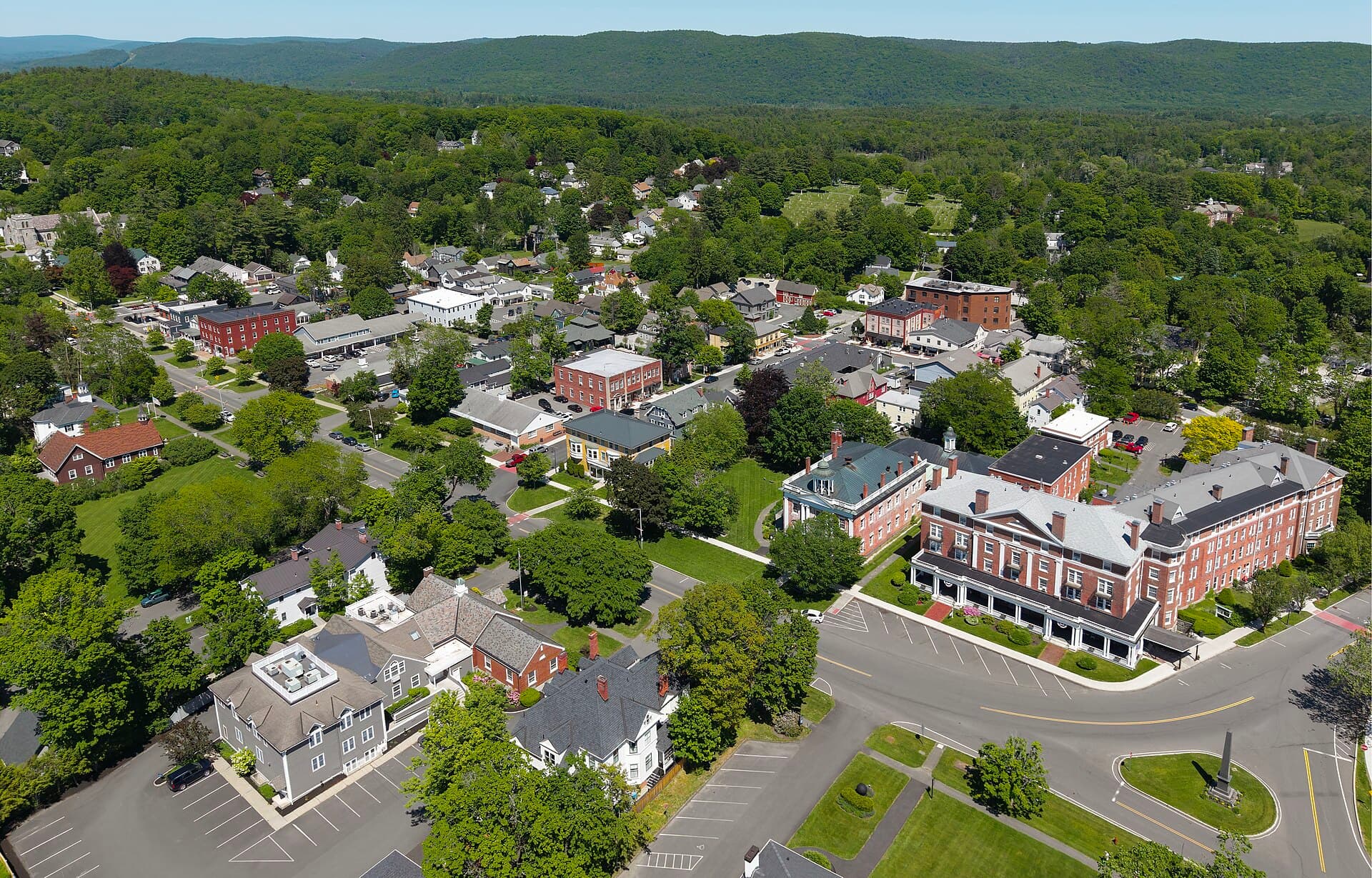
Ventfort Hall Mansion and Gilded Age Museum
This imposing Jacobean Revival mansion, constructed by J.P. Morgan's sister, holds more than just Gilded Age stories within its walls.
Full story unlocks in the tour
 Quintin Soloviev / CC BY 4.0, via Wikimedia Commons
Self-guided audio walking tour of Lenox — GPS route, offline playback, story-driven narration in 32 languages.
“Where Gilded Age splendor meets modern artistic spirit.”
Not the postcards. The stories even locals don't know — whispered in your ear, right where they happened.
This imposing Jacobean Revival mansion, constructed by J.P. Morgan's sister, holds more than just Gilded Age stories within its walls.
The striking modernist home of abstract artists George L.K. Morris and Suzy Frelinghuysen, a beacon of Bauhaus design in the Berkshires, once required a unique sacrifice for its completion.
The current Lenox Library building has a surprising past, having once served a very different civic function.
Discover every secret of Lenox
Every address, every reveal in full — in your ear, right where it happened.
You pick your stops. You walk. The voice reveals what the others miss.
Your self-guided audio tour of Lenox is ready — pick your landmarks, choose your language, and start the moment you arrive.
BuyLume has a built-in augmented-reality guide. Hold your phone up and its camera shows the street ahead of you, with a glowing arrow laid over the real view that always points to your next stop — no map to puzzle over, no wrong turns. Like everything in Lume, it works fully offline.
Lenox, Massachusetts, is a town in the Berkshire Hills of Western Massachusetts, celebrated for its blend of cultural sophistication, historical estates, and natural beauty. Once described as a "hideous, howling wilderness" by early travelers, Lenox transformed into a sought-after destination for the wealthy and artistic, earning it the moniker "Inland Newport." Today, it remains a thriving center, drawing visitors with its world-class music, theater, and art institutions, alongside opportunities for outdoor recreation.
The town's allure lies in its ability to offer both grand cultural experiences and peaceful natural escapes. From expansive Gilded Age mansions to tranquil wildlife sanctuaries, Lenox provides a diverse range of activities for every visitor. Its central location within the Berkshires also makes it an ideal base for exploring the wider region.
The area now known as Lenox was originally inhabited by the Mahican, Native American Algonquian speakers. European colonial settlement was slow to take hold due to hostilities during the French and Indian Wars, with the first permanent inn and general store established around 1750 by Jonathan and Sarah Hinsdale. The Province of Massachusetts Bay eventually auctioned large tracts of land, and in 1767, the village of Yokuntown was set off as Lenox, likely intended to be named Lennox after Charles Lennox, 3rd Duke of Richmond and Lennox, a supporter of colonial rights, but misspelled by a clerk.
Early Lenox was a community of farmers, traders, merchants, and innkeepers, with industries including sawmills, textile mills, potash production, glassworks, and ironworks, spurred by a vein of iron ore. In 1784, Lenox became the county seat, a distinction it held for 81 years until 1868 when the title passed to Pittsfield. The 1816 county courthouse now serves as the Lenox Library.
The town's rustic beauty began attracting artists and writers in the early to mid-19th century. Author Catharine Sedgwick moved to Lenox in 1821, followed by actress Fanny Kemble. Nathaniel Hawthorne resided here from 1850 to 1851, writing Tanglewood Tales and befriending Herman Melville, who wrote Moby Dick in nearby Pittsfield. The arrival of the Housatonic Railroad in 1838 made Lenox more accessible, leading to an influx of affluent visitors from Boston and New York. These prominent families, including the Morgans and Vanderbilts, constructed opulent summer homes, known as "Berkshire Cottages," during the Gilded Age (roughly 1880-1920), transforming Lenox into a fashionable summer resort. Edith Wharton, the Pulitzer Prize-winning novelist, designed and lived at The Mount from 1902 to 1911, where she wrote The House of Mirth and Ethan Frome. After the Gilded Age, many of these grand estates were sold or repurposed, with some becoming schools or cultural centers, such as Tanglewood, the summer home of the Boston Symphony Orchestra.
Lenox offers a diverse array of attractions. A visit to Tanglewood, the summer home of the Boston Symphony Orchestra, is a quintessential Lenox experience, with concerts ranging from classical to popular music from June through Labor Day. Guests can enjoy performances from the Koussevitzky Music Shed or picnic on the expansive lawns. For literary enthusiasts, The Mount, Edith Wharton's historic estate, offers tours of her beautifully preserved mansion and gardens.
Explore the Gilded Age at Ventfort Hall Mansion and Gilded Age Museum, an imposing Jacobean Revival mansion constructed for Sarah Morgan, sister of J.P. Morgan. For a different architectural and artistic perspective, the Frelinghuysen Morris House & Studio showcases modernist art in the Bauhaus-inspired home of abstract artists George L.K. Morris and Suzy Frelinghuysen. Shakespeare & Company provides a lively theatrical experience. Outdoor enthusiasts can explore the trails at Kennedy Park or the Pleasant Valley Wildlife Sanctuary, offering diverse ecosystems and views. The inviting downtown area of Lenox is perfect for strolling through boutique shops, art galleries, and cafes.
Lenox is a year-round destination, with each season offering a distinct appeal. Summer (late June to early September) is ideal for cultural events, particularly the Tanglewood Music Festival, and warm-weather outdoor activities. Fall, especially early to mid-October, is spectacular for vivid foliage displays and scenic drives. Winter provides opportunities for cross-country skiing and snowshoeing, with a tranquil, snow-covered landscape. While spring can be lovely, weather can be unpredictable.
Lenox is approximately a 2.5-hour drive from Boston and 3 hours from New York City. When planning a summer visit, especially during the Tanglewood season, booking accommodations and restaurant reservations well in advance is highly recommended, as the town fills up quickly. Parking is generally free and abundant at Tanglewood, but remembering your lot is useful. If attending a Tanglewood concert on the lawn, consider bringing a picnic, lawn chairs, and insect repellent; umbrellas are also advisable for potential rain. Many local restaurants participate in the locally-grown food movement. The downtown area is walkable, allowing easy access to shops and eateries.
Lenox in Korean, in Chinese or in Hebrew — and 29 more languages, every stop narrated by a native voice. The widest language range of any self-guided audio tour.
Available in: