Church of Sainte-Quitterie
The story of Sainte Quitterie speaks of defiance and a miraculous spring.
Full story unlocks in the tour
 Unknown author / Public domain, via Wikimedia Commons
Self-guided audio walking tour of Aire-sur-l'Adour — GPS route, offline playback, story-driven narration in 32 languages.
“Where ancient currents flow through a pilgrim's journey.”
Not the postcards. The stories even locals don't know — whispered in your ear, right where they happened.
The story of Sainte Quitterie speaks of defiance and a miraculous spring.
This striking 19th-century building once played a pivotal role in the region's economy.
Look closely at the cathedral's interior, and you'll find an unexpected blend of styles.
Discover every secret of Aire-sur-l'Adour
Every address, every reveal in full — in your ear, right where it happened.
You pick your stops. You walk. The voice reveals what the others miss.


Your self-guided audio tour of Aire-sur-l'Adour is ready — pick your landmarks, choose your language, and start the moment you arrive.
BuyLume has a built-in augmented-reality guide. Hold your phone up and its camera shows the street ahead of you, with a glowing arrow laid over the real view that always points to your next stop — no map to puzzle over, no wrong turns. Like everything in Lume, it works fully offline.
Aire-sur-l'Adour, a captivating town in the Landes department of Nouvelle-Aquitaine, offers a compelling blend of ancient history, spiritual significance, and Gascon culture. Situated along the Adour River, it has long been a vital crossroads, connecting the Pyrenees to the Atlantic and serving as a key stop on the historic Way of St. James pilgrimage route.
The town divides into a lower section along the river and an upper town sloping upwards, inviting thorough exploration. Its streets reveal centuries of stories, from its Celtic and Roman origins to its time as a Visigothic royal residence and an episcopal city. Today, it stands as a tranquil market town, known for its deep heritage, local cuisine—especially foie gras—and a lively market scene.
## From Celtic Roots to Roman Rule Aire-sur-l'Adour's story begins with a Celtic settlement called 'Atura,' a name likely derived from the Adour River. Its strategic location made it a significant site even in antiquity. In 56 BC, the area witnessed a pivotal battle between the Roman forces of Crassus, Julius Caesar's lieutenant, and Pompey's troops. Following the Roman victory, the settlement was reorganized and renamed 'Vicus Julii,' solidifying its importance in the Roman Empire.
## A Visigothic Capital and Episcopal See By the 5th century, Aire-sur-l'Adour had become a significant stronghold within the Visigothic Kingdom of Toulouse. In 506 AD, King Alaric II chose this very place to promulgate the 'Bréviaire d'Alaric,' a comprehensive legal code that governed both Visigothic and Gallo-Roman societies, remaining influential for centuries. The town's religious importance also grew, becoming an episcopal see for fifteen centuries, with the first bishop, Marcellus, attested in 507 AD. Bishops played a crucial role in shaping not only the religious life but also the economic and educational landscape of the town.
## Medieval Pilgrimage and French-English Conflicts The Middle Ages saw Aire-sur-l'Adour flourish, partly due to its position on the Adour River and its designation as a significant stop on the Way of St. James pilgrimage route. The 11th and 12th centuries marked the construction of the Cathedral of Saint-Jean-Baptiste and the Church of Sainte-Quitterie, the latter becoming a UNESCO World Heritage site. The town's strategic value also made it a point of contention, leading to a pact in 1290 with the King of England for protection. However, the English were eventually driven out by the end of the 15th century.
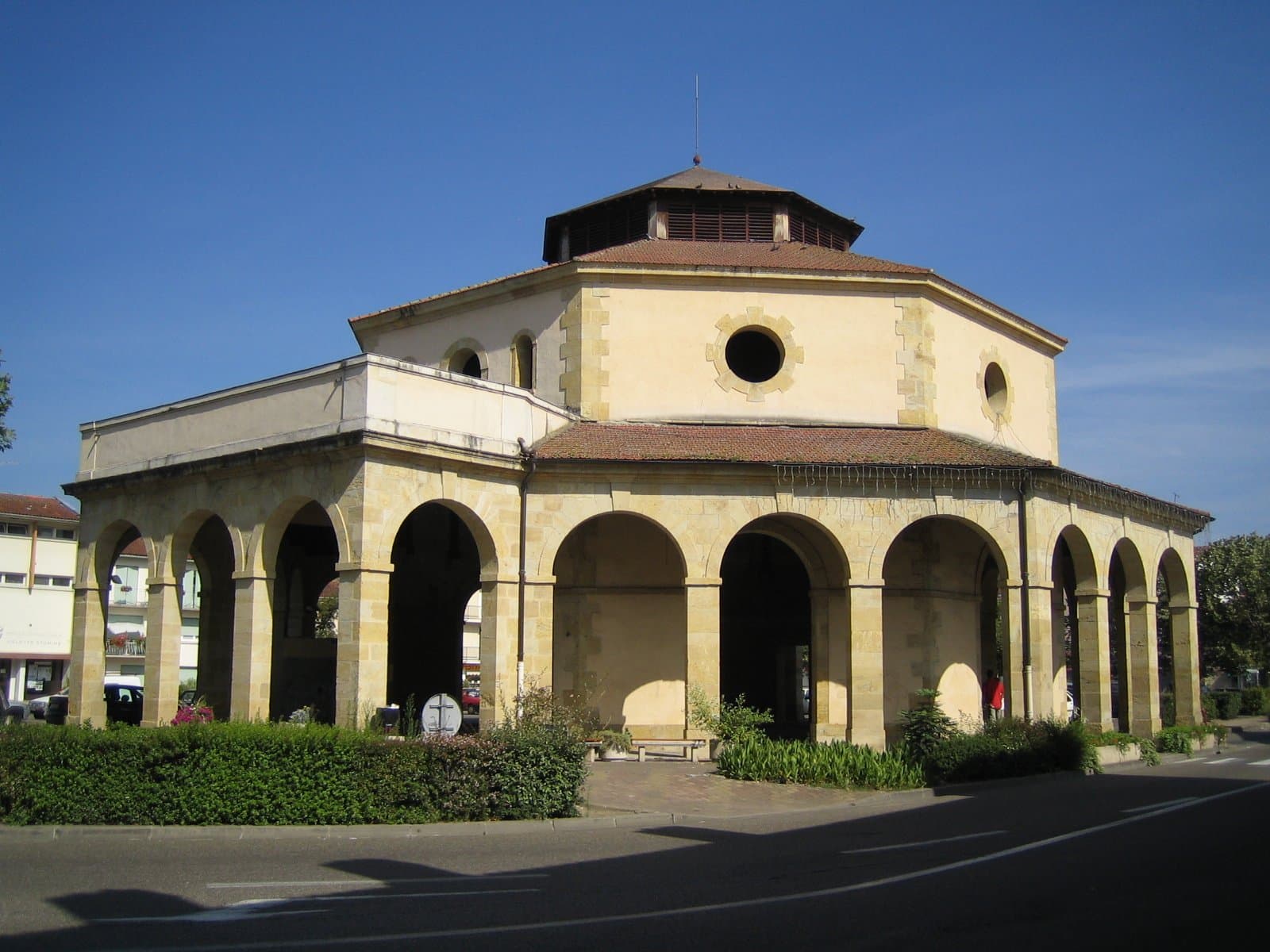
## Wars of Religion and Modern Developments The 16th century brought devastation during the Wars of Religion, with Protestant General Montgomery ravaging religious buildings in 1569. Despite these setbacks, the town rebuilt and evolved. The 17th century saw the reconstruction of the episcopal palace, now the Town Hall, into a grand residence. The 19th century brought economic growth, evidenced by the construction of the octagonal grain market hall in 1855, and Aire-sur-l'Adour became renowned as a 'capital of foie gras.' In more recent history, a bypass was constructed in the 2000s, incorporating the A65 autoroute, to alleviate traffic through the town center.
Begin your exploration at the Cathedral of Saint-Jean-Baptiste, a monument with origins in the 11th and 12th centuries, showcasing a blend of Romanesque and Gothic styles. Inside, admire the 18th-century organ, choir stalls, and the polychrome marble high altar. Just a short distance away, on the Mas hillside, stands the Church of Sainte-Quitterie, a UNESCO World Heritage site and a crucial stop on the Way of St. James. Its Gothic entrance and vast crypt, housing the 4th-century white marble sarcophagus of Sainte Quitterie, are particularly noteworthy.
Wander to the Halle aux Grains, a distinctive octagonal 19th-century market hall with arcades, a testament to the town's historical agricultural importance. The Hôtel de Ville (Town Hall), housed in the former 17th-century episcopal palace, is also worth a look for its architectural grandeur. Take a leisurely stroll along the shaded banks of the Adour River, where you can enjoy views of the 1834 stone bridge. For a deeper dive into local history, consider visiting the Lapidary Museum located within the Town Hall.
The best time to visit Aire-sur-l'Adour is during the months of June through August, when the weather is generally pleasant for exploring. For those seeking a quieter experience with fewer crowds and potentially better value, the months of October through December offer an alternative. While March can be moderately chilly and breezy, with temperatures ranging from 40-58°F (4-15°C), the town still offers plenty to see and do.
Aire-sur-l'Adour is well-connected, accessible via the A65 motorway (exit 7) and departmental roads like the D824 from Mont-de-Marsan and the D931 from Nogaro. The town is approximately 150 km south of Bordeaux and 50 km north of Pau. For those traveling by train, Aire-sur-l'Adour has convenient train connections. If arriving by air, the closest airports are Toulouse or Bordeaux, with bus and train connections available.
Once in Aire-sur-l'Adour, the town is easily explored on foot. There is a large parking area at the south end of the bridge over the Adour River, where the tourist office is also located. A food market is held in the covered market on Place de l'Hôtel de Ville every Tuesday and Saturday morning, featuring local producers and retailers.
Aire-sur-l'Adour in Korean, in Chinese or in Hebrew — and 29 more languages, every stop narrated by a native voice. The widest language range of any self-guided audio tour.
Available in: