Fuerte San Antonio
The cannons of Fuerte San Antonio once guarded more than just the bay.
Full story unlocks in the tour
 Paul Lowry / CC BY 2.0, via Wikimedia Commons
Self-guided audio walking tour of Ancud — GPS route, offline playback, story-driven narration in 32 languages.
“Where the Pacific murmurs stories of endurance and lore.”
Not the postcards. The stories even locals don't know — whispered in your ear, right where they happened.
The cannons of Fuerte San Antonio once guarded more than just the bay.
The Mercado Municipal is a place of lively commerce, yet it also holds a surprising connection to the island's identity.
Within the Museo Regional de Ancud, a full-size replica of a schooner recounts a story far grander than its dimensions suggest.
Discover every secret of Ancud
Every address, every reveal in full — in your ear, right where it happened.
You pick your stops. You walk. The voice reveals what the others miss.


Your self-guided audio tour of Ancud is ready — pick your landmarks, choose your language, and start the moment you arrive.
BuyLume has a built-in augmented-reality guide. Hold your phone up and its camera shows the street ahead of you, with a glowing arrow laid over the real view that always points to your next stop — no map to puzzle over, no wrong turns. Like everything in Lume, it works fully offline.
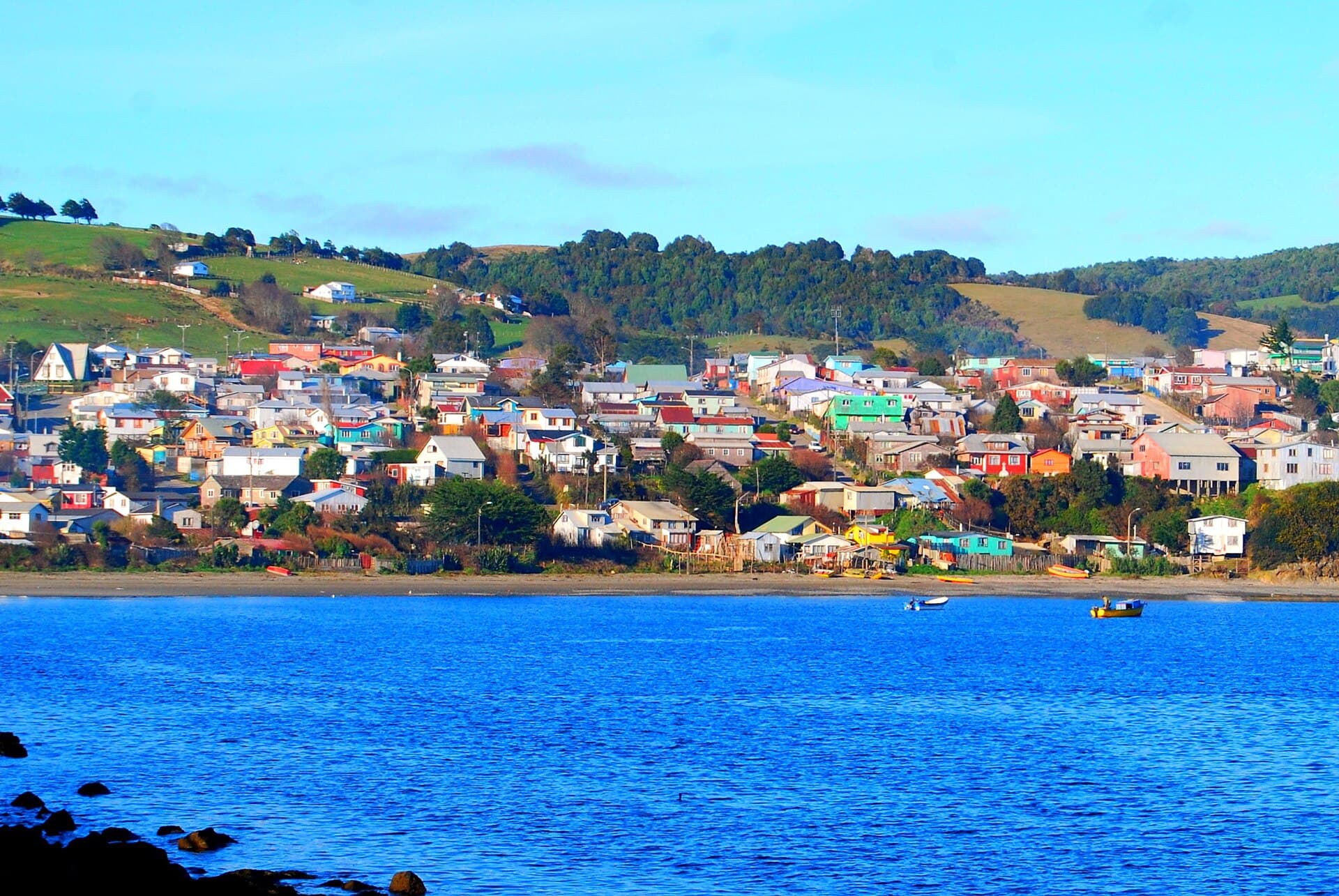
Ancud, the second-largest city on Chiloé Island in Chile's Los Lagos Region, acts as a captivating entrance to the fabled Chiloé Archipelago. This coastal settlement, home to approximately 39,000 residents, presents a blend of historical consequence and local allure. Verdant hills slope towards the water, and fishing vessels sway gently in the inlets, crafting a picturesque scene. Ancud's atmosphere moves at a deliberate pace, inviting unhurried walks along the waterfront and visits to local marketplaces.
Life here is deeply woven with the sea and the island's distinct character, forged through centuries of relative separation from mainland Chile. While it functions as a practical base for exploring the northern reaches of Chiloé, Ancud itself is a destination where colonial history, rich folklore, and a tangible sense of community converge. It is a place where the salty air carries echoes of old narratives, and every turn reveals a piece of Chilote life.
Ancud's origins trace back to its establishment as a Spanish settlement in 1768, initially named Villa y Fuerte Real de San Carlos de Chiloé. Before this, the site was recognized as Puerto Inglés, or "English Port." The city was founded under Governor Carlos de Beranger y Renaud, who received a royal command to fortify the northern area of the archipelago against foreign powers. This strategic position, controlling the Chacao Channel—the primary maritime passage to the archipelago—rendered Ancud a critical military center in the South Pacific.
For many years, Ancud served as the capital of the Chiloé Archipelago, a position it maintained until 1982. Its significance as a bulwark against foreign incursions persisted through the Chilean War of Independence. Ancud famously remained the final stronghold of Spanish royalist forces in the Americas, resisting Chilean troops in 1820 and 1824 before finally capitulating in 1826 with the signing of the Treaty of Tantauco. This event marked Chiloé's integration into the newly formed Republic of Chile.
Following its incorporation into Chile, Ancud was renamed in 1834 and continued to play a significant role, particularly in the Chilean colonization of Patagonia in the 19th century. The city's port was a vital transit point for ships navigating the Strait of Magellan, and it became a hub for the export of valuable timber. The 19th century witnessed a period of active commercial life, further boosted by the arrival of European settlers, notably Germans, who contributed to the city's development.
However, Ancud's prominence as an international port began to wane with the opening of the Panama Canal and the arrival of the railway in Puerto Montt in 1912, which redirected commercial and shipping traffic. The city also endured natural disasters, with the Great Chilean Earthquake and subsequent tsunami in 1960 destroying a considerable portion of its buildings and railway line. Despite these shifts and the loss of its provincial capital status to Castro in 1982, Ancud has preserved its distinct Chilote culture, a unique blend of Spanish settler traditions and indigenous Huilliche customs, making it a place rich in history and enduring local character.
Begin your exploration at Fuerte San Antonio, an 18th-century Spanish fort offering wide views of Ancud Bay. While much of the original structure has diminished, it stands as a testament to Ancud's strategic past and its role as the final Spanish outpost in Chile.
Delve into the island's heritage at the Museo Regional de Ancud (Regional Museum of Ancud). This museum displays archaeological, ethnographic, and historical artifacts, tracing Chiloé's development from its earliest inhabitants over 6,000 years ago to the present day. Notable exhibits include models of Chiloé's characteristic wooden churches and a full-size replica of the schooner Ancud.
Experience local life at the Mercado Municipal, a bustling center for fresh seafood, traditional Chilote dishes, and regional handicrafts like knitwear and carved wooden items. The market offers a sensory journey, where the aroma of fresh catches mingles with the earthy scent of local produce.
For wildlife encounters, consider a boat trip to the Puñihuil Islets Natural Monument, located approximately 25 kilometers west of Ancud. This is the only location globally where Humboldt and Magellanic penguins raise their young together. The breeding season from September to March provides the best opportunity for a visit.
Ancud experiences a temperate maritime climate, marked by mild temperatures and considerable rainfall throughout the year. The most agreeable time to visit is during the Southern Hemisphere's summer, from December to March. During these months, temperatures are milder, averaging around 13°C to 15°C, with less frequent rain. January and February are typically the warmest, with highs reaching 16-17°C. Spring (September to November) and autumn (March to May) also offer pleasant weather with fewer visitors. Winters (June to August) are cool and wet, with July being the coldest month, averaging 7.5°C, and high precipitation.
Ancud is reachable by bus from Puerto Montt, a journey that includes a scenic ferry ride across the Chacao Channel to Chiloé Island. The ferry crossing takes approximately 30 minutes. Buses from Puerto Montt depart frequently until around 9 PM. Alternatively, you can fly into El Tepual Airport in Puerto Montt or Mocopulli Aerodrome near Castro, then continue by bus or rental car.
Accommodation options in Ancud vary from budget-friendly hostels and guesthouses to mid-range hotels and bed and breakfasts. Reserving in advance is recommended, especially during peak travel seasons. The city center is walkable, with many attractions, eateries, and markets within easy reach. While Spanish is the primary language, you may find some English spoken in establishments catering to visitors. It is wise to pack layers of clothing, including a waterproof jacket and comfortable walking shoes, as the weather can be unpredictable.
Ancud in Korean, in Chinese or in Hebrew — and 29 more languages, every stop narrated by a native voice. The widest language range of any self-guided audio tour.
Available in: