Putre's Main Plaza
The central square of Putre holds a secret that speaks to the town's enduring spirit, even after a devastating event.
Full story unlocks in the tour
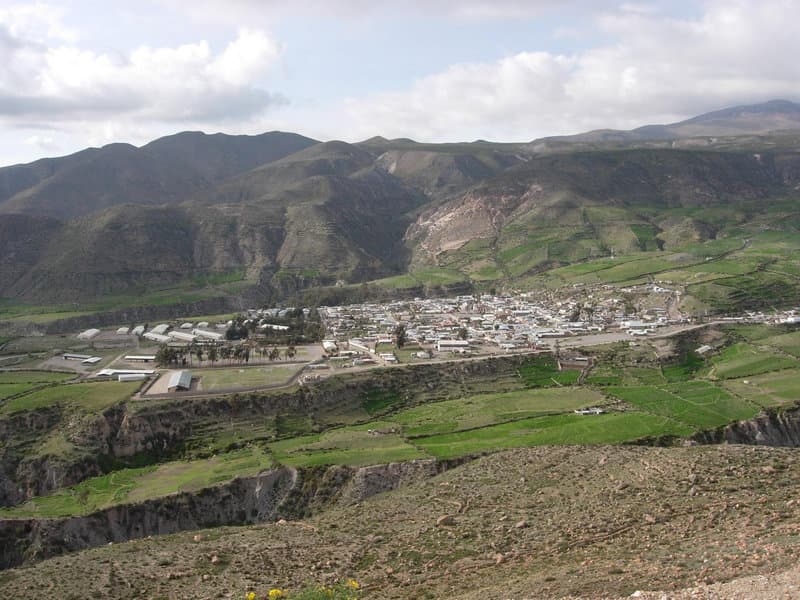 Unknown author / CC BY-SA 3.0, via Wikimedia Commons
Self-guided audio walking tour of Putre — GPS route, offline playback, story-driven narration in 32 languages.
“Where the high desert meets the sky, and ancient paths carry the echoes of trade and tradition.”
Not the postcards. The stories even locals don't know — whispered in your ear, right where they happened.
The central square of Putre holds a secret that speaks to the town's enduring spirit, even after a devastating event.
Driving to Putre, you'll pass through a landscape that drastically transforms, revealing an unexpected flourish of life in an otherwise arid expanse.
Near Putre, a site known as Las Cuevas holds a record of human presence far older than any colonial church or Incan road.
Discover every secret of Putre
Every address, every reveal in full — in your ear, right where it happened.
You pick your stops. You walk. The voice reveals what the others miss.


Your self-guided audio tour of Putre is ready — pick your landmarks, choose your language, and start the moment you arrive.
BuyLume has a built-in augmented-reality guide. Hold your phone up and its camera shows the street ahead of you, with a glowing arrow laid over the real view that always points to your next stop — no map to puzzle over, no wrong turns. Like everything in Lume, it works fully offline.
Putre, a village in Chile's Arica y Parinacota region, rests at an elevation of approximately 3,500 meters (11,483 feet) at the foot of the Taapaca volcano. This high-altitude settlement serves as a crucial base for exploring the Andean landscapes of northern Chile. The town's atmosphere reflects influences from neighboring Peru and Bolivia, with a quiet charm that attracts visitors seeking to connect with authentic Andean life and natural wonders.
Surrounded by dramatic mountains and peaceful valleys, Putre is a gateway to national parks, ancient cultures, and unique wildlife encounters. Its strategic location on historical trade routes has shaped its character, offering a blend of indigenous heritage and colonial architecture. The dry climate, with its intense sun during the day and chilly nights, is typical of the Altiplano region.
Putre's origins trace back to an Aymara settlement, strategically positioned on ancient trade routes connecting indigenous communities around Lake Titicaca with coastal towns. This made it an important intermediate point for trade between Bolivian, Peruvian, and Chilean peoples living at high altitudes and those on the coast.
With the arrival of the Inca Empire, agricultural practices evolved, incorporating new irrigation techniques and terraced fields to maximize crop yield. Putre's significance continued into the Spanish colonial period, when it became an administrative center for the region, particularly important for trade routes linking Peru, Chile, and Bolivia, including the movement of precious metals between Potosí and Arica. The town was founded by the Spanish around 1580 on an older Inca site.
Today, Putre retains much of its colonial atmosphere, with 16th and 17th-century buildings, houses with stone portals, and the notable San Ildefonso Church, built in 1670. Despite a past of prosperity tied to trade, the town has since become a quieter village, though pockets of its former glory can still be seen in its architecture and surprisingly lovely gardens. The region's history is also marked by conflicts, such as the Pacific War, which resulted in Chile annexing this part of the Altiplano, leading to Aymara communities finding themselves within Chilean borders.
Putre serves as an excellent base for exploring the surrounding Altiplano. The most prominent attraction is Lauca National Park, a UNESCO Biosphere Reserve known for its diverse flora and fauna, including vicuñas, pumas, Andean foxes, flamingos, and condors. Within the park, you'll find Lake Chungará, one of the world's highest lakes, offering panoramic views of surrounding volcanoes like Parinacota and Pomerape. Nearby are the Lagunas de Cotacotani, a series of high-altitude lagoons formed by meltwater, creating a vital ecosystem for various bird species.
Another significant natural wonder is the Salar de Surire, a vast white salt flat approximately 120 kilometers from Putre, where flamingos breed in the salt lagoons. The nature reserve surrounding the salt flat protects numerous native animal species, including vicuñas and rheas. For a relaxing experience, the Las Cuevas Hot Springs, fed by natural thermal waters, are believed to have therapeutic properties. In Putre itself, the Plaza Mayor and the 17th-century San Ildefonso de Putre Church are central points of interest, alongside streets featuring traditional adobe architecture and stone-carved facades. Ancient rock paintings, such as those at Vilacaurani and Incani, offer glimpses into the region's pre-Hispanic past.
The most favorable time to visit Putre for warm-weather activities is from mid-January to late March, though this is also the wetter season with more frequent rainfall. For cooler weather and clearer skies, the months from April to November are ideal, with temperatures ranging from 12°C (54°F) to 16°C (61°F) during the day and around 0°C (32°F) to 3°C (37°F) at night. The dry season in Putre typically runs from May to November. Winter months, from June to September, experience the least rainfall but also lower average temperatures.
Putre sits at a high altitude of 3,500 meters (11,483 feet), so acclimatization is crucial to avoid altitude sickness (soroche). It's recommended to take it easy on your first day, stay hydrated by drinking plenty of water, and consider coca tea, which is legal and can help with adjustment. Oxygen supplies are available at the local doctor's office in Putre if needed.
To reach Putre, the most common route is from Arica, a coastal city with an airport. Buses from Arica to Putre are available daily, with companies like Transporte La Paloma operating the route. The drive takes approximately 2.5 to 3 hours. If driving, be aware that there are no gas stations in Putre, though fuel can sometimes be purchased from a hardware store at a higher price. There is no ATM in Putre, so bring sufficient cash for your stay.
Putre in Korean, in Chinese or in Hebrew — and 29 more languages, every stop narrated by a native voice. The widest language range of any self-guided audio tour.
Available in: