Yin Ruins
The unearthing of oracle bones at Yin Ruins did more than reveal ancient texts; it resolved a long-standing historical question.
Full story unlocks in the tour
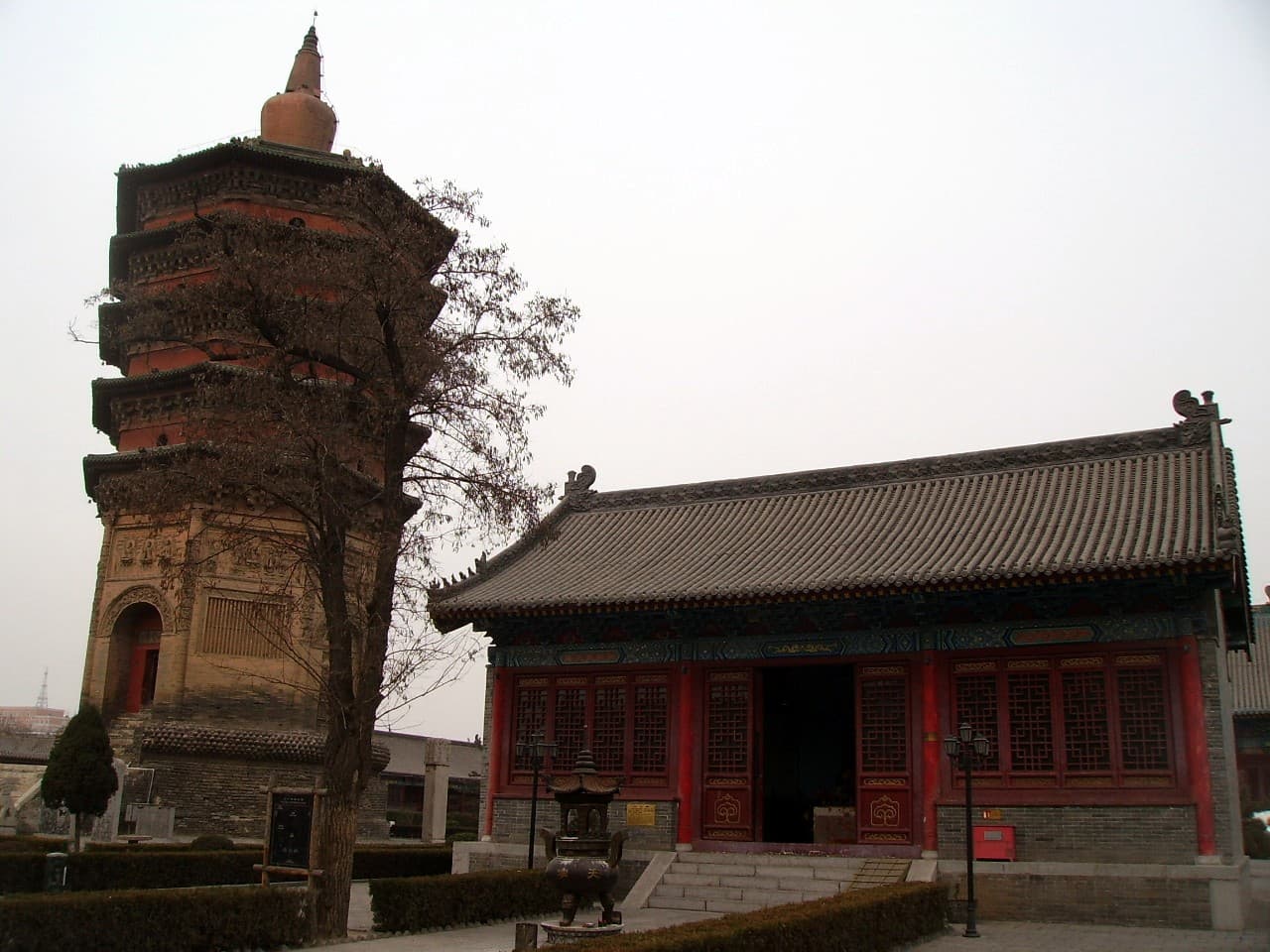 Chris Gyford / CC BY 2.5, via Wikimedia Commons
Self-guided audio walking tour of Anyang — GPS route, offline playback, story-driven narration in 32 languages.
“Where the echoes of antiquity meet the pulse of the present.”
Not the postcards. The stories even locals don't know — whispered in your ear, right where they happened.
The unearthing of oracle bones at Yin Ruins did more than reveal ancient texts; it resolved a long-standing historical question.
This pagoda distinguishes itself from nearly all others in China, not only by its age but by a peculiar architectural choice.
The Red Flag Canal is celebrated as a triumph of engineering, yet its construction arose from a desperate struggle for survival.
Discover every secret of Anyang
Every address, every reveal in full — in your ear, right where it happened.
You pick your stops. You walk. The voice reveals what the others miss.

Your self-guided audio tour of Anyang is ready — pick your landmarks, choose your language, and start the moment you arrive.
BuyLume has a built-in augmented-reality guide. Hold your phone up and its camera shows the street ahead of you, with a glowing arrow laid over the real view that always points to your next stop — no map to puzzle over, no wrong turns. Like everything in Lume, it works fully offline.
Anyang, one of China's eight ancient capitals, invites a profound exploration into the very origins of Chinese civilization. Situated in the northern expanse of Henan province, this city stands as a pivotal location for comprehending early Chinese history and culture. With a documented past stretching back over 3,000 years, Anyang served as the final capital of the Shang Dynasty, then known as Yin.
Today, Anyang is a city where archaeological marvels and contemporary life gracefully interweave. It is recognized globally for the Yin Ruins, a UNESCO World Heritage Site, which yielded the earliest known Chinese writing on oracle bones. Beyond its ancient foundations, Anyang presents a singular fusion of historical significance and human resilience, powerfully evident in sites like the Red Flag Canal.
## The Cradle of Chinese Civilization Anyang's historical weight is immense, frequently referred to as one of the wellsprings of Chinese civilization. Human presence in the area dates back over 7,000 years, with evidence of the Xiaonanhai culture discovered on the city's western flank. Ancient narratives also suggest that two sagacious kings, Zhuanxu and Emperor Ku, governed from this region around 2000 BCE.
The city gained prominence as Yin, the ultimate capital of the Shang Dynasty (c. 1600–1046 BCE), a period that marked the dawn of recorded Chinese history. King Pan Geng relocated the capital to Yin around 1300 BCE, where it remained for over 270 years. The archaeological site of Yin Xu, or the Yin Ruins, stands as a testament to this epoch. Systematic excavations, commencing in 1928, have brought to light over 100 palaces, 12 grand imperial graves, 2,500 sacrificial trenches, and extensive settlements. The most groundbreaking discoveries at Yin Xu include the oracle bone inscriptions—the earliest known form of Chinese writing—which meticulously documented everything from rituals and astronomy to royal decrees, and the remarkably preserved Tomb of Fu Hao, a powerful queen and military general.
Following the Shang Dynasty, Anyang's significance diminished as the succeeding Zhou Dynasty established its capital elsewhere. However, its legacy as a historical and cultural city was acknowledged in 1986. More recently, Anyang has garnered recognition for the Red Flag Canal, an extraordinary feat of modern engineering. Constructed in the 1960s, this massive irrigation project involved carving a 70.6-kilometer canal through the Taihang Mountains to bring water to drought-stricken areas, symbolizing human determination against adversity.
The Yin Ruins (Yin Xu), a UNESCO World Heritage Site, stands as the foremost attraction. This expansive archaeological park served as the last capital of the Shang Dynasty and offers a direct connection to a civilization over 3,000 years old. Explore the excavation sites of royal tombs, including the Tomb of Fu Hao, and admire the oracle bone inscriptions and bronze artifacts at the new Yin Ruins Museum, which opened in February 2024 and displays over 4,000 artifacts, many for the first time.
The National Museum of Chinese Writing is another essential destination, providing a comprehensive overview of the evolution of Chinese characters, originating from the oracle bone script found at Yin Xu. Entry to the museum is free.
For a blend of natural splendor and human ingenuity, visit the Red Flag Canal. This "Man-Made Heavenly River" meanders through the Taihang Mountains, offering grand vistas and the opportunity to explore the Youth Cave, a significant tunnel carved during its construction. The Red Flag Canal Museum details the history and challenges of this incredible engineering achievement.
In the city center, the Wenfeng Pagoda at Tianning Temple is a distinctive landmark, notable for its unusual inverted cone shape. Ascend to the top for views of the city. The Anyang Museum offers a broader historical context of the region, with collections of ceramics, jade, and stone carvings.
The most agreeable times to visit Anyang are during spring (April to May) and autumn (September to October). These seasons provide mild, dry weather, ideal for outdoor exploration. Temperatures in spring range from 10-22°C (50-72°F) and in autumn from 15-25°C (59-77°F). While summer can be hot and humid, and winter cold and dry, the shoulder seasons offer pleasant conditions for exploring Anyang's historical sites and natural surroundings. October is particularly sun-drenched.
Anyang is reachable by train, with the Anyang Railway Station serving as a convenient nexus for travelers exploring the broader Henan region. Within the city, public transport options like buses are available, with Bus 30 connecting major attractions, including the Chinese Character Museum. Taxis are also readily available. For a deeper understanding of the sites, consider arranging a guided tour, which often includes transportation and expert commentary. Accommodation options are diverse, with the Wenfeng District, particularly around the city center and Wanda Plaza, being a favored area for its closeness to dining, shopping, and entertainment. The Anyang Museum is open from 9:00 AM to 5:00 PM, with last entry at 4:30 PM. It is wise to check for national public holidays, such as Spring Festival (late January to early February), Labour Day (early May), and National Day (October 1-7), as these are peak travel times across China, potentially affecting crowds and accommodation prices.
Anyang in Korean, in Chinese or in Hebrew — and 29 more languages, every stop narrated by a native voice. The widest language range of any self-guided audio tour.
Available in: