Schloss Johannisburg
Beyond its imposing red sandstone walls, this Renaissance castle holds an unexpected collection.
Full story unlocks in the tour
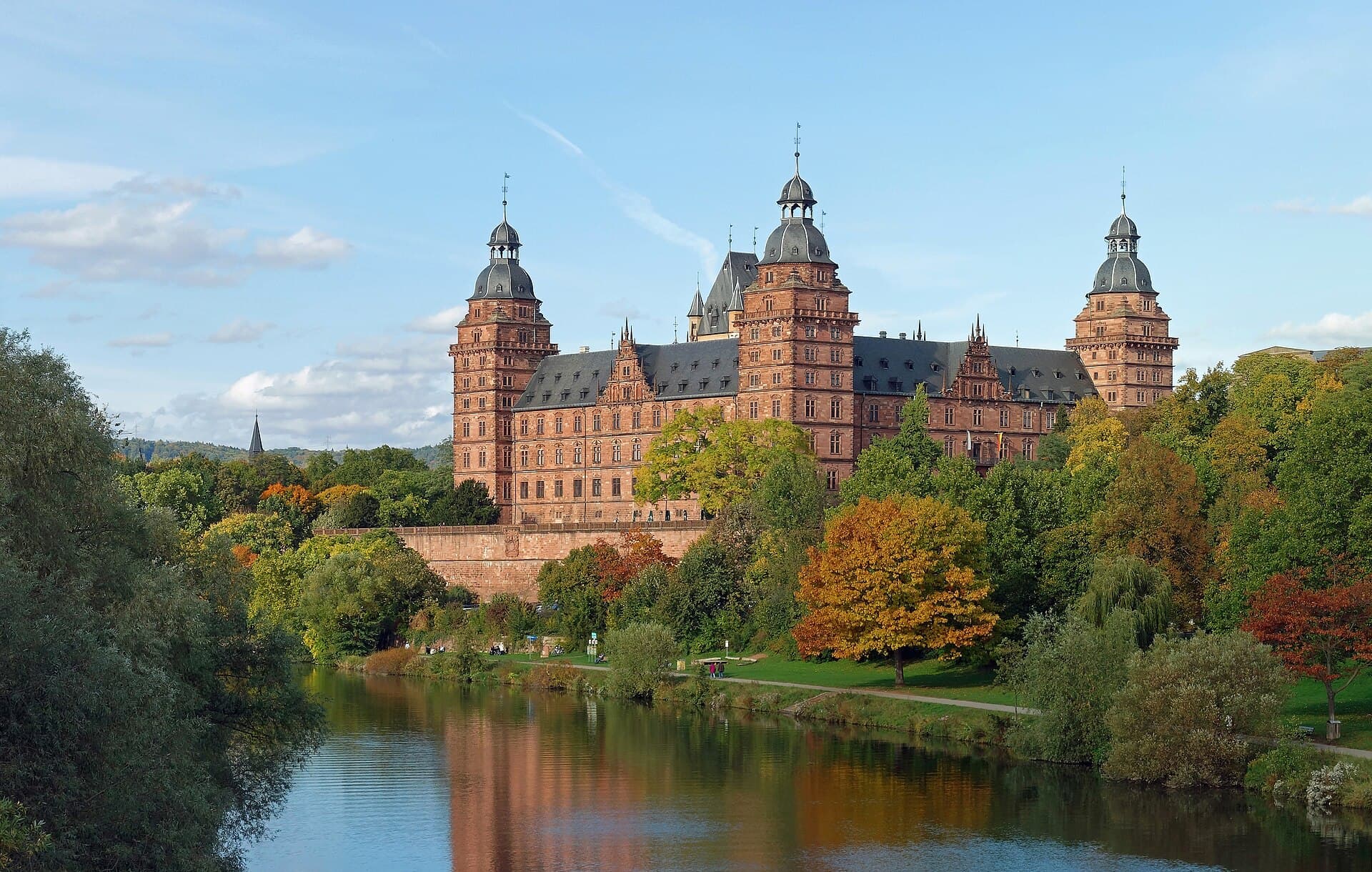 Rainer Lippert → Derivative work: Steffen Schmitz (Carschten) / CC0, via Wikimedia Commons
Self-guided audio walking tour of Aschaffenburg — GPS route, offline playback, story-driven narration in 32 languages.
“Where the Main River carries Bavarian charm into a sun-drenched, Mediterranean embrace.”
Not the postcards. The stories even locals don't know — whispered in your ear, right where they happened.
Beyond its imposing red sandstone walls, this Renaissance castle holds an unexpected collection.
King Ludwig I's deep admiration for ancient Rome inspired a singular architectural creation in Aschaffenburg.
This ancient basilica, a cornerstone of Aschaffenburg's enduring story, holds a distinction shared by no other church globally.
Discover every secret of Aschaffenburg
Every address, every reveal in full — in your ear, right where it happened.
You pick your stops. You walk. The voice reveals what the others miss.


Your self-guided audio tour of Aschaffenburg is ready — pick your landmarks, choose your language, and start the moment you arrive.
BuyLume has a built-in augmented-reality guide. Hold your phone up and its camera shows the street ahead of you, with a glowing arrow laid over the real view that always points to your next stop — no map to puzzle over, no wrong turns. Like everything in Lume, it works fully offline.
Aschaffenburg, affectionately known as the "Bavarian Nice" for its gentle climate and Mediterranean-influenced atmosphere, unfolds along the Main River in northwest Bavaria, Germany. Resting at the foot of the densely wooded Spessart mountains, it offers a harmonious blend of venerable sites, verdant expanses, and urban conveniences. The city's identity is shaped by its proximity to the Main, which provides a picturesque backdrop for its many attractions.
With a population projected around 74,517 in 2026, Aschaffenburg stands as the largest city in the Bavarian Lower Main region. It forms a part of the European metropolitan area of Frankfurt am Main, situated approximately 40 kilometers southeast of Frankfurt. Despite its historical depth and cultural offerings, Aschaffenburg maintains a compact, easily traversable old town, making it an inviting destination for unhurried exploration.
## From Roman Outpost to Bavarian Territory Aschaffenburg's origins stretch back to the Stone Age, with archaeological findings pointing to early Celtic settlements. Under Roman dominion, it developed as an outpost named Ascapha along crucial trade routes, where Roman legions were stationed. Around 550 AD, the Franks conquered the area, and in the 8th century, a Benedictine monastery was established, reputedly by Saint Boniface.
By 982, Aschaffenburg fell under the authority of the electors of Mainz, a formidable ecclesiastical state within the Holy Roman Empire. The town received its charter in 1173 and rapidly gained prominence, serving as a secondary residence for the archbishops who transformed it into an administrative and cultural nucleus. A stone bridge spanning the Main, reportedly constructed by Archbishop Willigis in 989, further solidified its role as a vital trading crossroads. Significant historical gatherings, such as a synod in 1292 and an imperial Diet in 1447 that prepared the Aschaffenburg Concordat, occurred here.
## Renaissance Splendor and Wartime Scars The Renaissance-style Schloss Johannisburg, a distinguished landmark today, was erected between 1605 and 1614 on the foundations of an earlier castle and Roman fortification. This served as the summer residence for the electors of Mainz. However, the city endured immense hardship during the Thirty Years' War (1618-1648), suffering plunder multiple times. In 1814, Aschaffenburg became part of the Kingdom of Bavaria, a pivotal moment that shaped its governance and cultural trajectory.
## Modern Resurgence and Mediterranean Appeal The Industrial Revolution brought economic transformation, with railways and industries such as paper, textiles, and engineering flourishing. Yet, Aschaffenburg's strategic location made it a target during World War II, resulting in extensive bombing that devastated much of its historic core, including portions of Schloss Johannisburg. Following decades of rebuilding, Aschaffenburg has re-emerged as a key cultural and economic center within the Frankfurt Rhine-Main metropolitan region. Today, it is celebrated for its Mediterranean character, a quality King Ludwig I of Bavaria so admired he dubbed it "Bavaria's answer to Nice."
Aschaffenburg presents a concentrated array of sights, many accessible on foot. The most commanding is Schloss Johannisburg, a grand red sandstone Renaissance palace constructed between 1605 and 1614. Inside, explore the palace museum, which includes a singular collection of cork architectural models, the Bavarian State Painting Collections featuring works by Lucas Cranach the Elder, and the palace church. Adjoining the castle is the Palace Park, offering tranquil paths for strolling.
A short walk from the castle leads to the Pompejanum, a full-scale recreation of a Roman villa from Pompeii, commissioned by King Ludwig I. Its interiors display colorful frescoes and mosaics, evoking Roman domestic life, and the surrounding gardens are filled with Mediterranean flora. The Stiftsbasilika St. Peter und Alexander, a 12th-century abbey church, is another key historical site, sheltering a Romanesque crucifix and the predella with the Lamentation of Christ by Matthias Grünewald. Do not overlook the Abbey Museum within the basilica complex, which exhibits archaeological and art collections.
For a refreshing interlude, visit Schönbusch Park, one of Germany's oldest English landscaped gardens, located across the Main River. It encompasses a small neoclassical castle, serene lakes, temples, and gazebos. Aschaffenburg's Old Town itself merits exploration, with its half-timbered houses, inviting cafés, and the impressive sundial on Theaterplatz. Other notable sites include the Christian Schad Museum for 20th-century art, the Jesuit Church Art Gallery for modern and contemporary art, and the Museum of Jewish History and Culture.
Aschaffenburg enjoys a temperate and mild climate, making it agreeable for visits nearly year-round. The summer months, from June to August, are particularly inviting, with average daytime temperatures hovering around 20-25°C, ideal for outdoor pursuits and exploration. May and September also offer comfortable weather. While summers are warm, they rarely become excessively hot. Rainfall is distributed fairly evenly throughout the year, so carrying an umbrella or light raincoat is advisable even in warmer months. Winters are generally mild, with average temperatures just above freezing. The Christmas market season in December also provides a festive atmosphere.
Aschaffenburg is situated in Bavaria, Germany, and the local currency is the Euro (EUR). German is the official language. The city benefits from excellent train connections, with Aschaffenburg station serving regional, RegionalExpress, InterCity, and InterCityExpress (ICE) trains, including frequent services to Frankfurt. From Frankfurt, train journeys typically range from 30 minutes to an hour. Frankfurt Airport also serves as a convenient entry point, with a 40-minute drive to Aschaffenburg via the A3 Autobahn.
Within Aschaffenburg, the city is compact and highly walkable, particularly its historic core. A local bus network, operated by Stadtwerke Aschaffenburg and VAB, provides efficient public transport. Buses run daily from approximately 5:30 AM to 9:00 PM, with single rides costing around 1.50€ and all-day tickets available for 2.80€. The regional bus station (ROB) is adjacent to the train station. For tourist information, the Tourist-Information office is located at Schlossplatz 1.
When preparing for your trip, consider layering clothing, as the weather can be variable, and comfortable walking shoes are essential for navigating historic paths and parks. Booking accommodation in advance, especially during the summer season (May to September) and major festivals, is recommended.
Aschaffenburg in Korean, in Chinese or in Hebrew — and 29 more languages, every stop narrated by a native voice. The widest language range of any self-guided audio tour.
Available in: