Arch of San Juan or Arrebatacapas
This medieval archway has a curious nickname that hints at a blustery secret.
Full story unlocks in the tour
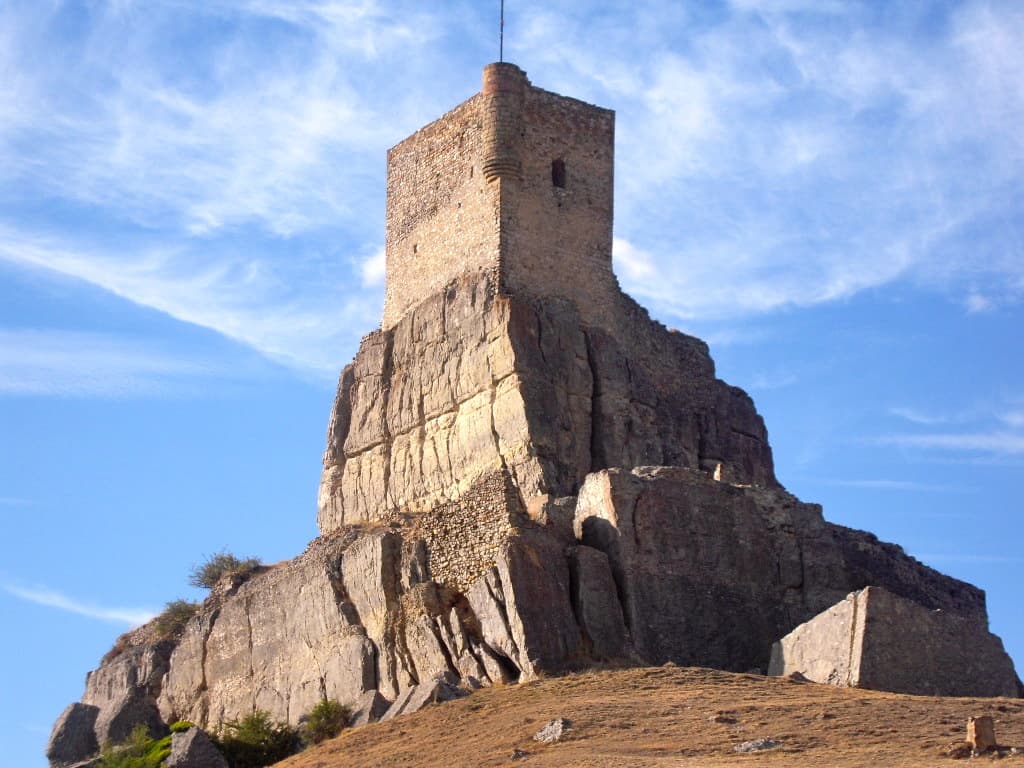 Josemguijarro / CC BY-SA 3.0 es, via Wikimedia Commons
Self-guided audio walking tour of Atienza — GPS route, offline playback, story-driven narration in 32 languages.
“Where medieval stones tell tales of knights, kings, and ancient winds.”
Not the postcards. The stories even locals don't know — whispered in your ear, right where they happened.
This medieval archway has a curious nickname that hints at a blustery secret.
Even a legendary figure like El Cid chose not to challenge this formidable stronghold.
An ancient inscription in an unexpected language hints at the building's earlier life.
Discover every secret of Atienza
Every address, every reveal in full — in your ear, right where it happened.
You pick your stops. You walk. The voice reveals what the others miss.
Your self-guided audio tour of Atienza is ready — pick your landmarks, choose your language, and start the moment you arrive.
BuyLume has a built-in augmented-reality guide. Hold your phone up and its camera shows the street ahead of you, with a glowing arrow laid over the real view that always points to your next stop — no map to puzzle over, no wrong turns. Like everything in Lume, it works fully offline.
Atienza, a municipality in the province of Guadalajara, Spain, is a town where history feels alive, with its medieval layout and architecture preserved through centuries. The town is dominated by the ruins of its imposing castle, visible for miles around. Declared a Historic-Artistic Site, Atienza invites visitors to wander its ancient streets, explore old churches, and immerse themselves in a past shaped by strategic importance and cultural exchange.
Atienza's historical significance is deeply tied to its location as a frontier between Christian and Moorish territories during the Middle Ages. Today, it retains a charm that draws visitors seeking to connect with Spain's heritage, offering a blend of historical sites, museums, and opportunities for outdoor activities in its surrounding natural landscapes.
## From Ancient Settlements to Medieval Stronghold Atienza's origins stretch back to prehistoric and ancient times, with evidence of Celtiberian, Roman, and Visigoth settlements on the site where the castle now stands. The town's strategic importance truly blossomed during the Middle Ages, particularly under Muslim rule, when it became a significant fortified stronghold and a center for culture and commerce.
In the 11th century, Atienza was reconquered by Christian forces led by Alfonso VI in 1085, though it didn't definitively pass into Christian hands until 1112 with Alfonso I of Aragon. The castle, originally built by the Arabs between the 11th and 12th centuries, was further fortified and enlarged by the Christians, serving as a state prison and a key defensive structure along the Duero River. Its formidable nature was even noted in 'El Cantar de Mío Cid,' which described it as a 'very strong rock.'
Atienza's medieval prosperity, lasting until the 15th century, led to the construction of numerous churches, fortified walls, and grand mansions. The town also played a role in the internal struggles of the nobility, famously aiding the young Prince Alfonso VIII, an event still celebrated today in the Fiesta de la Caballada, a festival dating back to 1162. During the Spanish War of Independence, the castle was attacked and looted by French troops. Today, Atienza's old town is recognized as a Historic-Artistic Site, preserving the echoes of its diverse and often tumultuous past.
The imposing Castle of Atienza offers expansive views from its square keep and two floors. The castle grounds also contain two cisterns with brick vaults. Explore the medieval Walls of Atienza, which once comprised two belts, with approximately two kilometers still preserved today. The Arch of San Juan, also known as 'Arrebatacapas,' is a pointed arch that once formed part of the town's first wall.
The Plaza del Trigo (Wheat Square) is a central medieval square, once the most important in town, featuring arcaded buildings and the Church of San Juan del Mercado. The Church of San Juan del Mercado itself, though largely rebuilt in the 16th and 17th centuries, retains some original elements.
Atienza is home to several museums. The San Bartolomé Church Museum (Church of San Bartolomé) is a 12th-century Romanesque church with an arcaded portico, housing a unique collection that combines sacred art with a significant regional paleontology exhibit of fossils and minerals. The Santisima Trinidad Church Museum (Church of the Holy Trinity), also Romanesque with a 12th-century apse, contains a museum dedicated to the La Caballada festival and sacred art, including carvings of the Christ of the Four Nails and the Christ of Forgiveness. The San Gil Religious Art Museum (Church of San Gil), set in a Romanesque church, displays medieval paintings, sculptures, and archaeological finds.
The best times to visit Atienza are during the spring (April to June) and early autumn (September to October). These shoulder seasons offer mild weather, fewer crowds, and pleasant conditions for exploring the town's historic sites and enjoying outdoor activities. Spring brings blooming wildflowers, while autumn offers golden light on the historic architecture. Summer can be quite warm, and while it's a popular time for festivals, it also sees larger crowds.
There is no entrance fee to visit the town of Atienza itself, allowing visitors to freely explore its streets. For those interested in deeper insights, guided tours may be available, particularly during peak season or for special events; inquire at the local tourist information point for details. Comfortable, sturdy shoes are recommended for navigating the ancient streets and the climb to the castle. Staying hydrated, especially during warmer months, is advisable, so bring water. Atienza is situated in the Castilla-La Mancha region and is part of the 'Most Beautiful Towns in Spain' network. The town is also on the route of El Cid and Don Quixote, and one of the pilgrim routes to Santiago de Compostela.
Atienza in Korean, in Chinese or in Hebrew — and 29 more languages, every stop narrated by a native voice. The widest language range of any self-guided audio tour.
Available in: