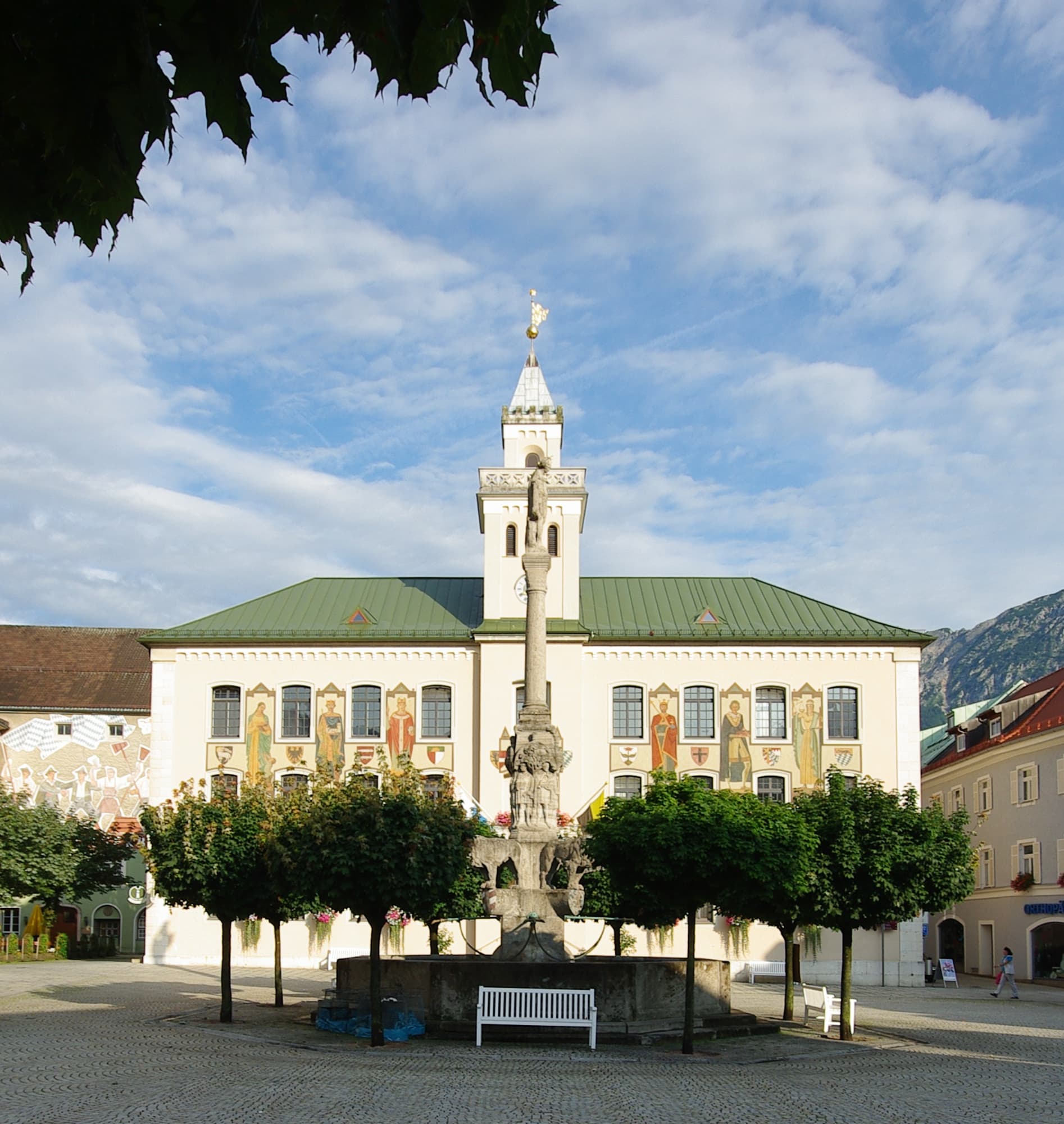
Bad Reichenhall, GermanyLuitold / CC BY-SA 3.0, via Wikimedia Commons
DE

Bad Reichenhall

Self-guided audio walking tour of Bad Reichenhall — GPS route, offline playback, story-driven narration in 32 languages.

Where Alpine air meets ancient salt, a Bavarian spa town with surprising depth.

The secrets of Bad Reichenhall

Bad Reichenhall, as no one tells it.

Not the postcards. The stories even locals don't know — whispered in your ear, right where they happened.

3 secrets below. Many more wait inside the tour.
Alte Saline (Old Salt Works)

Beneath the elegant facade of Bad Reichenhall's Old Salt Works, a secret network of waterways once powered an ingenious system that shaped the region's destiny.

Full story unlocks in the tour
Bad Reichenhaller Markensalz

While you might sprinkle Bad Reichenhaller salt on your food without a second thought, you're actually engaging with one of the oldest established brands in the world.

Full story unlocks in the tour
Predigtstuhl Cable Car

This iconic cable car doesn't just offer expansive views; it's a testament to enduring design and a piece of living history.

Full story unlocks in the tour
The full tour

Discover every secret of Bad Reichenhall

Every address, every reveal in full — in your ear, right where it happened.

Get the key to Bad Reichenhall

You pick your stops. You walk. The voice reveals what the others miss.

Choose your time

How long do you have in Bad Reichenhall?

Your self-guided audio tour of Bad Reichenhall is ready — pick your landmarks, choose your language, and start the moment you arrive.

Buy
About Bad Reichenhall

The story of Bad Reichenhall

Bad Reichenhall, a spa town in Upper Bavaria, Germany, is framed by the Chiemgau Alps, including Mount Staufen and Mount Zwiesel. Its identity is inextricably linked to salt, a resource that has shaped its history and continues to define its character as a health resort. The town's name itself, 'Reichenhall,' means 'rich in salt,' with 'Hall' being an ancient Celtic word for salt. Situated near the Austrian border and just a short distance from Salzburg, Bad Reichenhall offers a blend of serene alpine landscapes and cultural accessibility.

Beyond its reputation for therapeutic brine springs and a tranquil atmosphere, Bad Reichenhall is recognized for its commitment to sustainable tourism, having been awarded Alpine Town of the Year in 2001. Visitors can experience the healing powers of its natural saltwater, mountain pines, and mineral-rich mud, making it a destination for those seeking relaxation and rejuvenation amidst impressive natural beauty.

History

From Ancient Brine to Bavarian Spa

The story of Bad Reichenhall begins over 4,000 years ago, with the earliest known inhabitants, the Bell Beaker culture, settling around 2000 B.C. By 450 B.C., Celtic tribes had established organized salt production, utilizing the region's abundant brine pools. The area then became part of the Roman province of Noricum from 15 B.C. to 480 A.D., with archaeological findings indicating a high level of civilization and trade connections within the Roman Empire.

Salt production continued to flourish, and by the 7th century, the Reichenhall brine pans were well-documented. The saltworks here were among the most productive in the Eastern Alpine region, generating wealth that influenced dukes, archbishops, and kings, and even contributed to the founding of cities like Munich. The demand for wood to fuel the salt evaporation process was so significant that the first Bavarian Forestry Office, possibly the world's first, was established in 1509.

A pivotal moment arrived in 1834 when a devastating fire destroyed two-thirds of the town. King Ludwig I of Bavaria spearheaded the reconstruction, leading to the creation of the magnificent Old Salt Works that stands today. This period also marked a shift towards tourism, with Reichenhall developing into a renowned health resort. In 1890, the town officially adopted the prefix 'Bad,' meaning 'bath' or 'spa' in German, cementing its identity as a spa town.

The 20th century saw the opening of the Predigtstuhl Cable Car in 1928, further enhancing the town's appeal as a destination for both wellness and alpine exploration. While Bad Reichenhall experienced Allied bombing towards the end of World War II in April 1945, which destroyed parts of the town center, it has since rebuilt and re-established itself as a leading spa and alpine destination. In 2001, it was recognized as an Alpine Town of a Year, highlighting its ongoing commitment to sustainable development.

What to see

Start your exploration at the Alte Saline (Old Salt Works), an impressive industrial monument rebuilt by King Ludwig I. Take a guided tour to see the historic salt springs, the salt museum, and the still-operating hydraulic water wheels. Adjacent to the Old Salt Works is the Gradierhaus, a brine inhalation facility where saltwater trickles over blackthorn branches, creating a microclimate akin to a sea breeze—beneficial for respiratory health.

Stroll through the Royal Spa Garden, a meticulously maintained green space with exotic plants and historical statues, offering a tranquil retreat in the heart of the town. For expansive views, take the Predigtstuhl Cable Car, the world's oldest large cable car preserved in its original form, up to the Predigtstuhl mountain. At the summit, you'll find unforgettable vistas of the surrounding Alps and the town below.

For relaxation, visit the Rupertus Therme, a modern spa and family resort featuring alpine brine pools, saunas, and various wellness treatments. The town center itself offers a pleasant pedestrianized zone with shops, cafes, and restaurants. Don't miss the chance to try the original Reber Mozartkugeln chocolates, which were invented here.

When to visit

The ideal time to visit Bad Reichenhall for warm-weather activities is from June through September, when daytime temperatures range from 19-24°C (66-75°F), offering long daylight hours and full access to alpine trails. Expect frequent afternoon thunderstorms in high summer, so pack rain gear. For fewer crowds and better value, consider the shoulder seasons of May-June or September-December. Late September and October bring crisp hiking weather and golden foliage. December is magical for its Advent market and snow-dusted peaks, perfect for combining Christmas market visits with thermal soaks. Avoid November, as many mountain lifts and huts close.

Practical

Bad Reichenhall is easily accessible by rail, with direct commuter trains from Salzburg to Berchtesgaden passing through the town every 30 to 60 minutes. Travelers from Munich will need to connect in Salzburg or Freilassing. The town center is largely pedestrianized, making it pleasant for walking. For exploring the surrounding area, consider renting an e-bike. Parking can be challenging, so look for designated lots or choose accommodations with parking. If planning spa treatments at Rupertus Therme, booking in advance is recommended, especially during peak seasons. The local tourist information office can assist with accommodation, attractions, and event tickets. Bad Reichenhall serves as an excellent base for exploring the Berchtesgaden Alps and is just a 20-minute train ride from Salzburg, Austria.

Good to know
What is Bad Reichenhall known for?
Bad Reichenhall is renowned as a spa town, famous for its therapeutic brine springs and salt production, which has a history spanning over 4,000 years. It's also known for its alpine setting and commitment to sustainable tourism.
How far is Bad Reichenhall from Salzburg?
Bad Reichenhall is located approximately 14 kilometers (9 miles) southwest of Salzburg, Austria, making it a convenient day trip or a tranquil base for exploring both regions.
What is the 'Gradierhaus'?
The Gradierhaus, or brine inhalation facility, is a structure where saltwater trickles over blackthorn branches, creating a fine, salty mist in the air. Inhaling this air is believed to be beneficial for respiratory health, similar to a sea breeze.
Can you visit the Old Salt Works?
Yes, the Alte Saline (Old Salt Works) offers guided tours where visitors can explore the historic salt springs, underground tunnels, and a salt museum, learning about centuries of salt production.
When is the best time to visit for hiking?
The best time for hiking in Bad Reichenhall is from June through September, when the weather is warm, daylight hours are long, and the full alpine trail network is open.
Are there any unique local products from Bad Reichenhall?
Beyond its famous Bad Reichenhaller salt, the town is also the birthplace of the original Reber Mozartkugeln chocolates.
On the map
Bad Reichenhall
€9.90
No booking · activate anytime · 12h to walk it
Load on Wi-Fi, then walk offline — no roaming abroad
Get the key to Bad Reichenhall