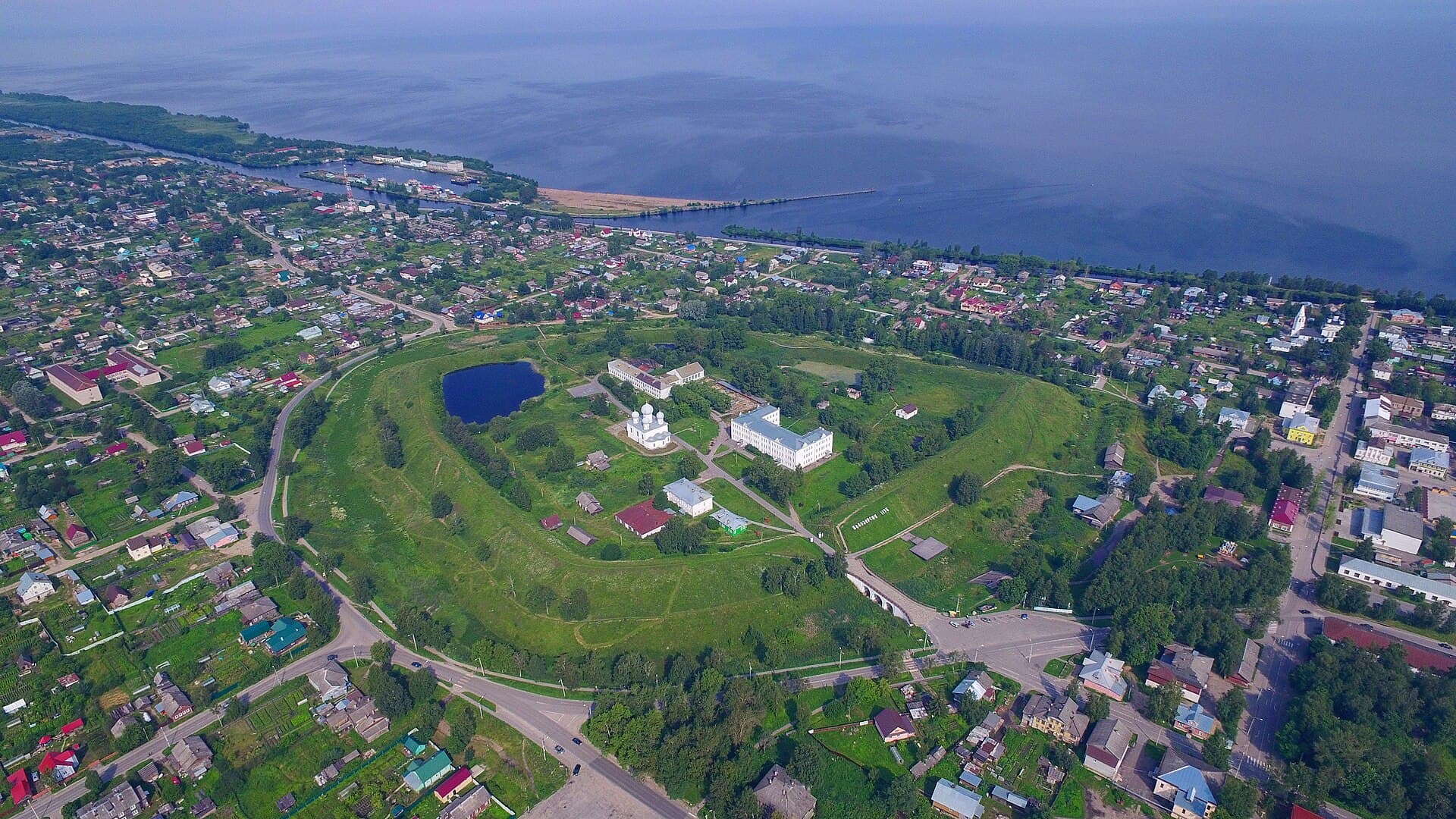
Belozersk, RussiaШелковников Евгений Анатольевич / CC BY-SA 4.0, via Wikimedia Commons
RU

Belozersk

Self-guided audio walking tour of Belozersk — GPS route, offline playback, story-driven narration in 32 languages.

Where ancient ramparts meet the quiet expanse of White Lake.

The secrets of Belozersk

Belozersk, as no one tells it.

Not the postcards. The stories even locals don't know — whispered in your ear, right where they happened.

3 secrets below. Many more wait inside the tour.
The Mound of Sineus

Near Belozersk lies a burial mound tied to one of Russia's legendary founders. Even a tsar tried to unearth its secrets, but ultimately ordered it sealed again.

Full story unlocks in the tour
Belozersk Kremlin

The formidable earthen ramparts of Belozersk's Kremlin held a surprising secret for defending against sieges, a detail often overlooked in military architecture.

Full story unlocks in the tour
Belozersk (Old Town)

Belozersk isn't where it started. The city has a habit of moving around, leaving behind older versions of itself.

Full story unlocks in the tour
The full tour

Discover every secret of Belozersk

Every address, every reveal in full — in your ear, right where it happened.

Get the key to Belozersk

You pick your stops. You walk. The voice reveals what the others miss.

Belozersk
Шелковников Евгений Анатольевич / cc by-sa 4.0, via Wikimedia Commons
Choose your time

How long do you have in Belozersk?

Your self-guided audio tour of Belozersk is ready — pick your landmarks, choose your language, and start the moment you arrive.

Buy
About Belozersk

The story of Belozersk

Belozersk, an ancient Russian town on the southern bank of Lake Beloye in the Vologda Oblast, holds a history stretching back over a millennium. First mentioned in the 'Tale of Bygone Years' in 862, it is considered one of Russia's oldest settlements. The city, originally known as Beloozero, has a dynamic past, having relocated several times across the shores of its namesake White Lake. Today, Belozersk offers a tranquil escape, inviting visitors to explore its enduring heritage and the serene natural beauty of the Russian North.

Despite its long history, Belozersk remains a relatively small town. It was included in the list of historical settlements of the RSFSR in 1990, and 52 cultural heritage objects are under state protection, with seven of federal significance. The town's enduring charm lies in its well-preserved historical core, dominated by the impressive earthen ramparts of the Belozersk Kremlin. It's a place where legends intertwine with tangible history, offering a glimpse into the formative years of the Russian state.

History

## From Ancient Origins to Princely Power Belozersk's recorded history begins in 862, when it was first mentioned as Beloozero in the 'Tale of Bygone Years' alongside other foundational Russian cities like Novgorod and Polotsk. Legend states that Rurik's brother Sineus became its first prince, though historical consensus suggests Sineus and his brother Truvor likely never existed. The city's location was not static; it moved multiple times, at one point spanning both banks of the Sheksna River where it flows from Lake Beloye.

For centuries, Beloozero was a significant center, initially under the authority of Novgorod and later Kiev. In the 11th century, the region was still largely inhabited by Finnic tribes who fiercely resisted Christianization, leading to a notable pagan rebellion in 1071. The city gained independence as the Principality of Beloozero in 1238, a period when it also served as a refuge for Bishop Kirill of Rostov, escaping the Mongol-Tatar invasions. The principality maintained its autonomy until the 1380s, when, following the death of its senior princes at the Battle of Kulikovo, it fell under the control of Grand Duke Dmitry Ivanovich Donskoy of Moscow.

## Flourishing Trade and Fortified Walls Under the reign of Ivan III in the late 15th century, Belozersk experienced a period of prosperity. In 1487, formidable 30-meter earthen ramparts were constructed, forming a powerful wooden kremlin surrounded by a moat. These were the largest earthworks in Russia at the time, and the Kremlin was strategically designed with five non-drying springs within its walls, ensuring a constant water supply during sieges. This era saw Belozersk become a crucial fortress on the northern borders of the burgeoning Muscovite state and a hub for trade routes.

## Decline and Revival The 17th century brought hardship, with Belozersk being the first northern city to be looted and partially burned by Polish-Lithuanian invaders in 1612. The wooden fortifications eventually fell into disrepair and were dismantled in the 18th century. However, the city began to rebuild in the latter half of the 17th century, and by 1777, when it officially became Belozersk, it contained 22 temples. The 19th century saw some economic development with the opening of the Mariinsky water system and the Belozersky Bypass Canal, which facilitated logging and trade. Today, Belozersk is recognized as a historical settlement, preserving its ancient past through its architectural monuments and museums.

What to see

The most prominent sight in Belozersk is the Belozersk Kremlin, an impressive complex of earthen ramparts dating back to the late 15th century. These monumental earthworks, some of the largest in Russia at the time of their construction, offer panoramic views of Lake Beloye and the surrounding town. While the original wooden fortifications are gone, the scale of the ramparts themselves is a testament to the city's historical importance.

Within the historical center, you'll find significant religious architecture. The Assumption Church, built in 1552, and the Transfiguration Cathedral from 1668 are notable examples of medieval monuments. The wooden Church of St. Elijah the Prophet, constructed in 1690, is a rare survivor and marks the site of a historical skirmish.

For a deeper dive into the city's past, visit the Belozersk Regional Museum of Local Lore. Housed in a 19th-century building, it offers exhibits spanning from the Paleolithic era to the 20th century, including archaeological finds and models of lost churches. The museum also provides interactive experiences, allowing visitors to engage with historical artifacts and even try on period clothing. Nearby, the Kirillo-Belozersky Monastery and Ferapontov Monastery are also significant historical and spiritual sites worth exploring.

When to visit

Belozersk experiences a humid continental climate, characterized by warm summers and cold, snowy winters. The most pleasant time to visit is during the warmer months, from late May to early September. July is typically the warmest month, with average temperatures around +18.5°C, making it ideal for exploring the outdoor historical sites and enjoying the lake. Winters are cold, with average January and February temperatures around -7.2°C, and can be quite picturesque with snow, but outdoor activities will be more limited.

Practical

Belozersk is located in the Vologda Oblast, approximately 214 kilometers northwest of Vologda, the administrative center. The town is accessible by car, with driving times of about 1 hour 30 minutes from Cherepovets and 2 hours 40 minutes from Vologda. While there is no direct railway access, the town's historical development was linked to waterways, and the Volga-Baltic Waterway passes nearby. For accommodation, options such as Hotel Legenda are available. The local cuisine can be sampled at restaurants like 'Kalina Krasnaya' and 'Panorama.' The Belozersk Regional Museum of Local Lore offers audio guides for its exhibitions, providing detailed information on 40 exhibits through the Artefact platform.

Good to know
What is Belozersk known for?
Belozersk is primarily known for its ancient history, dating back to 862 AD, making it one of Russia's oldest cities. It's famous for its well-preserved earthen ramparts of the Belozersk Kremlin and its connection to early Russian princely history.
How old is Belozersk?
Belozersk was first mentioned in the 'Tale of Bygone Years' in 862, making it over 1160 years old.
What is the Belozersk Kremlin?
The Belozersk Kremlin consists of massive earthen ramparts, constructed in 1487 under Ivan III. These were once the largest earthworks in Russia and housed a wooden fortress designed with unique defensive features, including internal springs.
Are there any museums in Belozersk?
Yes, the main museum is the Belozersk Regional Museum of Local Lore, which covers the town's history from the Paleolithic era to the 20th century. It offers interactive exhibits and displays archaeological finds and models of historical churches.
What is the significance of Lake Beloye for Belozersk?
Lake Beloye (White Lake) is central to Belozersk's identity, with the city taking its name from the lake. The city's location has shifted around the lake's shores throughout history, and the lake played a role in its trade routes.
Is Belozersk easy to get to?
Belozersk is accessible by car. It is located 214 kilometers northwest of Vologda and can be reached from Cherepovets in about 1.5 hours and from Vologda in about 2 hours 40 minutes.
On the map
Belozersk
€9.90
No booking · activate anytime · 12h to walk it
Load on Wi-Fi, then walk offline — no roaming abroad
Get the key to Belozersk