Cathedral of the Nativity of Christ
This 16th-century cathedral has been slowly sinking into the ground for centuries.
Full story unlocks in the tour
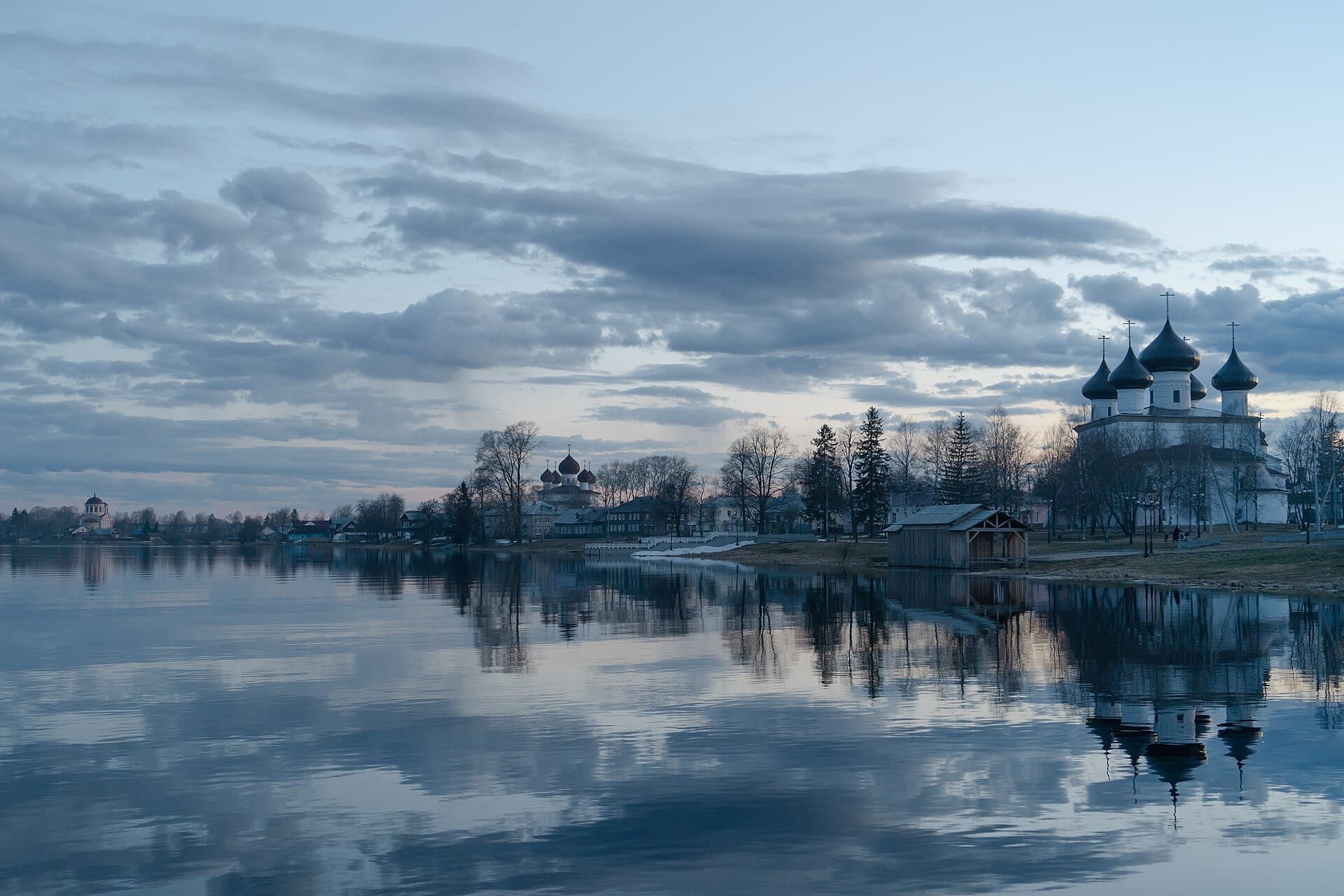 Olga Erilova / CC BY-SA 4.0, via Wikimedia Commons
Self-guided audio walking tour of Kargopol — GPS route, offline playback, story-driven narration in 32 languages.
“Where white stone churches guard ancient secrets and clay figures whisper forgotten tales.”
Not the postcards. The stories even locals don't know — whispered in your ear, right where they happened.
This 16th-century cathedral has been slowly sinking into the ground for centuries.
During a pivotal moment in Russian history, the cellars of this church held a surprising secret.
An art critic once compared the intricate stone carvings of this northern Russian church to the palaces of the Florentine Renaissance.
Discover every secret of Kargopol
Every address, every reveal in full — in your ear, right where it happened.
You pick your stops. You walk. The voice reveals what the others miss.


Your self-guided audio tour of Kargopol is ready — pick your landmarks, choose your language, and start the moment you arrive.
BuyLume has a built-in augmented-reality guide. Hold your phone up and its camera shows the street ahead of you, with a glowing arrow laid over the real view that always points to your next stop — no map to puzzle over, no wrong turns. Like everything in Lume, it works fully offline.
Kargopol is a small, ancient town in the Arkhangelsk Oblast of Russia, situated on both sides of the Onega River, a few miles north of Lake Lacha. First chronicled in 1146, it was a vital trade station of the Novgorod Republic and one of the northernmost permanent Russian settlements. The town's name itself is a historical puzzle, with 'pol(e)' meaning 'field,' while the first part can be translated as either 'crow' or 'bear,' reflecting its layered Finno-Ugric and Russian heritage.
Today, Kargopol is known for its remarkably preserved white-stone churches from the 16th to 19th centuries, adorned with distinctive local patterns. It serves as a gateway to the natural beauty of Kenozersky National Park and is a destination in its own right for those seeking to explore traditional wooden architecture and a slower pace of life in the Russian North. In 2020, Kargopol was recognized for its beauty, joining the Russian Association of the Most Beautiful Villages and Towns.
The history of Kargopol stretches back further than its official founding. Archaeological evidence suggests human habitation in the area as early as the 4th millennium BC, with early pottery traditions emerging in the Stone Age. The town's strategic location on the Onega River, connecting to the White Sea, made it a crucial trading post. During the 13th and 14th centuries, it was considered the most significant trade center of Bjarmaland.
Kargopol's importance grew, especially after the mid-16th century when it became a prosperous city on the ancient route between Moscow and Arkhangelsk, then Russia's only seaport. It held the valuable privilege of salt trade, a luxury commodity, which further boosted its economy. This prominence was such that in 1588, an English ambassador even listed Kargopol among Russia's most important cities, alongside Moscow.
The town was not without its struggles. During the tumultuous Time of Troubles, Kargopol successfully withstood multiple sieges by Polish and Lithuanian brigands, protected by its robust wooden fortress. However, its defenses are now mostly gone, with only earthen dikes, known as 'valushki,' remaining. Kargopol also served as a place of exile, notably for the peasant rebel leader Ivan Bolotnikov, who was executed here in 1608.
The 18th century marked a gradual decline for Kargopol. The shallowing of the Onega River impacted its trade routes, and the founding of St. Petersburg and Russia's access to the Baltic Sea shifted commercial focus away from the northern port of Arkhangelsk. A devastating fire in 1765 destroyed much of the city, though it was rebuilt with the help of Catherine the Great, who implemented a new 'regular plan' for the town, a plan later applied to other cities including St. Petersburg. The final blow to its former glory came with the construction of a railroad in the 19th century that bypassed Kargopol, leaving it somewhat isolated and earning it the moniker 'bear's corner.'
Despite its diminished economic significance, Kargopol retained its cultural and architectural heritage. It became known for a unique style of medieval Russian architecture, particularly its white-stone churches. The town is also the birthplace of Alexander Baranov, the first governor of Russian America (Alaska). Today, Kargopol is celebrated for its distinctive folk arts, especially the Kargopol clay toys, a tradition that almost died out but was revived through the efforts of local artisans.
Kargopol's charm lies in its well-preserved architectural ensemble and lively folk traditions. Begin your exploration at Cathedral Square (New Market Square), the heart of the town. Here stands the majestic Cathedral of the Nativity of Christ, the city's first stone church, consecrated in 1562. Inside, marvel at its unique collection of 'heavens'—painted wooden ceilings gathered from across the region—and a miraculously preserved five-tiered carved iconostasis from the 18th century. Nearby, the Vvedensky Church now houses the central exhibition hall of the Kargopol State Museum of History, Art, and Architecture. Do not overlook the imposing Cathedral Bell Tower, a sixty-meter stone structure built for a royal visit that never materialized.
Stroll along the streets to discover other exquisite examples of Russian white-stone architecture, such as the Church of the Annunciation, renowned for its intricate stone ornamentation. While the original wooden fortress is largely gone, you can still discern the 'valushki'—earthen dikes—that mark its former perimeter.
For a deeper dive into local culture, visit the Bereginya Centre of Folk Handicrafts, located in the historic House of Merchant Veshnyakov. Here you can learn about and even try your hand at making the famous Kargopol clay toys, birch bark weaving, and other traditional crafts. The Kargopol State Museum of History, Art, and Architecture offers a comprehensive look at the region's past, with ethnographic, art, and historical exhibits. Consider a visit to the Eco-Park 'Bear Land' (Medvezhiy Kray), a fairytale-like corner in a pine forest, featuring unique compositions and evening illuminations. The surrounding area of Kargopol also offers preserved wooden architecture, including tent-roofed churches in villages like Saunino and Oshevensk, and the Epiphany Church in Lyadiny.
The best time to visit Kargopol is during the warmer months, from late spring to early autumn, generally May through September. This allows for comfortable exploration of the town's outdoor architectural monuments and the surrounding natural landscapes, including Kenozersky National Park. Summer also brings local festivals, such as the 'Crystal Ringing' bell art festival and the Festival of Russian Craftsmen, offering unique cultural experiences. Winters are cold and snowy, but can offer a picturesque, quiet charm for those prepared for the weather.
Kargopol is located in the Arkhangelsk Oblast. The nearest train station is in Nyandoma, from which buses run to Kargopol. You can also reach Kargopol by bus from Arkhangelsk (Bus #521, approximately 8 hours). Driving is another option, with routes from Arkhangelsk (highway R-1), Moscow (M-8, then R-2), or St. Petersburg (via Vytegra), though some roads can be challenging. The town itself is small and walkable, with many attractions concentrated along Oktyabrsky Prospekt. For exploring the surrounding villages and wooden architecture, having your own transport or arranging a tour with the Kargopol Museum is highly recommended.
Accommodation options include the Kargopol Hotel and the Kargopolochka Hotel, both located in the city center. For dining, local delicacies include Kargopol-style ukha (fish soup), Kargopol gingerbread, and especially the traditional 'Kargopol thin pies' or 'podorozhniki,' which were historically baked for travelers. There are also supermarkets for basic necessities.
Kargopol in Korean, in Chinese or in Hebrew — and 29 more languages, every stop narrated by a native voice. The widest language range of any self-guided audio tour.
Available in: