Roman Baths
Beneath the surface of a seemingly medieval town lies a secret world of ancient luxury, complete with intricate aquatic artistry.
Full story unlocks in the tour
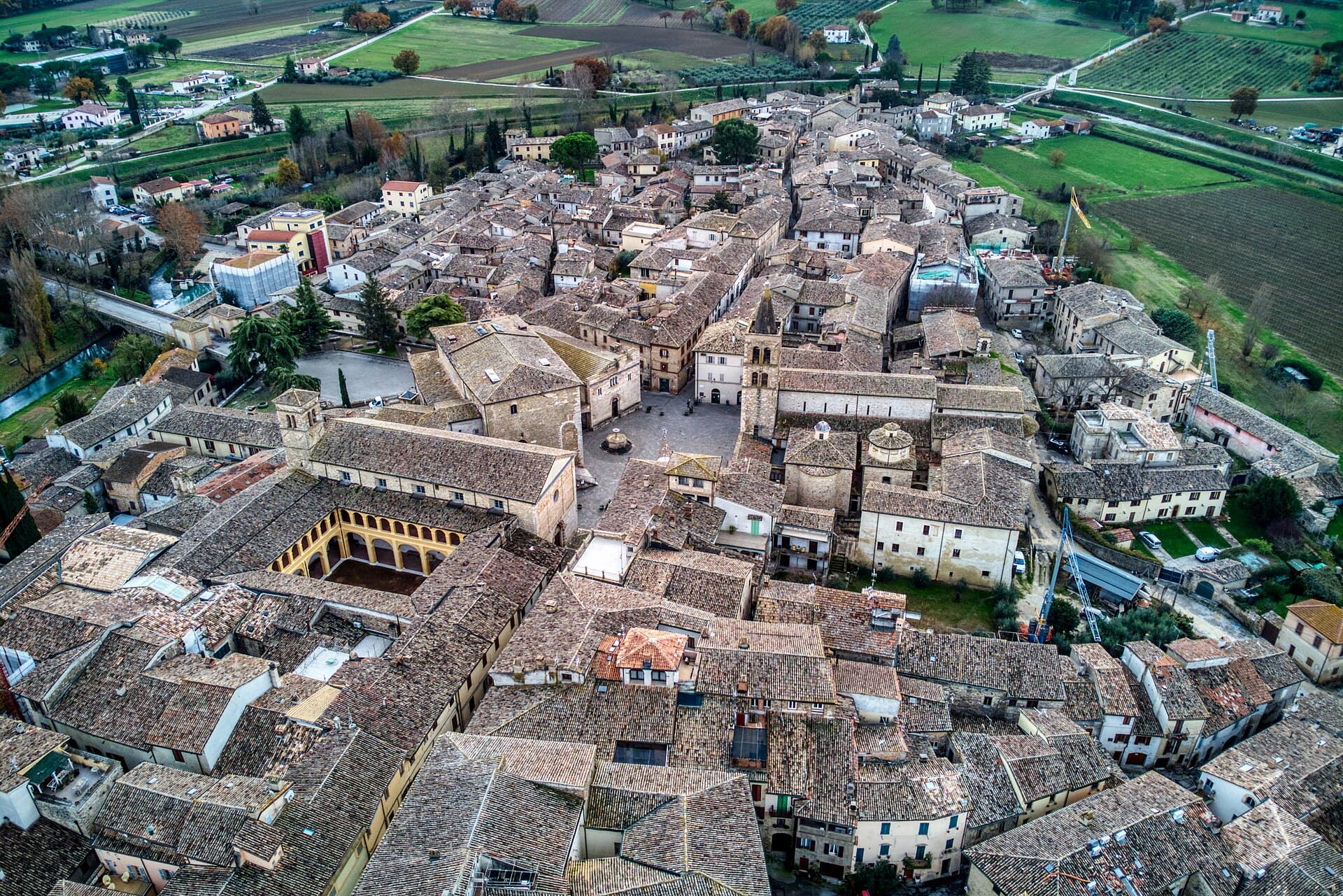 Hagai Agmon-Snir حچاي اچمون-سنير חגי אגמון-שניר / CC BY-SA 4.0, via Wikimedia Commons
Self-guided audio walking tour of Bevagna — GPS route, offline playback, story-driven narration in 32 languages.
“Where Roman foundations meet medieval grandeur, and history unfolds with every step.”
Not the postcards. The stories even locals don't know — whispered in your ear, right where they happened.
Beneath the surface of a seemingly medieval town lies a secret world of ancient luxury, complete with intricate aquatic artistry.
A humble stone within a Bevagna church is said to bear the impression of a saint's feet from a legendary sermon.
The central fountain in Bevagna's main square appears ancient, but its true age might surprise you.
Discover every secret of Bevagna
Every address, every reveal in full — in your ear, right where it happened.
You pick your stops. You walk. The voice reveals what the others miss.


Your self-guided audio tour of Bevagna is ready — pick your landmarks, choose your language, and start the moment you arrive.
BuyLume has a built-in augmented-reality guide. Hold your phone up and its camera shows the street ahead of you, with a glowing arrow laid over the real view that always points to your next stop — no map to puzzle over, no wrong turns. Like everything in Lume, it works fully offline.
Bevagna, a captivating medieval village in the heart of Umbria, offers a journey back in time where Roman foundations meet medieval splendor. Surrounded by intact 14th-century walls, this charming town, a member of "I Borghi più Belli d'Italia" (The Most Beautiful Villages in Italy), invites exploration of its winding alleys, ancient squares, and historic buildings. Unlike many Umbrian towns on hilltops, Bevagna sits on the flat Foligno plain, making it easy to navigate on foot as you uncover layers of history, from its Etruscan origins to its Roman and medieval past.
Beyond its architectural beauty, Bevagna is a living testament to tradition and craftsmanship. The town is recognized for its first-rate olive oil and Sagrantino DOCG wine, with vineyards and olive groves flourishing on the surrounding hills. Its engaging cultural scene is anchored by the Mercato delle Gaite, a meticulous medieval reenactment that transforms the town into a bustling 14th-century marketplace, showcasing ancient trades and culinary traditions. Whether you're drawn to its profound history, authentic local products, or immersive cultural experiences, Bevagna promises a deep and memorable encounter with Italy's past.
Bevagna's story stretches back to the Iron Age, with evidence of human presence dating to the 7th century B.C. Originally an Umbrian settlement, it became the Roman municipality of Mevania in 90 B.C., a name potentially signifying "the city that stands in the middle," highlighting its early geographical and political importance. The Romans recognized its strategic value, establishing it as a crucial commercial hub with a port on the Tiber River, connecting it directly to Rome via the Via Flaminia. Remains of a Roman temple, thermal baths with intricate mosaics, and the outline of an ancient theater still attest to its significant Roman past.
With the fall of the Roman Empire, Bevagna entered a period of shifting allegiances and conflicts. It fell under the rule of the Lombards, becoming part of the Duchy of Spoleto, and later experienced alternate domination by Spoleto, Foligno, the Germanic Empire, Perugia, and the Papal States. In 1187, Bevagna emerged as a free commune governed by consuls, a testament to its growing independence. The 13th century saw the rebuilding of the Palazzo dei Consoli in 1270, a symbol of its communal power. From 1371 to 1439, the town was under the lordship of the Trinci of Foligno, before returning to the direct dominion of the Holy See, where it remained until the Unification of Italy in 1860.
Throughout the Middle Ages, Bevagna's urban layout was shaped by its waterways, which powered mills and fostered artisan production of goods like yarns, hides, and paper. Today, its medieval character is remarkably preserved, with its walls, towers, gates, and the distinctive Piazza Silvestri, a masterpiece of medieval urban planning.
Begin your exploration in Piazza Silvestri, Bevagna's irregular yet captivating central square, home to significant architectural treasures. Here, you'll find the 12th-century Basilica of San Silvestro, a prime example of Umbrian Romanesque architecture, and the collegiate Church of San Michele Arcangelo, also from the 12th century, with its beautiful portal and spired bell tower. The 13th-century Gothic Palazzo dei Consoli dominates the square, housing the exquisite 19th-century Teatro Francesco Torti. Do not miss the 18th-century Fontana delle Tortorelle in the square's center.
Beyond the main square, discover the Church of San Domenico and Fra Giacomo, built in the late 13th century, featuring 14th-century frescoes and 13th-century wooden sculptures. Ascend to the highest point of town to visit the 13th-century Church of Saint Francis, which contains works by Doni Doni and a Pietà by Ascensidonio Spacca, and the stone where St. Francis is said to have preached to the birds. Explore the Roman past at the Museo Civico, where your ticket grants access to a nearby building housing remnants of a 2nd-century BCE Roman thermal bath mosaic depicting marine creatures. Wander along the medieval walls and through the four historic quarters (Gaite) to discover artisan workshops dedicated to traditional crafts like paper making, silk weaving, and ironmongery.
For a unique experience beyond the town walls, visit the Tenuta Castelbuona winery, famous for its copper-domed 'Il Carapace' building, offering wine tastings with views of Sagrantino vineyards.
The best times to visit Bevagna are during spring (May, June) and autumn (September, October) when the weather is mild and pleasant, with temperatures ranging from 20°C to 30°C (68°F to 86°F). These months offer ideal conditions for exploring the town and its surrounding vineyards. July and August are the warmest months, with average highs of 30°C (86°F) and clearer skies, suitable for warm-weather activities, but can also be drier. The most significant event, the Mercato delle Gaite, takes place for ten days in late June, transforming the town into a lively medieval spectacle.
Bevagna is easily accessible, with the nearest airport being Umbria International Airport (Perugia). From there, you can rent a car or take a bus to Foligno, which is about 10 km away. Foligno also has the nearest train station, with regular bus connections to Bevagna taking approximately 15 minutes.
While you cannot drive into the historic center due to narrow streets, several free parking lots are available just outside the medieval walls, such as Parcheggio Clitunno on the southwest side of town. Bevagna is a compact town, and its relatively flat terrain makes it easy to explore on foot. Consider staying in nearby Spello, which offers more dining options, though Bevagna itself has authentic trattorias where locals often outnumber tourists. Many artisan workshops are open year-round, offering demonstrations and guided tours.
Bevagna in Korean, in Chinese or in Hebrew — and 29 more languages, every stop narrated by a native voice. The widest language range of any self-guided audio tour.
Available in: