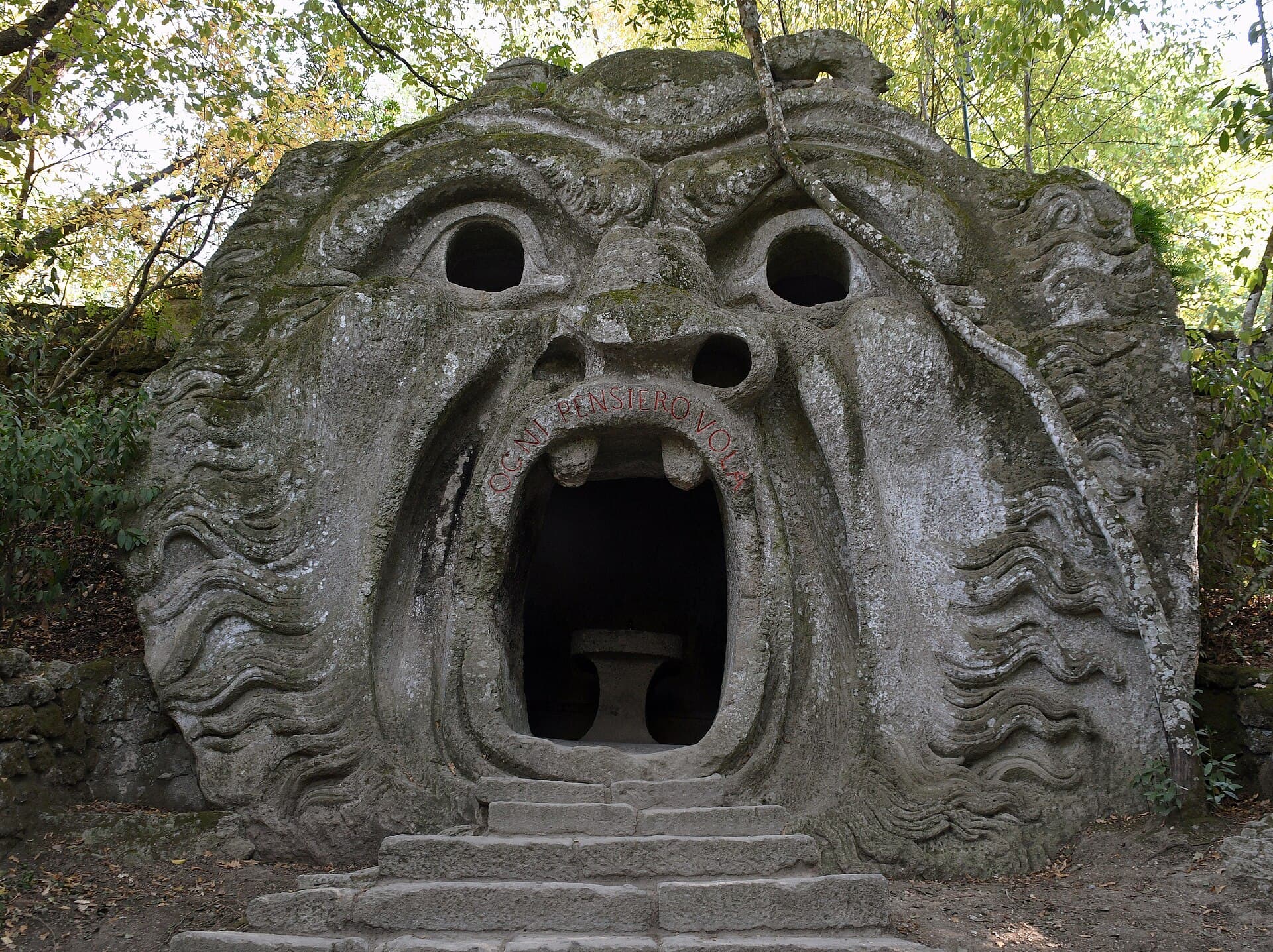
The Mouth of Orcus
Journey into the gaping maw of a monstrous face, and you will discover more than just darkness.
Full story unlocks in the tour
 Livioandronico2013 / CC BY-SA 4.0, via Wikimedia Commons
Self-guided audio walking tour of Bomarzo — GPS route, offline playback, story-driven narration in 32 languages.
“Where stone giants and enigmatic symbols twist through a Renaissance dreamscape.”
Not the postcards. The stories even locals don't know — whispered in your ear, right where they happened.
Journey into the gaping maw of a monstrous face, and you will discover more than just darkness.
Among the fantastical sculptures, a small structure defies architectural logic, built deliberately off-kilter.
One of the park's colossal figures depicts a creature of battle, yet its symbolism might extend beyond mere aggression.
Discover every secret of Bomarzo
Every address, every reveal in full — in your ear, right where it happened.
You pick your stops. You walk. The voice reveals what the others miss.

Your self-guided audio tour of Bomarzo is ready — pick your landmarks, choose your language, and start the moment you arrive.
BuyLume has a built-in augmented-reality guide. Hold your phone up and its camera shows the street ahead of you, with a glowing arrow laid over the real view that always points to your next stop — no map to puzzle over, no wrong turns. Like everything in Lume, it works fully offline.
Bomarzo, a captivating village in the Lazio region of Italy, offers a journey into the unexpected. Situated on a rocky spur amidst the rolling hills and volcanic landscapes of Tuscia, it presents a unique blend of medieval character and Renaissance eccentricity. While its historic center, with its narrow, winding streets and traditional stone buildings, exudes a timeless appeal, it is the extraordinary Sacro Bosco, or 'Sacred Grove,' that truly distinguishes Bomarzo.
This is not a destination for those seeking perfectly manicured gardens or predictable historical narratives. Instead, Bomarzo invites you to embrace the surreal, to wander through a landscape where colossal stone figures and enigmatic structures challenge perception and ignite the imagination. It is a place where art, nature, and history intertwine in a way that has fascinated artists, scholars, and curious travelers for centuries.
## From Ancient Roots to Princely Visions Bomarzo's origins extend back to antiquity, with evidence suggesting Etruscan and Roman settlements, and its name possibly deriving from 'Polimartium,' meaning 'town of Mars.' The village served as a bishop's seat as early as the 6th century and later became part of a Roman duchy before being donated to the church by Charlemagne.
In the 16th century, Bomarzo became a fiefdom of the influential Orsini family, a period that marked a significant transformation for the town. It was under the patronage of Prince Pier Francesco Orsini, known as Vicino, that Bomarzo truly found its singular identity. A condottiero and patron of the arts, Vicino Orsini embarked on an ambitious project in 1552: the creation of the Sacro Bosco, or 'Sacred Grove.'
Designed by the acclaimed architect Pirro Ligorio, who had also contributed to St. Peter's Cathedral in Rome, the Sacro Bosco was a radical departure from the symmetrical and harmonious Renaissance gardens of the era. It was conceived as a 'Villa of Wonders,' a landscape filled with grotesque sculptures carved directly from the volcanic peperino stone of the region. Scholars believe the park was an intensely personal project for Orsini, an expression of his profound grief following the death of his wife, Giulia Farnese. The park's unsettling and disorienting design was intended to shock and provoke thought, rather than soothe.
After Orsini's passing in 1583, the garden fell into neglect and obscurity for centuries, becoming overgrown and largely forgotten. It was not until the 20th century that the Sacro Bosco was rediscovered, notably by Surrealist artist Salvador Dalí, who visited in the 1940s and was deeply inspired by its fantastical elements. Today, the Bettini family manages the park, having undertaken its restoration and opening it to the public, allowing visitors to experience Orsini's extraordinary vision.
The primary attraction in Bomarzo is undoubtedly the Sacro Bosco, also recognized as the Park of the Monsters (Parco dei Mostri). This 16th-century Mannerist garden is a labyrinth of colossal sculptures carved from local volcanic rock. Wander freely among grotesque figures of mythical beasts, giants, and enigmatic architectural follies. Do not miss the iconic Mouth of Orcus, a gaping maw with an unsettling inscription, or the Leaning House, crafted to disorient visitors with its tilted interior. Other notable sculptures include the War Elephant, battling dragons, and various mythological figures.
Beyond the park, explore the charming historic center of Bomarzo. The imposing Palazzo Orsini, a Renaissance palace that once served as the seat of the powerful Orsini family, dominates the skyline. While portions now house the town hall, its grand halls and Renaissance frescoes offer a glimpse into Bomarzo's aristocratic past. The Church of Santa Maria Assunta, an early Christian church restored in the 16th century, is also worth a visit for its Renaissance frescoes and sculptures. For those seeking an older mystery, the Etruscan Pyramid of Bomarzo, a large carved boulder in a nearby forest, offers a fascinating archaeological detour.
The best times to visit Bomarzo are during the spring (April to June) and early autumn (September to October). During these months, the weather is pleasant, with average temperatures ranging from 19°C to 28°C, making it ideal for exploring the outdoor attractions like the Sacro Bosco and the surrounding natural landscapes. The lush greenery of the forest is particularly beautiful in spring and autumn. Summers can be warm, with August seeing average highs of 32°C (90°F), while winters are cooler and quieter.
Bomarzo is located in the province of Viterbo, approximately 90 kilometers north of Rome. The most convenient way to reach Bomarzo is by car, taking the A1 motorway (Milan–Naples) and exiting at Orte or Attigliano, then following local signs. Free parking is available near the Sacro Bosco entrance. While public transport is less direct, you can take a regional train from Rome to Orte Scalo or Viterbo, then connect via a local COTRAL bus to Bomarzo.
The Sacro Bosco is open daily, typically from 9:00 AM to 7:00 PM during the warmer months (March-September) and closing earlier in winter (November-February, 9:00 AM - 5:00 PM). Last admission is usually one hour before closing. Adult entrance tickets are €15, with discounts for children (4-13 years old) at €9, and free entry for children under 4. The park is not wheelchair accessible due to unpaved and uneven paths. Comfortable walking shoes are highly recommended. There is a restaurant and snack bar on-site. Accommodations in Bomarzo include charming bed and breakfasts, hotels, and vacation rentals.
Bomarzo in Korean, in Chinese or in Hebrew — and 29 more languages, every stop narrated by a native voice. The widest language range of any self-guided audio tour.
Available in: