Piazza San Rufo
Rieti claims the geographical center of Italy, a notion stretching back to ancient Roman times.
Full story unlocks in the tour
 Alessandro Antonelli / CC BY 3.0, via Wikimedia Commons
Self-guided audio walking tour of Rieti — GPS route, offline playback, story-driven narration in 32 languages.
“Rieti: Where ancient Roman engineering meets Franciscan spirituality at the heart of Italy.”
Not the postcards. The stories even locals don't know — whispered in your ear, right where they happened.
Rieti claims the geographical center of Italy, a notion stretching back to ancient Roman times.
Beneath Rieti's modern streets lies a Roman engineering marvel that solved a critical ancient problem.
The serene Velino River, coursing through Rieti, holds a dramatic secret about its ancient past and a powerful Roman intervention.
Discover every secret of Rieti
Every address, every reveal in full — in your ear, right where it happened.
You pick your stops. You walk. The voice reveals what the others miss.


Your self-guided audio tour of Rieti is ready — pick your landmarks, choose your language, and start the moment you arrive.
BuyLume has a built-in augmented-reality guide. Hold your phone up and its camera shows the street ahead of you, with a glowing arrow laid over the real view that always points to your next stop — no map to puzzle over, no wrong turns. Like everything in Lume, it works fully offline.
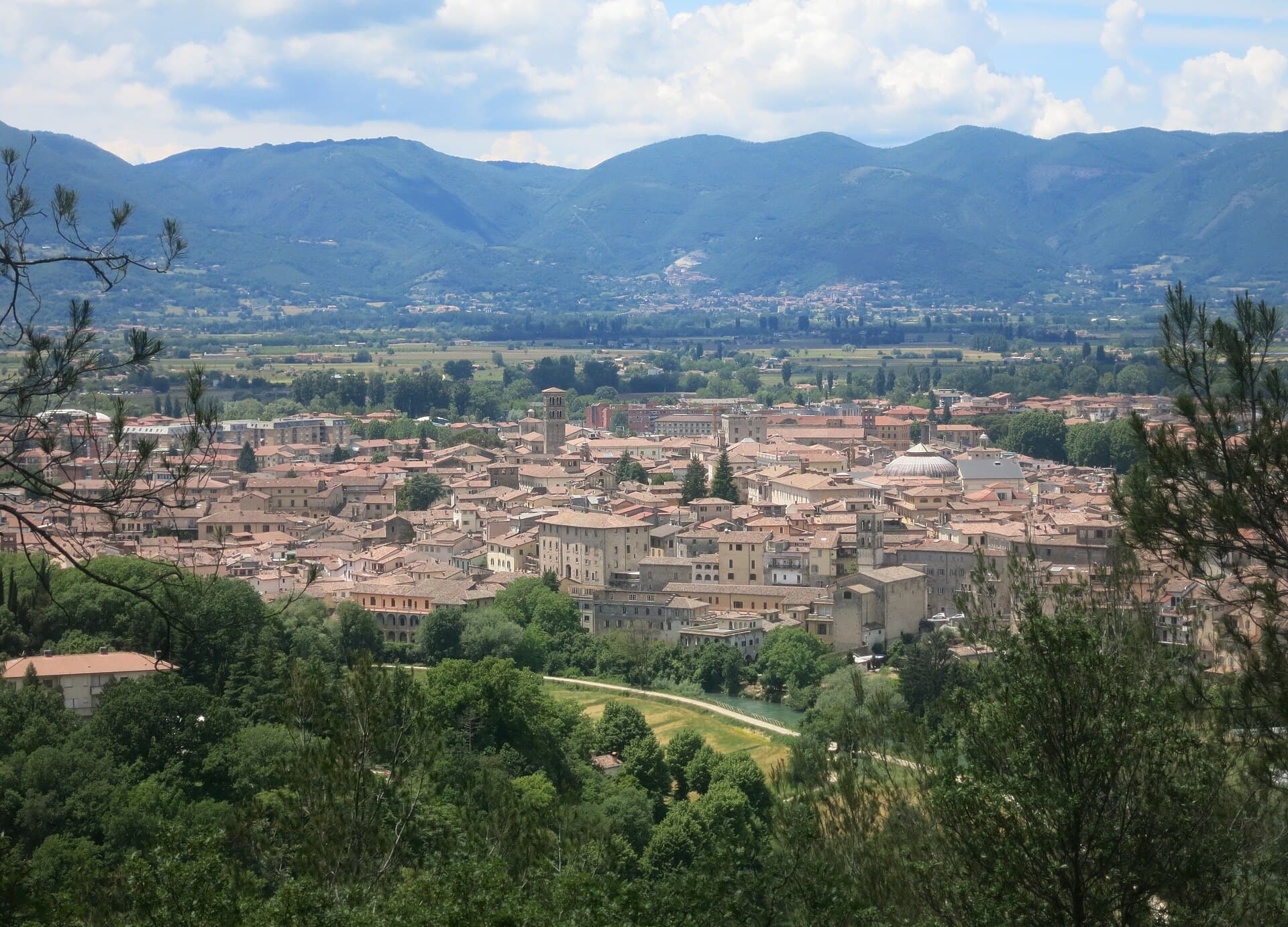
Rieti, often referred to as the 'Umbilicus Italiae' or 'Navel of Italy,' is a captivating city in the Lazio region, situated in a wide, fertile valley at the foot of the Sabine hills and the Reatini mountains. This ancient city, once a significant Sabine settlement, offers a compelling blend of Roman heritage, medieval character, and Franciscan spirituality. Enclosed by remarkably intact medieval walls, Rieti's historic center invites exploration with its narrow streets, historic palaces, and significant religious sites.
The city's distinctive identity is profoundly shaped by its relationship with water and its deep historical roots. The Velino River, a vital artery, flows through Rieti, and beneath its modern streets lies a testament to Roman engineering: an underground viaduct. Beyond the city limits, the surrounding 'Valle Santa' (Holy Valley) is dotted with Franciscan sanctuaries, offering serene retreats and a glimpse into the life of Saint Francis of Assisi. Rieti provides an authentic Italian experience, away from the bustling crowds, amidst a landscape rich in history and natural splendor.
Rieti's history stretches back to the Iron Age, with legends attributing its founding to the goddess Rea. Before the rise of Rome, it was a major center for the Sabine people, a civilization that significantly influenced early Roman culture, even contributing two of Rome's seven kings, Numa Pompilius and Anco Marzio. The Roman conquest in 290 BC by Manius Curius Dentatus marked a pivotal moment, transforming Reate (as it was then known) into a strategic hub on the Via Salaria, the ancient 'salt road' connecting Rome to the Adriatic. It was during this period that a monumental hydraulic feat reshaped the landscape: Dentatus drained a vast lake in the Rieti Valley, diverting the Velino River to create the Marmore Falls and fertile agricultural land, earning Rieti the moniker 'granary of Rome.'
After the fall of the Western Roman Empire, Rieti endured barbarian invasions but maintained its importance under Lombard rule and later as a Frankish county capital. It faced further attacks from Saracens and Normans, leading to its destruction in 1149 by Roger II of Sicily. Rebuilt with Roman assistance, Rieti emerged as a free Guelph commune by 1198. The 13th century was a golden age, as Rieti became a favored papal residence, hosting popes like Innocent III, Honorius III, Gregory IX, Nicholas IV, and Boniface VIII. Saint Francis of Assisi also spent considerable time here, establishing several sanctuaries in the surrounding 'Holy Valley.'
Following the papal seat's move to Avignon, Rieti experienced periods of rule by various noble families and was briefly part of the Kingdom of Naples. It became a provincial capital within the Papal States from 1816 to 1860, and in 1821, the Battle of Rieti, a significant event of the Risorgimento, was fought nearby. Giuseppe Garibaldi, a key figure in Italian unification, also stayed in Rieti in 1849 while recruiting his 'red shirts.' Initially part of Umbria after Italy's unification, Rieti was annexed to Lazio in 1923 and officially became a provincial capital on January 2, 1927. The 20th century saw industrial growth with the establishment of Italy's first sugar industry in 1873 and the Supertextile factory in 1928, contributing to the city's modern development.
Begin your exploration in the heart of Rieti at Piazza San Rufo, where a marker proudly proclaims the city as the 'Umbilicus Italiae,' or geographical center of Italy. From here, delve into the Rieti Underground (Rieti Sotterranea) to witness the impressive Roman viaduct that once supported the ancient Via Salaria, a fascinating journey beneath the city's surface.
Above ground, wander through the well-preserved medieval streets, taking in the Arch of Boniface VIII, a 13th-century Gothic arch commemorating a papal visit. Visit the Cathedral of Santa Maria Assunta, a significant religious landmark, and the adjacent Papal Palace. For art and regional history, the Civic Museum - Historical-Artistic Section, housed in the Town Hall, offers a collection spanning from the Middle Ages to the Renaissance.
Beyond the city center, the Valle Santa (Holy Valley) beckons with its Franciscan sanctuaries. The Fontecolombo Sanctuary is particularly notable as the place where Saint Francis drafted the definitive Rule of his Order. Other sanctuaries, like those at Greccio and Poggio Bustone, offer further spiritual insight and historical connections. For nature lovers, the nearby Mount Terminillo provides opportunities for hiking and, in winter, skiing. Consider a visit to the picturesque medieval villages of Labro and Cottanello, each offering distinctive character and historical sites.
The best times to visit Rieti are during the spring (April to June) and autumn (September to October). During these shoulder seasons, the weather is pleasant, with warm temperatures, and you will encounter fewer crowds than in the peak summer months. Summers (July and August) are hot and sunny, with average highs in July reaching 86°F (30°C), making it ideal for hot-weather activities, but also the busiest and most expensive. Winters (December to February) are cool to cold, with average lows in January around 35°F (2°C), and can be quite wet, though periods of clear, cold weather occur.
Rieti is accessible, though not directly connected to Italy's main motorway network. The most important road link is the Strada Statale 4 Via Salaria, connecting Rieti with Rome to the south and Ascoli Piceno to the north. While there is not a direct railway line to Rome, trains to Rieti typically involve a change in Terni, though limited direct services to Rome are available in the early morning and late evening. Buses offer a comfortable and timely alternative, with frequent connections to Rome and other regional cities.
Within Rieti, the city center is compact and easily explored on foot. Public buses, operated by ASM, serve the city's suburbs and nearby landmarks. Accommodation options range from luxurious hotels to comfortable B&Bs. Dining in Rieti offers a chance to savor authentic Italian and regional Sabina cuisine. Events like the Festa del Sole in July and the 'Rieti Cuore Piccante' chili pepper fair provide cultural experiences, so check local listings.
Rieti in Korean, in Chinese or in Hebrew — and 29 more languages, every stop narrated by a native voice. The widest language range of any self-guided audio tour.
Available in: