Via degli Asini (Donkey's Alley)
This elevated, covered street isn't just unique architecture; it conceals a surprising past about its original residents and their four-legged companions.
Full story unlocks in the tour
 Geobia / CC BY-SA 3.0, via Wikimedia Commons
Self-guided audio walking tour of Brisighella — GPS route, offline playback, story-driven narration in 32 languages.
“Where three rocky peaks tell tales of donkeys, popes, and prized olive oil.”
Not the postcards. The stories even locals don't know — whispered in your ear, right where they happened.
This elevated, covered street isn't just unique architecture; it conceals a surprising past about its original residents and their four-legged companions.
The town's iconic Clock Tower keeps time with an unusual system, a relic of an older Italian way of life.
Brisighella's renowned olive oil has a history stretching further than you might imagine, with evidence found in an unexpected location.
Discover every secret of Brisighella
Every address, every reveal in full — in your ear, right where it happened.
You pick your stops. You walk. The voice reveals what the others miss.


Your self-guided audio tour of Brisighella is ready — pick your landmarks, choose your language, and start the moment you arrive.
BuyLume has a built-in augmented-reality guide. Hold your phone up and its camera shows the street ahead of you, with a glowing arrow laid over the real view that always points to your next stop — no map to puzzle over, no wrong turns. Like everything in Lume, it works fully offline.
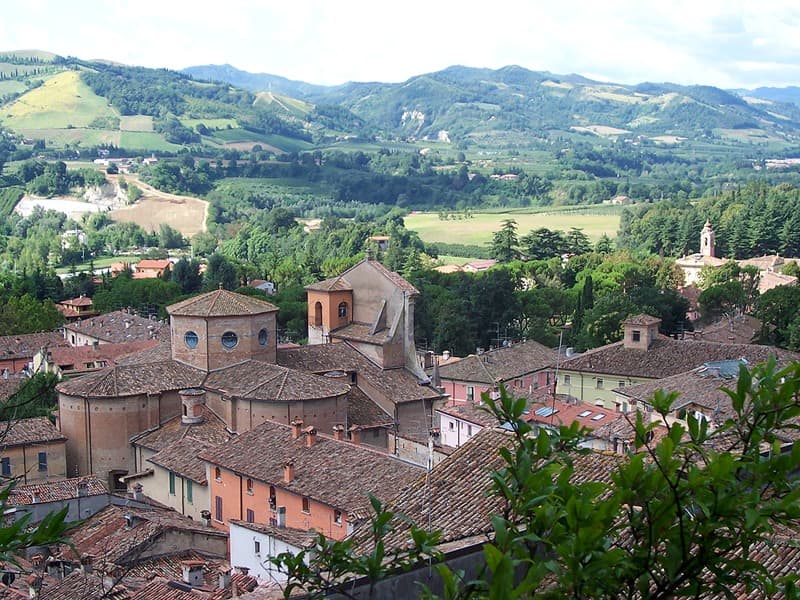
Brisighella, a captivating medieval village in Italy's Emilia-Romagna region, rises from the foothills of the Northern Apennines, its distinctive skyline defined by three rocky spurs. Each peak is crowned with a historic landmark: a 14th-century castle, a 19th-century clock tower, and an 18th-century sanctuary. This 'village of the three hills' offers a journey back in time, with its labyrinthine narrow streets, ancient defensive walls, and stairways carved directly into the gypsum rock.
Beyond its picturesque appearance, Brisighella is a place where history intertwines with nature and culinary excellence. It's a member of the 'I Borghi più belli d'Italia' (The most beautiful villages of Italy) and a 'Cittaslow' town, emphasizing a slower pace of life. The village is also a gateway to the Vena del Gesso Romagnola Regional Park, a geological marvel that adds another layer to its unique appeal.
While larger cities like Bologna and Parma often draw the culinary spotlight, Brisighella holds its own with gastronomic specialties, most notably its prized extra virgin olive oil. The town invites visitors to explore its medieval heart on foot, savor local flavors, and discover the secrets held within its ancient walls and surrounding landscape.
The history of Brisighella stretches back far beyond its medieval appearance. Archaeological findings in the Tanaccia cave, near the Monticino-Limisano road, reveal the presence of human settlements dating to the Neolithic and Bronze Ages. Later, Celtic populations occupied the valley, as evidenced by a necropolis found in the hamlet of San Martino in Gattara. Some local place names, such as Rontana ('high place'), are thought to have Gallic origins.
Under Roman dominion, the area's importance grew with the construction of the Via Faentina (also known as Via Antonina), a Roman road connecting Faenza with Florence. This route, though no wider than a mule track, was crucial for salt caravans traveling from the salt mines in Cervia to Rome. The Pieve di San Giovanni in Ottavo, an ancient church just outside the village, is named for its location at the eighth mile of this Roman road, and its origins are sometimes attributed to Galla Placidia in the 5th century.
The origins of the present-day town are traditionally attributed to Maghinardo Pagani da Susinana, a renowned Romagnol mercenary captain. In 1290, he ordered the construction of a fortified tower using square chalk blocks on one of the three peaks, which later became the Clock Tower, to control the nearby Baccagnano castle. The village of Brisighella gradually developed at the base of this tower. In the 14th century, the Manfredi family, Lords of Faenza, began building a larger castle, the Rocca Manfrediana, on another peak.
The Renaissance brought a period of turbulence. Around 1500, the Rocca briefly fell under the control of Cesare Borgia, the formidable son of Pope Alexander VI. From 1503 to 1509, the Republic of Venice ruled the fortress, adding the Great Tower and more defensive walls. Eventually, Brisighella, like much of Romagna, came under the control of the Church State.
One of Brisighella's most distinctive features, the Via degli Asini (Donkey's Alley), dates back to the 14th century. Originally a defensive bulwark, this elevated and covered street was later converted into housing for carters who used donkeys to transport gypsum from local quarries, giving the alley its evocative name.
In more recent times, Brisighella has gained recognition for its preserved medieval charm and its culinary heritage. In 1996, its extra virgin olive oil was granted PDO (Protected Designation of Origin) status by the European Union, a testament to its quality and unique local cultivar, Nostrana di Brisighella. Today, Brisighella is celebrated as one of Italy's most beautiful villages and a 'Slow City,' inviting visitors to experience its deep history and authentic Italian way of life.
Brisighella's charm lies in its unique blend of medieval architecture and natural beauty. Begin your exploration in the heart of the village, Piazza Marconi, and wander through the colorful streets.
No visit is complete without experiencing the Via degli Asini, or Donkey's Alley. This extraordinary elevated and covered street, illuminated by half-moon-shaped arches, offers a unique glimpse into medieval life.
Ascend to the Rocca Manfrediana, the 14th-century fortress, for a superb example of medieval military architecture and sweeping views of the village and the surrounding Lamone valley. From the fortress, a short, untarred lane leads to the Clock Tower (Torre dell'Orologio). Originally a defensive structure from 1290, the tower was rebuilt in 1850 and features a unique six-hour clock. The climb offers excellent views of the village and the distinctive 'calanchi' (bleak ravines) formed by blue clays.
The third of Brisighella's iconic hills is home to the Santuario di Monticino, an 18th-century sanctuary housing a venerated polychrome terracotta plaque from 1626. The uphill path to the sanctuary is rewarding with beautiful views.
Just outside the village, the Pieve di San Giovanni in Ottavo (Pieve del Tho) is the oldest and most important Romanesque church in the Lamone valley, dating back to the 9th century. For nature lovers, the Vena del Gesso Romagnola Regional Park offers hiking trails through a spectacular gypsum landscape, with caves and diverse flora and fauna.
Do not forget to indulge in an olive oil tasting at Terra di Brisighella, an association of local olive growers, to sample the renowned Brisighella DOP extra virgin olive oil.
The best times to visit Brisighella are during the spring (April to June) and fall (September to October). During these months, the weather is mild, and the tourist crowds are generally smaller. Spring offers festivals celebrating local produce like the Moretto artichoke, while autumn is ideal for observing the olive harvest and tasting new oil. The local gastronomic traditions provide a reason to visit at any time of year, with events following the rhythm of the seasons. Summers are warm and mostly clear, perfect for hot-weather activities from late June to late August, though it can be muggy in August. Winters are very cold and partly cloudy.
Brisighella is a small town best explored on foot, so pack comfortable walking shoes, especially for the uphill climbs to the fortress, clock tower, and sanctuary. While the village itself is relatively flat, accessing the higher landmarks involves stairs and shingle paths.
Brisighella is accessible by train from major cities like Bologna and Florence, with a change in Faenza. The journey from Bologna takes about an hour. Driving is also an option, though be prepared for narrow, winding roads typical of the Italian countryside.
Accommodation options range from charming bed and breakfasts to small hotels and agriturismi (farm stays). Booking in advance is recommended, particularly during peak tourist seasons. While the town's famous thermal baths are currently closed, Brisighella is known for its 'slow tourism' and 'agro-tourism' offerings.
Basic Italian is helpful, but not strictly necessary, especially in tourist-focused areas. It's always wise to take standard precautions, such as avoiding poorly lit areas at night.
Brisighella in Korean, in Chinese or in Hebrew — and 29 more languages, every stop narrated by a native voice. The widest language range of any self-guided audio tour.
Available in: