Valley of Blood (Valle de la Sangre)
The valley below Calatañazor Castle bears a name not merely descriptive, but an echo of a legendary, brutal encounter.
Full story unlocks in the tour
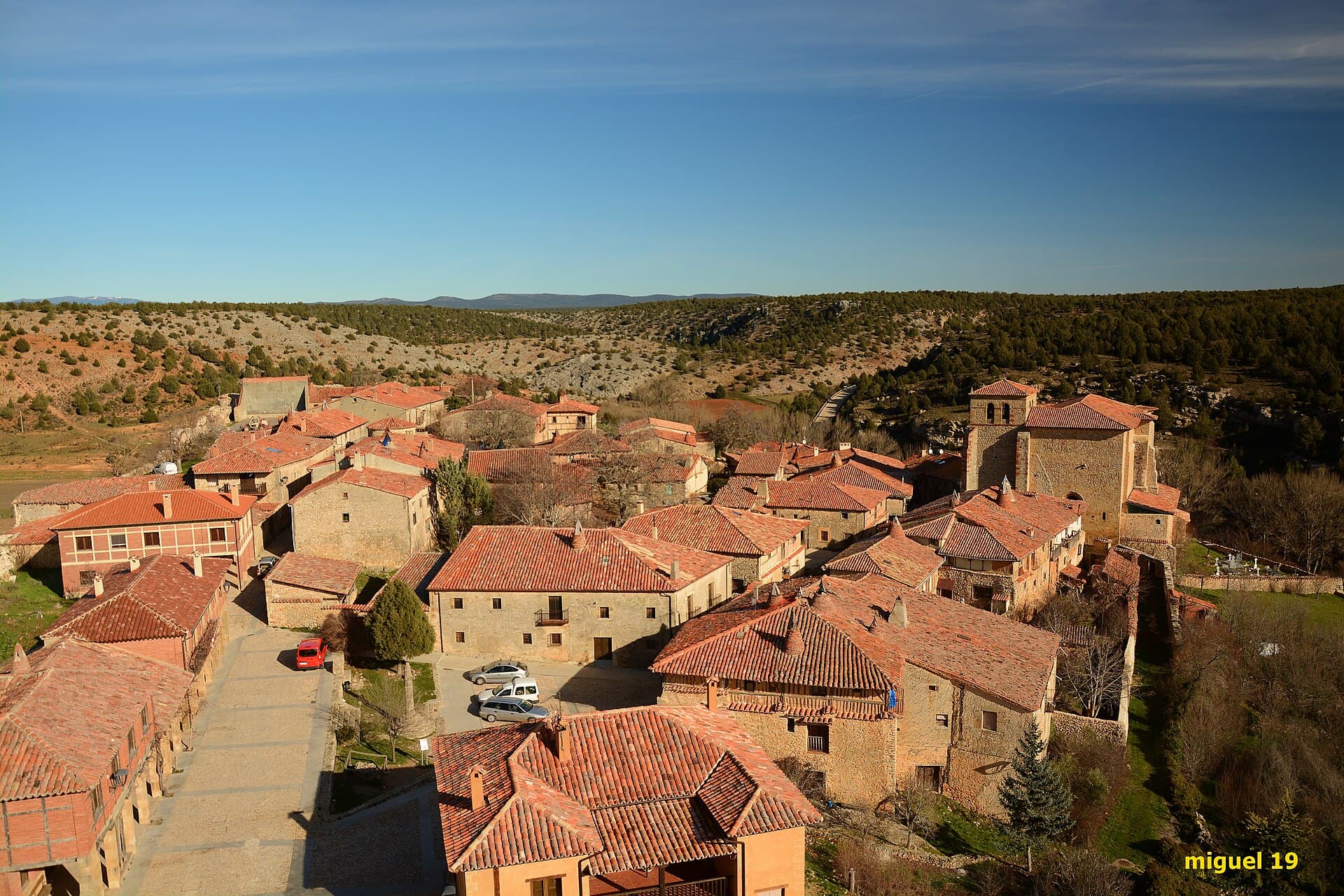 Miguel Ángel García. from Ólvega., España / CC BY 2.0, via Wikimedia Commons
Self-guided audio walking tour of Calatañazor — GPS route, offline playback, story-driven narration in 32 languages.
“Where legends linger and medieval stones tell old stories.”
Not the postcards. The stories even locals don't know — whispered in your ear, right where they happened.
The valley below Calatañazor Castle bears a name not merely descriptive, but an echo of a legendary, brutal encounter.
Beyond its formidable ruins, the castle offers a subtle clue to its strategic importance, dating further back than its visible stone.
Far from the battlefield, a strange phenomenon accompanied the legendary defeat of Almanzor, witnessed by many but understood by few.
Discover every secret of Calatañazor
Every address, every reveal in full — in your ear, right where it happened.
You pick your stops. You walk. The voice reveals what the others miss.

Your self-guided audio tour of Calatañazor is ready — pick your landmarks, choose your language, and start the moment you arrive.
BuyLume has a built-in augmented-reality guide. Hold your phone up and its camera shows the street ahead of you, with a glowing arrow laid over the real view that always points to your next stop — no map to puzzle over, no wrong turns. Like everything in Lume, it works fully offline.
Calatañazor, a small village in the Soria region of Spain, feels like a journey back to the Middle Ages. Its stone houses and Mozarabic architectural details create a timeless atmosphere. The village is set on a rocky hill, overlooking the Abión river and surrounded by a singular juniper forest. Its name, derived from the Arabic 'Qal'at an-Nusur,' means 'Citadel of Vultures,' a fitting description given the birds often seen soaring near the village rooftops.
Calatañazor is known for its association with the legendary Battle of Calatañazor in 1002, a pivotal, though possibly mythical, event in the Reconquista. This battle is said to have marked the beginning of the end for Islamic rule in the Iberian Peninsula, giving rise to the popular saying, 'En Calatañazor perdió Almanzor el tambor' (In Calatañazor, Almanzor lost his drum). Designated a Historic-Artistic Site since 1962, Calatañazor invites visitors to explore its well-preserved heritage and immerse themselves in its long, storied past.
The area around Calatañazor has been inhabited since Celtiberian times, known then as Voluce. Remains of this ancient settlement are found about a kilometer southwest of the present village. With the arrival of the Visigoths, it is likely that the population moved to the hill where Calatañazor now stands. The village gained prominence during the Arab reign of the Caliphate of Córdoba, who gave it its current name, Qal'at an-Nusur, meaning 'Castle of Vultures.'
Calatañazor holds a significant, albeit debated, place in the history of the Reconquista. According to legend, it was the site of the Battle of Calatañazor in July 1002, where a coalition of Christian forces from León, Castile, and Navarre supposedly defeated the powerful Muslim leader Almanzor. While some historians question the battle's historicity due to a lack of contemporary evidence, the legend asserts that Almanzor was wounded here and died a month later in Medinaceli. This mythical defeat is immortalized in the Castilian saying, 'En Calatañazor, Almanzor perdió su tambor' ('In Calatañazor, Almanzor lost his drum'), symbolizing a turning point in the conflict.
Following Almanzor's death in 1002, Calatañazor was re-Christianized and repopulated. The village was fortified in the early 12th century during the reign of Alfonso I el Batallador, and its walls, largely preserved today, contribute to its distinct medieval character. During the Middle Ages, it became a lordship of the influential Padilla family, who built the castle on the site of the earlier Arab fortress. The village experienced a period of prosperity before beginning to decline in the 14th century. By the 17th century, Calatañazor was part of the possessions of the Dukes of Medinaceli, and a century later, it passed to the Marquisate of Feria. Since the 19th century, it has been a municipality within the province of Soria.
Begin your exploration at the Castillo de Calatañazor, a ruined castle on a crag that offers expansive views of the surrounding valley, known as the 'Valle de la Sangre' (Valley of Blood). While largely in ruins, you can still observe fragments of the curtain wall and the impressive cylindrical keep, which dates from the 14th and 15th centuries.
Wander through the village's narrow streets to admire the traditional architecture, characterized by stone and adobe houses with distinctive conical chimneys, some of which were covered to prevent snow entry. The Plaza Mayor (Main Square) features the Rollo de la Justicia (Pillory), a medieval stone column that once symbolized royal authority and served for public punishments.
The Iglesia de Santa María del Castillo is a Romanesque church from the 12th century, notable for its main facade with a large rosette, blind arches, and an unusual Arabic-style alfiz framing its Romanesque entrance. Inside, you'll find a 16th-century altarpiece, a Romanesque carving of Our Lady of the Castle, and a Gothic Christ of Amparo. The church also houses a museum with Flemish paintings, sculptures, and historical documents.
Just outside the walled enclosure, visit the Romanesque Hermitage of La Soledad, featuring a single nave, an apse with a quarter-sphere vault, and intricate anthropomorphic and animalistic carvings on its corbels. For a glimpse into local life, the ethnographic museum on Calle Real provides insight into the region's traditions.
The ideal times to visit Calatañazor are during spring (April and May) or fall (September and October). These seasons offer pleasant temperatures, ranging from 59-77°F (15-25°C) in spring and 64-77°F (18-25°C) in early fall, making it comfortable for exploring the village and surrounding natural areas. Rainfall is minimal during these months, increasing slightly in late November. Visiting in these shoulder seasons also means fewer crowds compared to the summer months. While winter can be magical with snow, some natural attractions may be inaccessible due to weather conditions.
Calatañazor is a small village, and most of its attractions are outdoors, making it walkable. A visit to the walled enclosure and a walk to view the town from the plain can take two to three hours. For dining, consider El Palomar de Calatañazor, a restaurant in a refurbished dovecote known for traditional regional dishes like sopa castellana or migas pastoriles. Another option is Restaurante Sabinar, offering local cuisine with a terrace and views. Accommodation options, though limited, include Casa Rural de la Villa, a stone house with well-appointed rooms and breakfast, or El Mirador de Almanzor. The provincial capital, Soria, is about a 40-minute drive away, and El Burgo de Osma is roughly 30 minutes away, offering more services and accommodations. Parking is available, with a larger lot near the ruins of the Hermitage of San Juan Bautista.
Calatañazor in Korean, in Chinese or in Hebrew — and 29 more languages, every stop narrated by a native voice. The widest language range of any self-guided audio tour.
Available in: