The main piazza
Imagine a 16th-century German mercenary, fresh from the Sack of Rome, concealing a most unusual treasure within a cave in Calcata's walls.
Full story unlocks in the tour
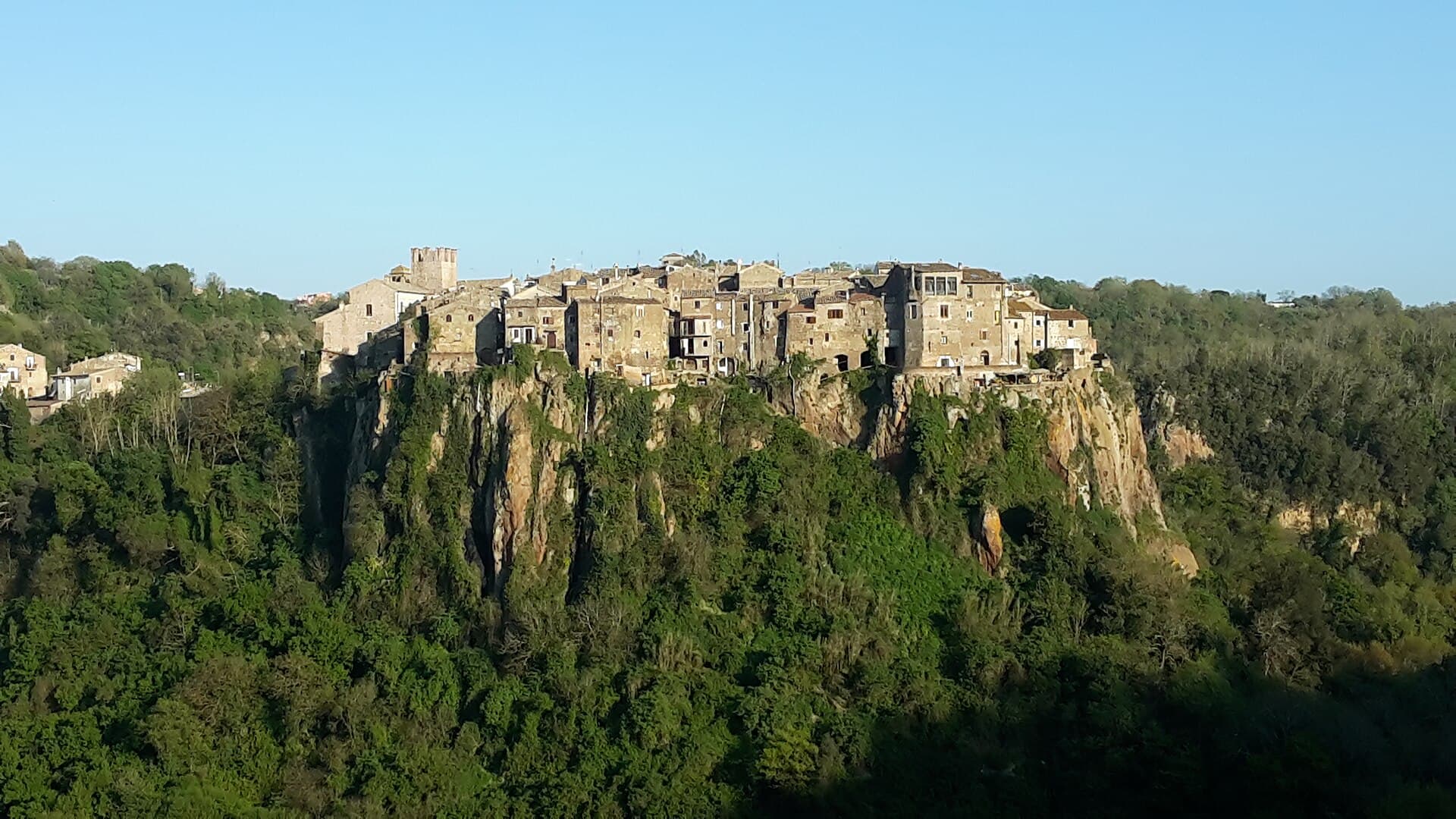 OrCer / CC BY-SA 4.0, via Wikimedia Commons
Self-guided audio walking tour of Calcata — GPS route, offline playback, story-driven narration in 32 languages.
“Where ancient stones embrace a free spirit, and history breathes through creative lanes.”
Not the postcards. The stories even locals don't know — whispered in your ear, right where they happened.
Imagine a 16th-century German mercenary, fresh from the Sack of Rome, concealing a most unusual treasure within a cave in Calcata's walls.
Some say that on windy nights, the echoes of ancient voices still drift through the village.
The very rock Calcata rests upon holds a secret that drew a particular kind of spiritual seeker.
Discover every secret of Calcata
Every address, every reveal in full — in your ear, right where it happened.
You pick your stops. You walk. The voice reveals what the others miss.


Your self-guided audio tour of Calcata is ready — pick your landmarks, choose your language, and start the moment you arrive.
BuyLume has a built-in augmented-reality guide. Hold your phone up and its camera shows the street ahead of you, with a glowing arrow laid over the real view that always points to your next stop — no map to puzzle over, no wrong turns. Like everything in Lume, it works fully offline.
Set dramatically on a volcanic tufa cliff, Calcata Vecchia, or Old Calcata, is a village that transcends expectations. Located about 40 kilometers north of Rome in the Lazio region, this medieval hamlet appears to rise directly from the earth, surveying the green Treja River valley. Its intricate alleys, ancient stone houses, and expansive views create an atmosphere that feels suspended in time.
Once declared unsafe and deserted in the 1930s due to concerns of geological instability, Calcata experienced a remarkable resurgence in the 1960s. It became a magnet for artists, intellectuals, and free spirits from Italy and beyond, who revitalized its crumbling structures and imbued it with a spirited, alternative character. Today, Calcata is a living, breathing art commune, a place where history, nature, and creativity intertwine, offering a distinctive escape from the activity of modern life.
The history of Calcata extends back over two millennia, with evidence of human habitation in the area dating to prehistoric times. The pre-Roman Faliscan civilization, an Italic tribe, established settlements on the tufa mounds and hills of the Treja Valley, utilizing their elevated positions for defense. They also attributed mystical energy to the area, conducting ancient magic rituals. The Faliscans eventually yielded to the Romans, who then integrated the territory into their empire, with Calcata becoming an agricultural production center serving Rome during Emperor Hadrian's time.
During the Middle Ages, Calcata evolved into a fortified medieval village. The Anguillara family constructed the Church of the Most Holy Name of Jesus around 1300, and the Anguillara Castle, or Baronial Palace, also dates to this period. A significant moment in Calcata's history occurred in 1527. Following the Sack of Rome, a German mercenary allegedly took the Holy Prepuce of Jesus from the Basilica of San Giovanni in Laterano. He was later apprehended in Calcata and concealed the relic in his cell. It was discovered 30 years later and became a revered object, transforming Calcata into a pilgrimage site for centuries.
In the early 20th century, Calcata faced a dramatic turning point. Following the devastating Messina earthquake in 1908, the Italian government began identifying certain towns as potential earthquake hazards. In the 1930s, the ruling Mussolini government condemned Calcata Vecchia, expressing concern that the volcanic cliff on which it stood would collapse, and ordered its residents to evacuate. A new village, Calcata Nuova, was constructed nearby, and Calcata Vecchia lay deserted for three decades, seemingly destined for destruction.
However, the story did not conclude there. In the 1960s and 70s, a new wave of inhabitants—artists, intellectuals, and free spirits from Italy and abroad—discovered the deserted village. Drawn by its raw beauty, isolation, and perceived mystical energy, they began inhabiting and eventually acquiring the old stone houses at remarkably low prices. These new residents revitalized the village, opening art galleries, workshops, cafes, and restaurants. They successfully lobbied the government to rescind the condemnation order, arguing that the original claim was politically motivated. This transformation established Calcata's reputation as a 'village of artists' and a 'free-spirited sanctuary,' a creative haven where artistry and an alternative lifestyle flourish amidst ancient stones.
Stepping through Calcata's single arched gateway immediately immerses you in its distinctive atmosphere. The village is a maze of narrow, stone-paved alleys, small squares, and arcades that open to expansive cliff-edge views of the Treja River valley.
The main piazza features the 14th-century Chiesa del Santissimo Nome di Gesù (Church of the Most Holy Name of Jesus), though it was restored in the late 1700s. Adjacent to it stands the Anguillara Castle, or Baronial Palace, with its tower, a structure that has served the community in various capacities over the centuries.
The true character of Calcata lies in its active artistic community. The narrow lanes are lined with art galleries, artisans' studios, and craft shops, often situated in caves carved into the tufa rock. Here, you can find unique handmade items, from ceramics to jewelry, and even interact directly with the artists. Do not miss the opportunity to explore these workshops and perhaps discover a piece of Calcata to take home. The Museo della Civiltà Contadina (Museum of Rural Life), located in the deconsecrated church of San Giovanni Decollato, offers free admission and houses about 500 instruments used in domestic and agricultural life of the Viterbo area. For tea enthusiasts, the Sala dei 201 tè offers dozens of varieties in a delightful setting with a sweeping terrace.
Beyond the village, the Treja Valley Regional Park offers various nature trails for walking or horseback riding, leading to waterfalls and remnants of ancient settlements.
Calcata can be visited in any season, as its climate is generally warm-temperate, with mild winters and not excessively warm summers. However, the spring through autumn months are generally considered the most favorable time to visit. During summer, more businesses, including restaurants, tend to be open throughout the week. Weekends are particularly lively, with many local artists gathering in the main piazza and art galleries, craft shops, and restaurants extending their hours from Friday to Sunday evening. The village also hosts special events, such as the Summer Solstice celebration in June and the "Night of the Witches" on October 31st.
Calcata Vecchia is approximately 40-50 kilometers (25-30 miles) north of Rome, making it a popular day trip destination. While driving is the most straightforward option, you can also reach Calcata by public transport. Buses connect Rome's Saxa Rubra terminus to Calcata; timetables are available on the CO.TRA.L website. Note that cars are not allowed inside Calcata Vecchia itself. There are no parking spots directly at the village entrance, and reserved spaces are for residents only, with frequent fines for unauthorized parking. Visitors typically park in Calcata Nuova and walk to the old village, a path that offers scenic views. There are no hotels within Calcata Vecchia, but some rooms and apartments are available for rent. For daily necessities like toothpaste or milk, you will need to visit the neighboring villages. Be prepared for uphill climbs and intricate streets as you explore the village on foot.
Calcata in Korean, in Chinese or in Hebrew — and 29 more languages, every stop narrated by a native voice. The widest language range of any self-guided audio tour.
Available in: