La Ruetta
Imaginez un passage si étroit qu'il faudrait peut-être se mettre de côté pour le traverser. Civitella del Tronto en abrite un, et sa conception était bien plus qu'un choix architectural curieux.
L'histoire complète se débloque dans le tour
 DDF19483 / public domain, via Wikimedia Commons
Visite audio autoguidée de Civitella del Tronto — parcours GPS à pied, lecture hors ligne, narration en 32 langues.
“Là où les pierres anciennes murmurent la résistance, et le cours du temps ralentit à un rythme réfléchi.”
Pas les cartes postales. Les histoires que même les habitants ignorent — soufflées à l'oreille, là où elles se sont passées.
Imaginez un passage si étroit qu'il faudrait peut-être se mettre de côté pour le traverser. Civitella del Tronto en abrite un, et sa conception était bien plus qu'un choix architectural curieux.
Cette formidable forteresse, parmi les plus grandes d'Europe, fut le théâtre d'un dernier acte résolu dans l'unification de l'Italie, bien après que le reste du pays ait célébré.
Un mercenaire irlandais, un siège napoléonien et un monument égaré – cette ville recèle une histoire qui traverse les continents et les siècles.
Découvrez tous les secrets de Civitella del Tronto
Chaque adresse, chaque révélation en entier — dans ton oreille, là où elle s'est passée.
Tu choisis tes lieux. Tu marches. La voix te révèle ce que les autres ignorent.
Votre visite audioguidée de Civitella del Tronto vous attend — choisissez vos lieux, votre langue, et lancez-vous dès votre arrivée.
AcheterLume intègre un guide en réalité augmentée. Levez votre téléphone : sa caméra montre la rue devant vous, avec une flèche lumineuse posée sur l'image réelle qui pointe toujours vers votre prochain arrêt — aucune carte à déchiffrer, aucun mauvais virage. Comme tout dans Lume, ça fonctionne entièrement hors-ligne.
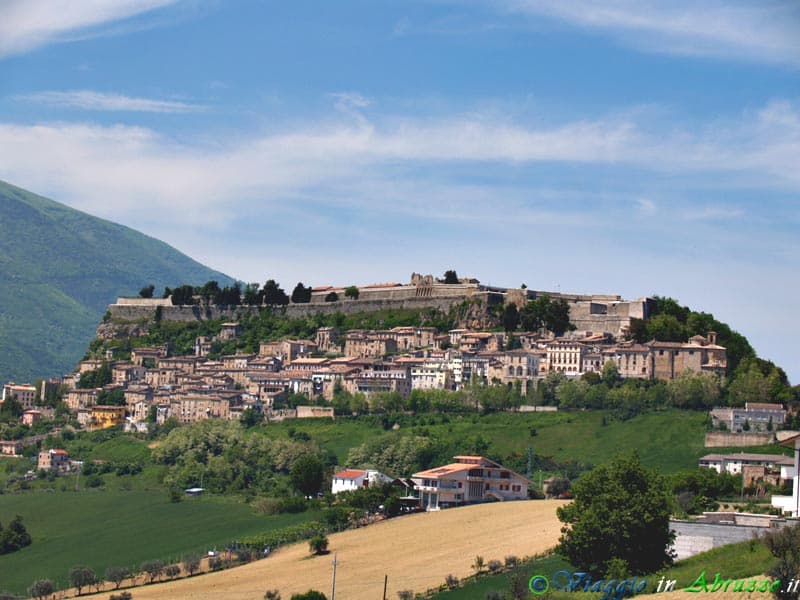
Dramatiquement perchée sur un éperon rocheux de travertin, Civitella del Tronto est un captivant village médiéval de la région des Abruzzes en Italie, près de la frontière avec les Marches. Reconnue pour son imposante Forteresse Bourbon – la plus grande d'Italie et la deuxième plus grande d'Europe – la ville offre un voyage à travers des siècles d'importance stratégique et de résolution inébranlable. Comptant parmi les 'Plus Beaux Villages d'Italie', Civitella del Tronto est un dédale de ruelles étroites, d'escaliers escarpés et de places charmantes, le tout encadré par des vues imprenables sur les montagnes du Gran Sasso, les contreforts des Abruzzes et la lointaine mer Adriatique.
Au-delà de sa formidable architecture militaire, Civitella del Tronto invite les visiteurs à flâner dans ses rues anciennes, à découvrir des détails architecturaux et à s'imprégner d'une atmosphère paisible qui dément son passé tumultueux. Le mélange unique d'histoire, d'art et de nature de la ville en fait une destination fascinante pour ceux qui cherchent à explorer le cœur authentique de l'Italie centrale.
Les origines de Civitella del Tronto sont voilées dans la nuit des temps, avec des preuves archéologiques suggérant une présence humaine dès les âges néolithique et paléolithique supérieur. L'établissement actuel aurait été construit sur Beregra, une ancienne ville de la tribu italique des Piceni. La ville est mentionnée pour la première fois officiellement aux Xe-XIe siècles comme une ville fortifiée, probablement fondée par les premiers colons cherchant refuge contre les raids sarrasins.
La position stratégique de Civitella del Tronto, située à la frontière nord entre le Royaume de Naples (plus tard le Royaume des Deux-Siciles) et les États pontificaux, lui a assuré une importance militaire continue. Au fil des siècles, elle a changé de mains à de nombreuses reprises, tombant sous la domination des Lombards, des Normands, des Souabes, des Angevins, des Aragonais et des Bourbons.
La caractéristique la plus proéminente de Civitella del Tronto, la magnifique forteresse, remonte au XVIe siècle. Philippe II de Habsbourg, roi d'Espagne, ordonna sa construction en 1564, transformant un ancien château aragonais en l'immense complexe défensif que l'on voit aujourd'hui. Cette entreprise fut motivée par la résistance résolue de la ville face à un siège français mené par le duc de Guise en 1557. La forteresse, merveille elliptique d'ingénierie militaire couvrant 25 000 mètres carrés, devint un symbole de loyauté inébranlable.
Civitella del Tronto gagna l'épithète 'la fedelissima Civitella' (la très fidèle Civitella) pour son service inébranlable au Royaume de Naples. Sa résilience fut mise à l'épreuve à plusieurs reprises. En 1806, pendant les guerres napoléoniennes, la forteresse, commandée par le mercenaire irlandais Matthew Wade, subit un siège de quatre mois par Joachim Murat, beau-frère de Napoléon. La défense tenace de Wade lui valut un monument dans la ville, témoignage de sa bravoure.
Le siège le plus célèbre de la forteresse eut lieu pendant le Risorgimento, le mouvement pour l'unification italienne. En 1860, elle devint le dernier bastion du Royaume des Deux-Siciles contre les forces piémontaises de Victor-Emmanuel II. Le siège dura cinq mois, la forteresse se rendant finalement le 20 mars 1861 – trois jours après la proclamation officielle du Royaume d'Italie. Cette reddition tardive souligna les profondes divisions et la résistance à l'unification dans certaines parties de la péninsule. Après sa chute, la forteresse fut largement abandonnée et même partiellement démantelée par les habitants, avant qu'un important projet de restauration entre 1975 et 1985 ne lui rende sa splendeur d'antan.
Un chapitre moins connu et plus sombre de l'histoire de Civitella del Tronto se déroula pendant la Seconde Guerre mondiale, lorsque la ville abrita trois camps de concentration où près de deux cents Juifs furent emprisonnés. Aujourd'hui, Civitella del Tronto se présente comme un mélange captivant de son passé stratifié, invitant les visiteurs à explorer ses pierres anciennes et à réfléchir aux nombreuses histoires qu'elles recèlent.
Le point culminant incontesté de Civitella del Tronto est sa colossale Forteresse. Cette merveille militaire elliptique, l'une des plus grandes d'Europe, invite à une exploration approfondie de ses remparts, citernes, casernes, des ruines du palais du Gouverneur et de l'église Saint-Jacques. De sa position élevée, vous profiterez de vues panoramiques à 360 degrés englobant trois chaînes de montagnes, le village en contrebas et la lointaine mer Adriatique. Ne manquez pas la passerelle panoramique au sommet des murs et le musée des armes, qui présente également une exposition surprenante sur les liens avec la guerre de Sécession américaine.
En descendant de la forteresse, laissez-vous flâner dans le charmant centre historique. Sa structure médiévale est préservée avec des rues étroites et pavées, des escaliers escarpés et des détails architecturaux intrigants. Cherchez La Ruetta, célèbrement connue comme la rue la plus étroite d'Italie, mesurant à peine 40 centimètres de large. L'entrée de la ville se fait souvent par la Porta Napoli, la seule porte intacte restante, qui mène directement à la Piazza Filippo Pepe, offrant une autre vue panoramique spectaculaire. D'autres bâtiments religieux notables incluent l'Église de San Lorenzo avec son intérieur baroque, et l'Église de San Francesco. Vous pouvez également trouver le Monument à Matteo Wade, commémorant le mercenaire irlandais qui a défendu la ville. Pour une immersion plus profonde dans la culture locale, le Musée NINA présente des textiles et de la mode des XVIIIe et XIXe siècles. Juste à l'extérieur des murs de la ville, le Sanctuaire de Santa Maria dei Lumi est un autre site religieux important.
Les périodes idéales pour visiter Civitella del Tronto sont la fin du printemps (mai-juin) ou le début de l'automne (septembre-octobre). Au printemps, la campagne est en fleurs, offrant un cadre coloré pour les activités de plein air et un temps doux parfait pour la marche. Le début de l'automne offre des températures agréables et un feuillage d'automne attrayant, avec une diminution des foules de touristes. L'été (juillet-août) est la haute saison, apportant des températures plus chaudes et une atmosphère animée, bien qu'il puisse faire assez chaud. Juillet connaît généralement le ciel le plus clair et le moins de précipitations. Novembre est le mois le plus nuageux et le plus humide.
Civitella del Tronto est mieux accessible en voiture, la gare la plus proche étant située à Teramo, à environ 35 km. Le trajet jusqu'à la ville est pittoresque mais sinueux, alors prenez votre temps et profitez des vues. Une fois sur place, la ville est petite et se découvre mieux à pied, mais préparez-vous à des rues escarpées et des chaussures confortables sont une nécessité. Un parking est disponible au pied de la ville, avec un ascenseur pratique pour atteindre le centre historique, ce que vous apprécierez après une journée de marche.
De nombreux magasins et restaurants observent une longue pause déjeuner, généralement de 13h à 16h, alors planifiez vos repas et vos achats en conséquence. Il est toujours conseillé de vérifier les heures d'ouverture de la forteresse avant votre visite, car elles peuvent varier selon les saisons. Envisagez de participer à une visite guidée pour apprécier pleinement le passé stratifié de la ville et ses histoires individuelles. Bien que les Italiens soient connus pour leur hospitalité, apprendre quelques phrases italiennes de base comme 'per favore' (s'il vous plaît) et 'grazie' (merci) sera apprécié.
Civitella del Tronto en coréen, en chinois ou en hébreu — et dans 29 autres langues, chaque étape narrée par une voix native. La plus large gamme de langues de tous les audioguides autoguidés.
Disponible en :