Château de Clisson
The formidable remains of Clisson's medieval castle conceal a grim event from the French Revolution.
Full story unlocks in the tour
 Stephanemartin / CC BY-SA 3.0, via Wikimedia Commons
Self-guided audio walking tour of Clisson — GPS route, offline playback, story-driven narration in 32 languages.
“Where Brittany's medieval past converges with Tuscan elegance.”
Not the postcards. The stories even locals don't know — whispered in your ear, right where they happened.
The formidable remains of Clisson's medieval castle conceal a grim event from the French Revolution.
This seemingly tranquil Italianate park emerged from a surprising vision following a period of profound destruction.
Clisson's venerable covered market hall has maintained a continuous, remarkable function for centuries.
Discover every secret of Clisson
Every address, every reveal in full — in your ear, right where it happened.
You pick your stops. You walk. The voice reveals what the others miss.


Your self-guided audio tour of Clisson is ready — pick your landmarks, choose your language, and start the moment you arrive.
BuyLume has a built-in augmented-reality guide. Hold your phone up and its camera shows the street ahead of you, with a glowing arrow laid over the real view that always points to your next stop — no map to puzzle over, no wrong turns. Like everything in Lume, it works fully offline.
Clisson, a striking town in western France, presents a singular fusion of medieval history and Italian-inspired architecture. Positioned at the meeting point of the Sèvre Nantaise and Moine rivers, approximately 30 kilometers southeast of Nantes, it offers an experience akin to a journey to Tuscany within the Loire-Atlantique department. The town's distinct character, with its terracotta roof tiles, slender bricks, and classical statues, directly stems from its tumultuous past and a remarkable 19th-century reconstruction.
Often overlooked by those traveling to the Vendée coast, Clisson provides a peaceful yet enriching escape for those interested in history, architecture, and wine. Its romantic ambiance is amplified by calm riverside settings, stone bridges, and lush hills, making it an inviting place for unhurried walks and exploration. Clisson also lies at the core of the Nantes wine region, renowned for its Muscadet, offering opportunities for vineyard visits and tastings.
The origins of Clisson extend back to the 11th century, when the first Lords of Clisson established a fortification on a rocky promontory overlooking the Sèvre Nantaise river. By the 13th century, much of the current Château de Clisson was built by Guillaume de Clisson, an irregular polygon defended by round towers. This medieval fortress held significant strategic importance, serving as a defensive barrier for the Duchy of Brittany at the crossroads of Anjou and Poitou. Over the centuries, the castle was expanded and updated, with figures like Olivier V de Clisson, Constable of France, and François II, the last Duke of Brittany, residing there.
The 18th century brought a period of immense sorrow to Clisson. The town was severely affected by harsh winters, destructive floods, and most significantly, the Wars of Vendée during the French Revolution. Clisson found itself at the heart of the conflict, repeatedly occupied by both Royalist and Republican forces. In 1793, after the defeat at Torfou, the town was almost entirely destroyed, reduced to rubble and abandoned by its inhabitants.
Clisson's extraordinary revival began in the early 19th century, thanks to the vision of sculptor François-Frédéric Lemot and the art-patron brothers Cacault from Nantes. Inspired by his travels in Italy and the evocative, though ruined, landscape of Clisson, Lemot embarked on a project to rebuild the town in an Italianate style. This extensive reconstruction introduced the Tuscan and Umbrian aesthetics that define Clisson today, with its characteristic tile and brick villas, classical statues, and Mediterranean gardens. The Garenne Lemot Park, with its neo-Palladian villa and architectural follies, stands as a testament to this unique architectural transformation.
Begin your exploration at the Château de Clisson, a defining medieval fortress whose impressive remains offer sweeping views of the town and the Sèvre Nantaise river. Wander through its grounds to glimpse its storied past, with detailed displays illuminating the 13th-century structure.
Next, immerse yourself in the Italianate appeal of Garenne Lemot Park. This expansive landscape park displays the 19th-century Italian influence on Clisson, featuring a neoclassical villa, Tuscan and Umbrian farmhouses, and Mediterranean vegetation. Stroll along the Sèvre Nantaise River, where kayaking, paddleboarding, and riverside walks are popular activities, with inviting picnic spots along the banks.
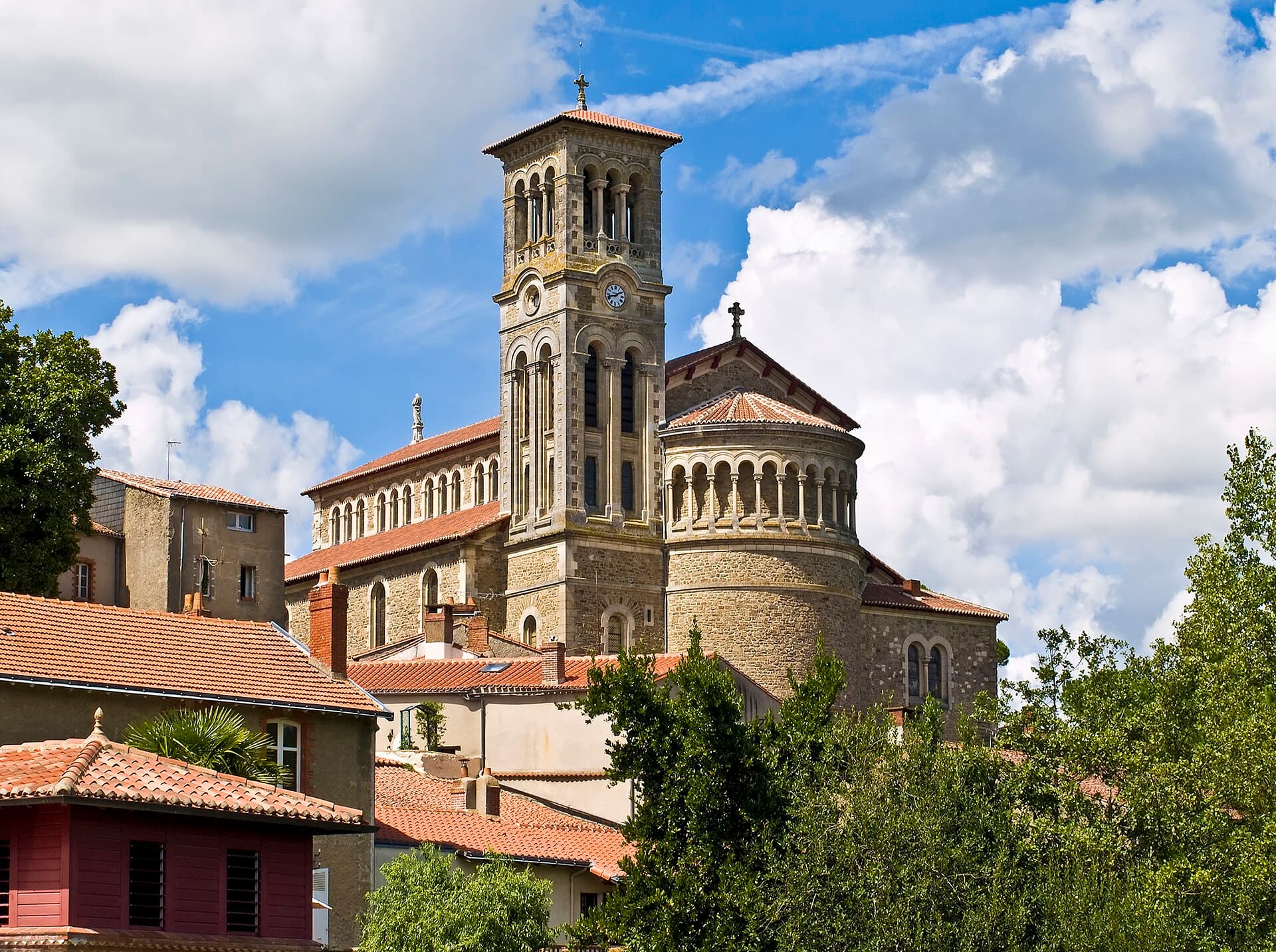
Cross the Pont de la Vallée, a charming covered bridge over the Sèvre Nantaise, recognized for its wooden structure and scenic surroundings. Visit the Halles de Clisson, a vast, timber-framed covered market from the 14th century, still active with local produce and artisan goods on market days. Do not overlook the Église Notre-Dame de Clisson, a neo-Romanesque church that stands as a striking landmark. For a distinctive artistic element, seek out the grand frescoes by Alain Thomas, such as Le Jardin du Héron beneath the viaduct and La Cascade aux Toucans in the town center.
The most favorable time to visit Clisson for warm-weather activities spans from mid-June to mid-September. This period offers agreeable temperatures, verdant landscapes, and various outdoor events. July and August are the warmest months, with average highs around 24-25°C (76-77°F) and more sunshine. For those who prefer fewer crowds and a milder climate, late spring (May-June) or early autumn (September-October) are also excellent choices. June is particularly popular due to the Hellfest Open Air Festival, while September marks the grape harvest season, a lively time to explore local vineyards.
Clisson is conveniently situated approximately 30 kilometers from Nantes, ensuring easy access. Direct trains from Nantes take about 25 minutes. If driving, take the D763 from Nantes for a scenic journey. Nantes Atlantique Airport is the closest major airport, roughly 45 minutes away by car.
Within Clisson, the town is very accessible on foot, allowing you to explore its attractions without difficulty. Several parking options are available, including free and paid car parks near the town center. The Parking de la Garenne Lemot is a convenient choice for reaching main attractions. Be aware that some central car parks are in blue zones, requiring a parking disc for regulated time limits.
The Clisson Tourist Office, located on Place du Minage, provides valuable information, guided tours, and even tickets for local attractions and the Nantes Pass. They also offer resources for visitors with disabilities.
Clisson in Korean, in Chinese or in Hebrew — and 29 more languages, every stop narrated by a native voice. The widest language range of any self-guided audio tour.
Available in: