The House of the Duke of Épernon
This unassuming house in Confolens conceals a secret that helped alter the course of French royal history.
Full story unlocks in the tour
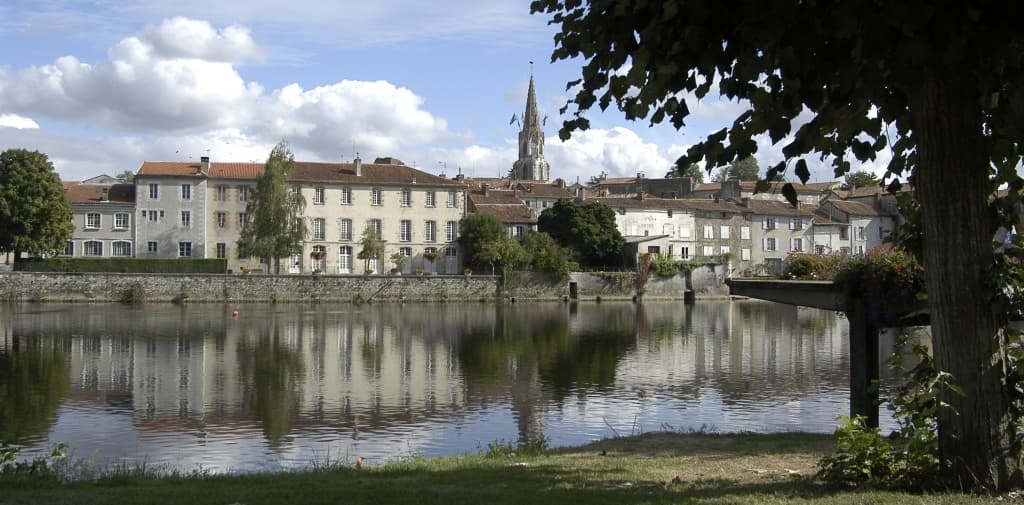 Confolens16 / CC BY-SA 3.0, via Wikimedia Commons
Self-guided audio walking tour of Confolens — GPS route, offline playback, story-driven narration in 32 languages.
“Where two rivers converge, a thousand years of stories unfurl.”
Not the postcards. The stories even locals don't know — whispered in your ear, right where they happened.
This unassuming house in Confolens conceals a secret that helped alter the course of French royal history.
The graceful 13th-century stone bridge spanning the Vienne River once possessed a feature that made crossing it a truly singular experience.
The appealing half-timbered houses lining the Goire River are more than just pleasant facades; they are a tangible link to Confolens' surprising economic past.
Discover every secret of Confolens
Every address, every reveal in full — in your ear, right where it happened.
You pick your stops. You walk. The voice reveals what the others miss.


Your self-guided audio tour of Confolens is ready — pick your landmarks, choose your language, and start the moment you arrive.
BuyLume has a built-in augmented-reality guide. Hold your phone up and its camera shows the street ahead of you, with a glowing arrow laid over the real view that always points to your next stop — no map to puzzle over, no wrong turns. Like everything in Lume, it works fully offline.
Confolens, a 'Petite Cité de Caractère' in France's Nouvelle-Aquitaine region, is a town sculpted by its waterways. Positioned at the confluence of the Vienne and Goire, its very name, derived from the Latin 'confluens,' speaks to this geographical identity. This medieval town, with an estimated population of around 2,730 residents in 2026, offers a journey through centuries of time, evident in its well-preserved architecture and winding pathways.
Confolens is a place where history feels palpable, from the remnants of its ancient fortifications to the appealing half-timbered houses that line its routes. It is a town that invites exploration on foot, encouraging visitors to uncover its quiet corners and admire the vistas from its historic bridges. Beyond its historical allure, Confolens also serves as a cultural center, celebrated for its international folklore festival that draws artists and visitors from across the globe.
The town acts as the capital of the Confolens and Charente Limousine area, a region recognized for its rural charm and green landscapes. It is a place where the past and present intertwine, offering a blend of historical discovery and lively cultural encounters.
## From Roman Road to Medieval Stronghold Confolens's origins extend back to prehistoric times, as revealed by numerous megalithic monuments in the area. However, the town is first mentioned in texts around the 10th century. Its strategic placement on an ancient Roman road connecting Angoulême to Bourges, where it crossed the Vienne River, played a crucial role in its early development.
Initially, Confolens was part of the principality of Chabanais, a political entity formed in the early 11th century. The town was geographically divided by the Vienne, with each bank belonging to a different diocese – Limoges to the east and Poitiers to the west. Throughout the 11th century, the Counts of La Marche repeatedly, though unsuccessfully, laid siege to Confolens's donjon, a testament to its defensive significance.
## Fortifications and Flourishing Trade Political struggles seemed to recede in the 12th century, making way for further development. By the 13th century, fortifications, including a surrounding wall, town gates, and a 'castle,' were built in the Saint-Maxime quarter. The Saint-Barthélemy quarter was also fortified later, after 1469, with royal authorization. Two fortified bridges, the Pont Vieux over the Vienne and the Pont du Goire, were also constructed during the Middle Ages. The Pont Vieux, specifically, dates to the 13th century.
The 15th and 16th centuries marked a period of considerable prosperity for Confolens. The town separated from the principality of Chabanais, becoming a barony. Economically, Confolens prospered due to its strong connection to livestock farming, which fueled important markets, butcheries, and a thriving tannery industry. Many of the distinctive half-timbered houses seen today were built during this prosperous era, particularly along the Vienne in the Saint-Barthélemy area and along the Goire outside the Saint-Maxime ramparts.
## Modern Era and Cultural Recognition In the 19th century, Confolens became a sub-prefecture, leading to alterations in its urban landscape as it assumed administrative and commercial functions. Today, Confolens is recognized with the 'Petite Cité de Caractère' label, acknowledging its dedication to preserving its heritage. The town is also internationally known for its Festival de Confolens, a folklore festival established in 1957, which celebrates traditional music and dance from around the world every August.
Begin your exploration of Confolens at the Old Bridge (Pont Vieux), a 13th-century stone bridge spanning the Vienne River. This historic crossing offers appealing views of the old town and the river, and its pedestrian refuges provide ideal spots for photographs. Next to the bridge, you will find the Fontaine de la Fontorse, a charming fountain drawing water from an ancient spring, marking a good starting point for a walk into the older parts of town.
Stroll through the narrow, stone-paved streets of the old quarters, particularly around Rue du Soleil, to admire the well-preserved 15th and 16th-century half-timbered houses. Seek out the House of the Duke of Épernon, noteworthy for its facade and the intriguing legend associated with it. While only partially standing, the old donjon serves as a remnant of Confolens's original castle and its medieval fortifications.
Confolens is home to several religious monuments, including the Church of Saint-Maxime, with its origins in the 10th century and a prominent 13th-century arched stone entrance and rose window, and the Church of Saint-Bartholomew, originally built in the 12th century. Do not overlook the Chapel of the Commandery in the Saint-Michel district, an iconic 13th-century building linked to the Order of the Hospitallers. For a broader perspective, consider visiting the nearby village of Saint-Germain-de-Confolens to see the substantial ruins of its ancient castle and church.
The optimal time to visit Confolens for warm-weather activities extends from late June to mid-September. During July and August, average high temperatures hover around 25°C to 27°C (77°F to 81°F), with clearer skies and less precipitation. The acclaimed Festival de Confolens, an international folklore festival, occurs annually during the second week of August, drawing large crowds and creating a lively atmosphere. For those who prefer cooler weather, May, June, and September also offer comfortable conditions. Winters, particularly January and December, are colder, with average lows around 2°C to 4°C (36°F to 39°F) and more cloudy days and precipitation.
Confolens is situated in the Charente department of the Nouvelle-Aquitaine region. While there are no major public transport systems directly serving the area, it is approximately 55 km from Limoges and 65 km from Angoulême. The Limoges and Angoulême airports are about 40 minutes away, and TGV Atlantic train stations are an hour away in Angoulême or Poitiers. The town is also located on the Centre-Europe Atlantic road axis.
Confolens has a population of about 2,730 residents and offers various administrative, educational, cultural, and sports services. The local Office de Tourisme de Charente Limousine can provide further information and assistance for visitors. The town is also twinned with Pitlochry in Scotland and Georgenthal in Germany.
Confolens in Korean, in Chinese or in Hebrew — and 29 more languages, every stop narrated by a native voice. The widest language range of any self-guided audio tour.
Available in: