Deal Castle
Beyond its formidable Tudor defenses, a secret language was etched into the castle's very fabric, a quiet record of lives lived within its walls.
Full story unlocks in the tour
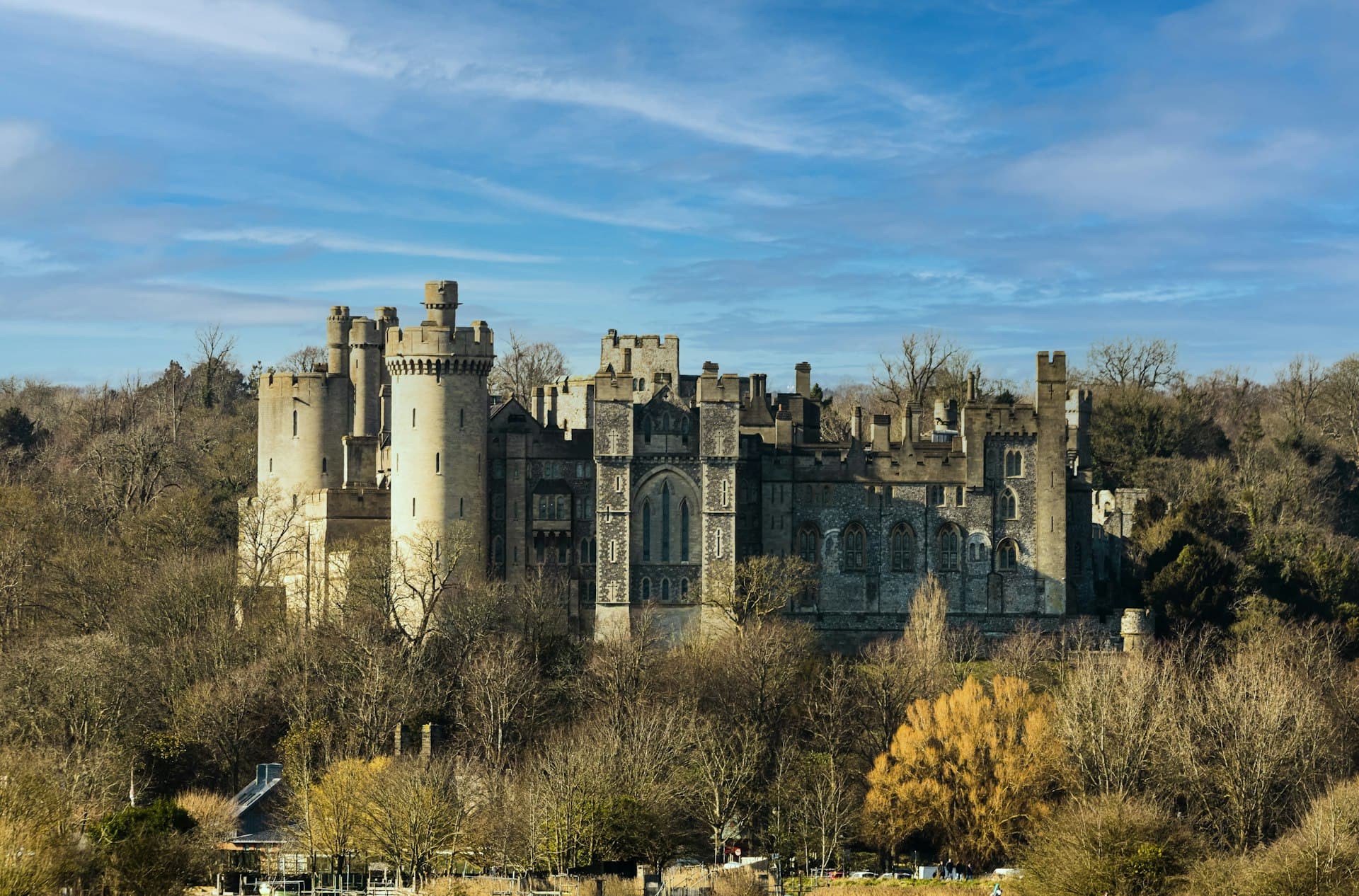 Photo of Arundel, via Wikimedia Commons
Self-guided audio walking tour of Deal — GPS route, offline playback, story-driven narration in 32 languages.
“Where the sea carves stories into the shore and an independent spirit flourishes.”
Not the postcards. The stories even locals don't know — whispered in your ear, right where they happened.
Beyond its formidable Tudor defenses, a secret language was etched into the castle's very fabric, a quiet record of lives lived within its walls.
The pier stretching into the Channel today is not Deal's first, nor its second; an earlier structure met a dramatic end involving a Dutch ship and wartime necessity.
Before the advent of GPS, sailors navigated the vast oceans by observing a peculiar daily ritual from this tower, a precise signal against the horizon.
Discover every secret of Deal
Every address, every reveal in full — in your ear, right where it happened.
You pick your stops. You walk. The voice reveals what the others miss.


Your self-guided audio tour of Deal is ready — pick your landmarks, choose your language, and start the moment you arrive.
BuyLume has a built-in augmented-reality guide. Hold your phone up and its camera shows the street ahead of you, with a glowing arrow laid over the real view that always points to your next stop — no map to puzzle over, no wrong turns. Like everything in Lume, it works fully offline.
Deal, a coastal town in Kent, England, offers a distinctive blend of maritime heritage and contemporary character. Situated where the North Sea meets the English Channel, it lies approximately eight miles northeast of Dover and eight miles south of Ramsgate. Once a bustling port and a 'limb port' of the Cinque Ports, Deal has since evolved into a tranquil seaside resort, its streets and architecture reflecting centuries of passage.
The town is recognized for its unspoiled seafront, pebbled beaches, and a pier celebrated for its modernist design and angling opportunities. Beyond the immediate coastline, Deal's narrow streets and alleys, particularly in Middle Street, evoke its past as a center for smuggling. Deal's singular character has earned it recognition as an appealing coastal destination, offering a quieter alternative to some of its busier Kentish neighbors.
With its strategic location near the Strait of Dover, Deal has played a significant role in England's coastal defenses and maritime trade. Today, it invites visitors to explore its historic landmarks, enjoy scenic walks, and experience a town that gracefully balances its enduring past with a lively, independent spirit.
## From Domesday to Device Forts Deal's origins can be traced back to the Domesday Book of 1086, where it was recorded as 'Addelam,' later becoming 'Dela' in 1158 and 'Dale' in 1275, deriving from the Old English word for 'valley.' By the late 13th century, Deal had developed into a port and was granted special status in 1278 as a 'limb port' of the Cinque Ports. This confederation provided ships to the Crown in exchange for tax exemptions and tolls, making Deal a crucial shipping hub.
Its strategic importance was further solidified by its proximity to the Downs, a sheltered anchorage between the Deal shoreline and the Goodwin Sands. This natural breakwater allowed hundreds of ships to anchor safely, sometimes for weeks, creating a thriving demand for provisions supplied by the town. Deal's maritime activity was not always lawful; it became known for extensive smuggling, so much so that Prime Minister William Pitt the Younger reportedly ordered the town's luggers to be burned on the beach.
## Tudor Defenses and Naval Power In 1495, Deal was the site of an attempted landing by Perkin Warbeck, a pretender to the English throne, whose supporters were repelled by loyal locals in the Battle of Deal. The threat of invasion in the 16th century prompted Henry VIII to commission the construction of three coastal artillery forts in 1539: Deal Castle, Walmer Castle, and Sandown Castle. Deal Castle, with its distinctive Tudor rose shape and circular bastions, was designed for 360-degree defense and remains one of England's best-preserved Tudor fortifications.
By the early 18th century, Deal ranked as a major English naval port alongside Portsmouth, Plymouth, and Rochester. The town also served as a garrison for over two centuries, housing cavalry and infantry before becoming home to the Royal Marines in 1869. The Royal Marines School of Music was based in Deal from 1930 until 1996.
## Piers and Modernity The seafront at Deal has seen three piers in its history. The first, a wooden structure built in 1838, was destroyed in an 1857 gale. It was replaced by an iron pier in 1864, which became a popular pleasure pier. However, this second pier was severely damaged in January 1940 when a mined Dutch ship, the Nora, drifted into it during World War II. The current pier, a reinforced concrete structure, was opened in 1957 by Prince Philip. Today, Deal is a lively seaside resort, with its historic Middle Street recognized as the first conservation area in Kent in 1968.
Begin your exploration at Deal Castle, a Tudor artillery fortress commissioned by Henry VIII. Its unique rose-shaped design and defensive passages offer a fascinating glimpse into 16th-century military engineering. You can explore the inner courtyard, keep, and bastions, and even descend into the 'Rounds'—narrow, dim passages within the outer walls.
A short distance south, Walmer Castle and Gardens, also an English Heritage site, provides a contrast with its focus on its later role as the Lord Warden's residence and its extensive gardens.
Stroll along Deal Pier, Kent's last remaining fully intact leisure pier. This modernist concrete structure, opened in 1957, offers expansive views of the coastline and the English Channel. At its end, a glass-walled café-bar provides a spot for refreshment.
Discover the Timeball Tower Museum, a Grade II listed building on the seafront. This unique Victorian maritime signal tower, built in 1820, once helped ships synchronize their chronometers by dropping a large ball at 1 PM daily. The museum details its history in navigation and its role in the efforts against smuggling.
Delve into local history at the Deal Maritime and Local History Museum, which features exhibits on boats, smuggling galleys, and model naval ships, alongside local parish registers. Wander through Middle Street, the first conservation area in Kent, with its elegant Georgian townhouses and fishermen's cottages, which still hint at the town's smuggling past.
The best time to visit Deal for warm-weather activities is from late June to early September, when average daily high temperatures are above 66°F (19°C) and skies are clearest in July. Summers are generally moderately warm, with average temperatures in July and August reaching around 64°F (18°C), with maximums rising to 70°F (21°C). Precipitation is fairly evenly distributed throughout the year, with October being the wettest month and April the driest.
For those seeking fewer crowds and potentially lower prices, the shoulder seasons of March to April or September to October offer mild weather. Deal can also be an appealing destination for a winter getaway, with its cozy pubs and fresh sea air, particularly attractive to those who appreciate comforting food and atmosphere.
Deal is well-connected by train, with regular services to London St Pancras via High Speed 1, taking approximately 90 minutes, making it a viable commuter location. Local bus services connect to nearby villages and towns, and the A258 provides direct access to Dover, Sandwich, and Canterbury. Dover's ferry terminal is a short drive away for international travel.
Within the town, many attractions are accessible on foot, and the town center is easy to navigate. Car parking is available in various short-term and long-term car parks, with charges typically applying from 9 AM to 6 PM, Monday to Saturday. Some car parks, like Middle Street, charge on Sundays.
Accommodation options range from budget-friendly choices to stylish boutique hotels and sea-view apartments. Booking in advance is recommended, especially during peak tourist season. For local information, the Visitor Information Centre at Deal Town Hall can provide guidance, travel details, and a range of leaflets and guides.
Deal in Korean, in Chinese or in Hebrew — and 29 more languages, every stop narrated by a native voice. The widest language range of any self-guided audio tour.
Available in: