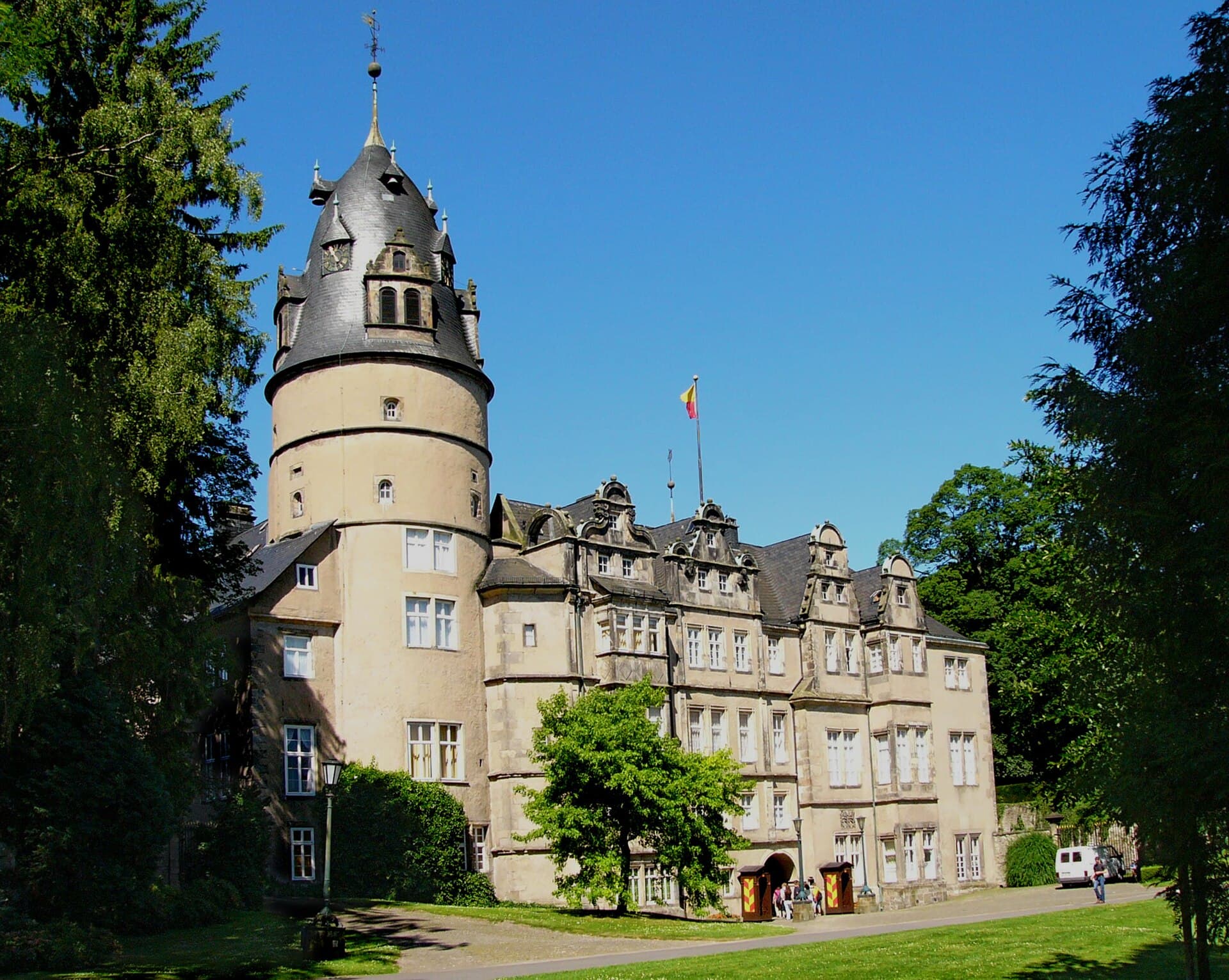
Detmold, GermanyNo machine-readable author provided. Nikater assumed (based on copyright claims). / CC BY-SA 3.0, via Wikimedia Commons
DE

Detmold

Self-guided audio walking tour of Detmold — GPS route, offline playback, story-driven narration in 32 languages.

Where ancient narratives meet half-timbered grace, cradled by the Teutoburg Forest.

The secrets of Detmold

Detmold, as no one tells it.

Not the postcards. The stories even locals don't know — whispered in your ear, right where they happened.

3 secrets below. Many more wait inside the tour.
Hermannsdenkmal

The towering Hermann Monument, Germany's tallest statue, symbolizes national pride, yet its genesis reveals a sculptor's profound, singular vision more than a unified nation's will.

Full story unlocks in the tour
Lippisches Landesmuseum

Among its expansive holdings, the Lippisches Landesmuseum safeguards a relic far more ancient than celebrated mummies like Ötzi or Tutankhamun, and its nature might surprise you.

Full story unlocks in the tour
Fürstliches Residenzschloss Detmold

This grand residence of the Princes of Lippe employs a distinctive method for safeguarding its historic floors during guided visits.

Full story unlocks in the tour
The full tour

Discover every secret of Detmold

Every address, every reveal in full — in your ear, right where it happened.

Get the key to Detmold

You pick your stops. You walk. The voice reveals what the others miss.

Choose your time

How long do you have in Detmold?

Your self-guided audio tour of Detmold is ready — pick your landmarks, choose your language, and start the moment you arrive.

Buy
About Detmold

The story of Detmold

Detmold, a city in North Rhine-Westphalia, Germany, serves as the administrative heart of the Lippe district and the Regierungsbezirk Detmold. It rests at the edge of the Teutoburg Forest, a gentle mountain range that begins at the city's southwestern perimeter. With a population of approximately 74,000, Detmold stands as the cultural core of the Lippe region, offering a thoughtful fusion of historical depth and natural allure.

The city's intimate, walkable design allows visitors to meander effortlessly through its historic center, the castle grounds, and its many museums. Detmold's identity is profoundly interwoven with its past as the capital of the Principality of Lippe, a heritage vividly expressed in its architecture and cultural institutions.

History

Detmold's origins stretch back to 783 AD, when it first appeared in records as Theotmalli, the battleground for Saxon and Charlemagne's forces during the Saxon Wars. By 1263, Bernard III of Lippe strengthened the settlement, granting it a municipal charter and reinforcing its defenses with stone walls. The town's strategic position at a crossing of the Werre River fostered its swift economic growth.

In 1447, Detmold sustained significant damage during a conflict with Soest, followed by a devastating fire in 1547 that consumed over 70 homes. Despite these adversities, Detmold became the permanent seat of Count Simon III of Lippe in 1550. The counts of Lippe ascended to princely status in 1789, and Detmold remained the capital of the small Principality of Lippe until the close of World War I in 1918, when all princely states in Germany were dissolved. From 1919 to 1947, Detmold functioned as the capital of the Free State of Lippe before its incorporation into the state of North Rhine-Westphalia.

The city's religious narrative is also noteworthy, marked by the spread of Reformed Protestantism from the latter half of the 16th century. This led to a period of contention between Lutheran and Reformed adherents, culminating in the Peace of Röhrentrup in 1617, which formally divided Lippe into Lutheran and Reformed confessions. Today, these two confessions are united within the Detmold-based Regional Church of Lippe, and both Reformed and Lutheran congregations share the city.

Detmold's past is also closely linked with the Hermannsdenkmal, a colossal monument commemorating Arminius's victory over the Romans in the Battle of the Teutoburg Forest in 9 AD. While the monument was constructed between 1838 and 1875, during a period of German nationalism, the actual battle site is now thought to be near Kalkriese, approximately 100 km northwest of Detmold.

What to see

Detmold presents a range of points of interest, harmonizing historical locations with natural splendor. The Hermannsdenkmal (Hermann Monument) stands as a prominent marker, a 53-meter-high statue commemorating Arminius's triumph over the Romans. Visitors may ascend to its viewing platform for sweeping vistas of the Lippe region and the Teutoburg Forest.

In the city center, the Fürstliches Residenzschloss Detmold (Princely Residence Castle Detmold) is a Renaissance palace that served as the home for the Princes of Lippe for centuries. Guided tours allow for exploration of its grand chambers and impressive architecture. The surrounding castle park offers a tranquil setting for a leisurely walk.

The Lippisches Landesmuseum (Lippe State Museum) is the oldest and most extensive regional museum in East Westphalia, featuring broad collections of art, culture, and natural history, including a 6,500-year-old child mummy from Peru. The LWL-Freilichtmuseum Detmold (LWL Open-Air Museum Detmold) is among Europe's largest open-air museums, illustrating rural life and customs with over 100 historical buildings. Detmold's old town itself is a captivating sight, with over 700 architectural monuments, including well-preserved half-timbered structures and narrow passageways.

When to visit

The most agreeable period for experiencing Detmold's outdoor activities is from late June to late August. During these months, average daily temperatures span from a high of 24°C (75°F) to a low of 13°C (55°F). July typically offers the warmest weather and clearer skies. While rain occurs throughout the year, June generally experiences the most precipitation, and April the least. The window from June to September provides optimal weather for exploring the city and its open-air attractions.

Practical

Detmold is situated in the state of North Rhine-Westphalia, positioned between Bielefeld and Hanover. The nearest airport is Paderborn/Lippstadt (PAD), approximately 50 km south of Detmold, though it provides limited flight connections. Larger airports are found in Hanover (HAJ), 100 km northeast, and Dortmund (DTM), 115 km southeast. Detmold benefits from regional train services, with hourly connections from Herford, Bielefeld, Altenbeken, and Paderborn, where travelers can transfer to long-distance trains. The city is compact and easily navigated on foot, with many primary sights accessible via pedestrian routes. The Tourist Information Lippe & Detmold, located at Marktplatz 5, offers information, guidance, and assistance with accommodation bookings.

Good to know
What is Detmold known for?
Detmold is recognized for its profound past as the former capital of the Principality of Lippe, its meticulously preserved old town adorned with half-timbered houses, and the Hermannsdenkmal, an immense monument commemorating Arminius's triumph over the Romans.
Is Detmold a walkable city?
Indeed, Detmold is a compact city, easily traversed on foot, with most of its primary points of interest, including the central square, castle grounds, and museums, readily reachable via pedestrian paths.
What is the Hermannsdenkmal?
The Hermannsdenkmal is a 53-meter-high monument southwest of Detmold, memorializing the Cherusci war chief Arminius (Hermann) and his victory over the Roman Empire in the Battle of the Teutoburg Forest in 9 AD.
What can I see at the Lippisches Landesmuseum?
The Lippisches Landesmuseum in Detmold houses extensive collections encompassing art, culture, and natural history. Notable exhibits include a 6,500-year-old Peruvian child mummy and displays on the Battle of the Teutoburg Forest.
What kind of architecture can I expect in Detmold?
Detmold's old town displays over 700 architectural monuments, including many well-preserved half-timbered houses from the late Middle Ages, Biedermeier, and Wilhelminian periods. The Princely Residence Castle also showcases Renaissance architecture.
Are there any open-air museums in Detmold?
Yes, the LWL-Freilichtmuseum Detmold stands as one of Europe's largest open-air museums, spanning 90 hectares and featuring over 100 historical buildings that portray rural life and customs from various German regions.
On the map
Detmold
€9.90
No booking · activate anytime · 12h to walk it
Load on Wi-Fi, then walk offline — no roaming abroad
Get the key to Detmold