Dozza's Town Name
The name 'Dozza' isn't merely a pleasant sound; it offers a clue to the village's ancient purpose.
Full story unlocks in the tour
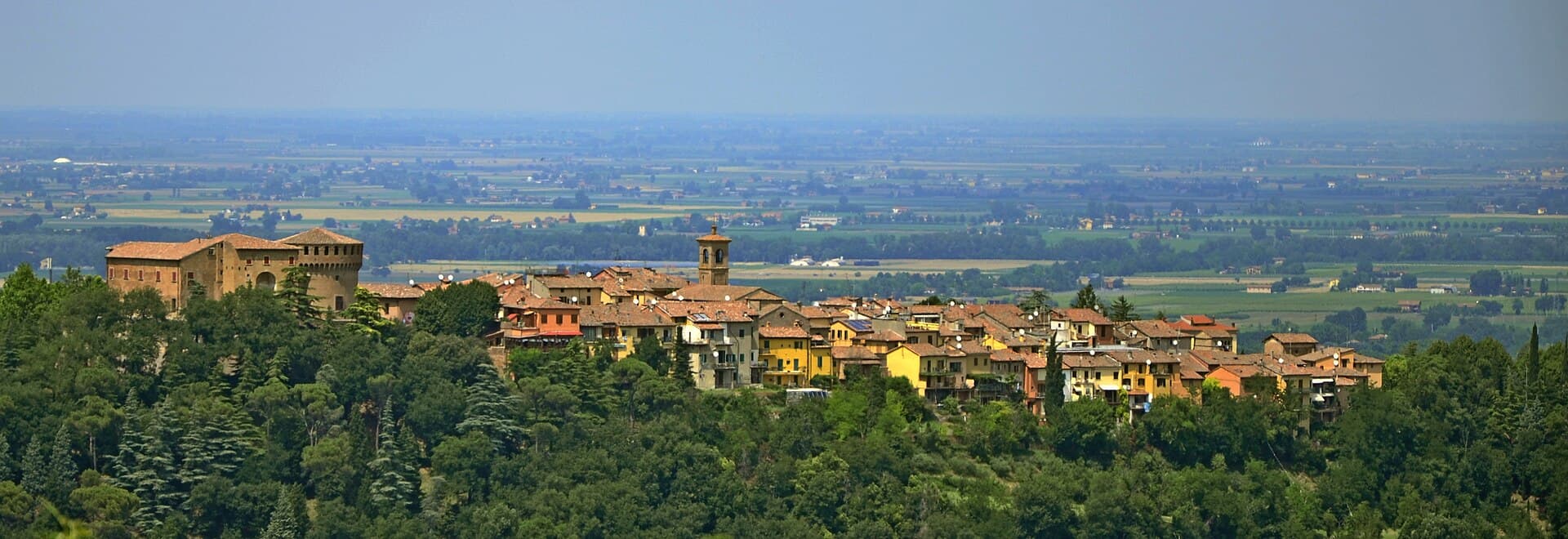 Durmas (Durelli Massimo) / CC BY-SA 3.0, via Wikimedia Commons
Self-guided audio walking tour of Dozza — GPS route, offline playback, story-driven narration in 32 languages.
“Where ancient walls tell their enduring tales, and contemporary art declares new ones.”
Not the postcards. The stories even locals don't know — whispered in your ear, right where they happened.
The name 'Dozza' isn't merely a pleasant sound; it offers a clue to the village's ancient purpose.
The formidable Rocca Sforzesca, standing guard over Dozza, holds a secret within its stone walls that speaks of a powerful, astute woman.
Step into the castle's historic kitchen, and you will discover more than just old hearths and cooking implements.
Discover every secret of Dozza
Every address, every reveal in full — in your ear, right where it happened.
You pick your stops. You walk. The voice reveals what the others miss.


Your self-guided audio tour of Dozza is ready — pick your landmarks, choose your language, and start the moment you arrive.
BuyLume has a built-in augmented-reality guide. Hold your phone up and its camera shows the street ahead of you, with a glowing arrow laid over the real view that always points to your next stop — no map to puzzle over, no wrong turns. Like everything in Lume, it works fully offline.
Dozza, a medieval village set upon a ridge amidst the gentle hills of Emilia-Romagna, is a living canvas. Just 35 kilometers southeast of Bologna, this fortified town has earned its place among "Italy's Most Beautiful Villages" not only for its well-preserved ancient allure but for a lively secret it has embraced since the 1960s: its walls are alive with art.
Beyond the captivating outdoor gallery, Dozza offers a rich array of experiences. Its imposing Rocca Sforzesca, a medieval fortress now a museum, stands sentinel at the village's highest point, providing expansive views and a journey through centuries of time. Below, in the castle's ancient cellars, lies the Enoteca Regionale dell'Emilia-Romagna, a regional wine hub presenting the finest of the area's viticultural heritage. Dozza is a quiet, authentic escape, a place where history, art, and the tastes of Emilia-Romagna converge in a truly singular way.
The territory surrounding Dozza has been inhabited since prehistoric times, with scattered Roman and early medieval settlements. The village's very name, derived from the Latin 'Ducia' or 'Duza' meaning 'channel which leads water,' hints at its ancient strategic importance due to abundant springs and perhaps an early fortified Roman camp.
Dozza emerges more clearly in medieval documents in the 12th century, identified as a castrum (fortified settlement) as early as 1126. Its strategic position on the border between Bologna and Romagna made it a coveted prize, leading to centuries of conflict between Bologna and Imola, Guelphs and Ghibellines, and various local lordships and the Roman Church.
The current imposing structure of the Rocca Sforzesca, Dozza's fortress, largely dates back to the late 15th century. It was then that Caterina Sforza, daughter of the Duke of Milan and wife of Girolamo Riario, Lord of Imola, commissioned significant defensive works. These included the addition of defensive towers, a moat, and merlons, transforming the castle into a formidable Renaissance fortress. This fortification proved its worth when it resisted attacks by Cesare Borgia for over a month in 1499.
In the 16th century, Pope Clement VII granted Dozza to the Campeggi family, who began converting the military fortress into a noble residence, roofing the courtyard and creating open loggias. Following the disappearance of the last male Campeggi heir in 1728, the castle passed to the Malvezzi family through marriage, who continued renovations, particularly on the second floor. The Malvezzi-Campeggi family inhabited the fortress until 1960, when it was deeded to the city of Dozza and opened to the public as a museum.
The mid-20th century marked a pivotal moment for Dozza. Facing a slow decline and an aging population, the town sought to reinvent itself. In 1960, Tomaso Seragnoli, the then-mayor, conceived the idea of the Biennale del Muro Dipinto (Biennial of the Painted Wall). This innovative festival invited artists to use the ancient facades of Dozza as their canvases, transforming the village into a unique open-air art gallery. The initiative was a resounding success, leading to a continuous evolution of the village's artistic landscape. Since 2007, the Biennale has also expanded to the nearby hamlet of Toscanella, featuring more modern street art and graffiti. This artistic endeavor has not only revitalized Dozza but has also contributed to its population doubling since 1961, a testament to the power of cultural events in fostering sustainable tourism.
Dozza invites you to wander its ancient paths, where every turn reveals a new artistic revelation. The Dozza Painted Walls (Muro Dipinto) are the primary draw, with over 200 contemporary murals adorning houses, arches, and squares, transforming the entire village into a compelling open-air museum.
At the village's summit, the Rocca Sforzesca stands as a testament to centuries of time. This medieval fortress, now a museum, offers a glimpse into noble life with its historic kitchen, furnished apartments, and frescoes. Do not miss the expansive views from the castle towers, or a visit to the old prison with its display of torture devices and carved graffiti. Within the Rocca, you might even encounter Fyrstan, the dragon, guardian of imagination.
In the castle's atmospheric cellars, the Enoteca Regionale dell'Emilia-Romagna awaits. This regional wine headquarters presents over 1,000 labels of wines, balsamic vinegars, and spirits. You can explore the collection, arranged by food pairings, and participate in tastings guided by sommeliers.
Beyond the art and fortress, consider a stroll along the Dozza Wine Path, a picturesque 6.5km hike through vineyards and hills, connecting local wineries. For those interested in fantasy literature, the Centro Studi Tolkieniani "La Tana del Drago" (The Dragon's Lair) is a unique study center dedicated to J.R.R. Tolkien and the world of fantasy.
Dozza retains its charm throughout the year, with its murals always visible. However, for the most lively experience, consider visiting in mid-September, especially during odd-numbered years when the Biennale del Muro Dipinto (Biennial of the Painted Wall) takes place. During this time, you can witness artists at work, attend exhibitions, and enjoy concerts. The weather in September is typically warm, and the vineyards are picturesque, without the peak summer crowds. Arriving early, around 9 AM, is recommended to enjoy the village before it becomes too busy. The warmer months from late June to late August are also suitable for hot-weather activities.
Dozza is located about 30-45 minutes southeast of Bologna. The easiest way to reach Dozza is by car, with parking available at the town's arched entrance, as only locals are permitted to drive within the village. Alternatively, you can take a train from Bologna Centrale to Imola (a 20-30 minute journey) and then a taxi to Dozza (approximately €15). Public bus service is also available from Bologna to Toscanella (Bus 101), followed by a local bus (Bus 147) to Dozza, though the latter may require a request and schedules can vary.
Due to its compact size and pedestrian-friendly ancient paths, Dozza is best explored on foot. The Rocca Sforzesca typically has an entry fee of around €8. The Enoteca Regionale dell'Emilia-Romagna is generally closed on Mondays. While Dozza is generally quiet, especially on weekdays and outside of festival times, some restaurants might have limited hours during the off-season.
Dozza in Korean, in Chinese or in Hebrew — and 29 more languages, every stop narrated by a native voice. The widest language range of any self-guided audio tour.
Available in: