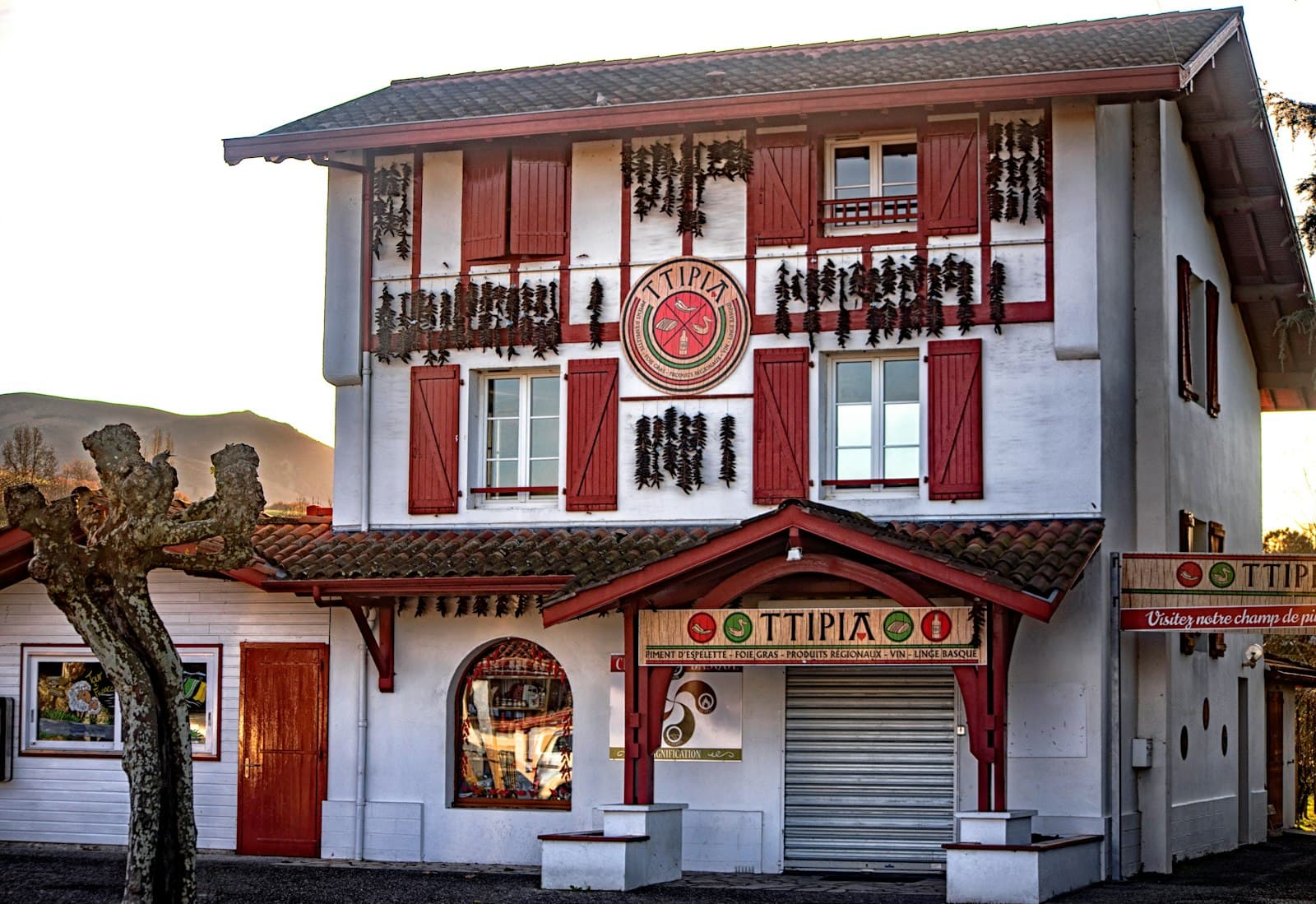
Espelette's Architecture
The lively red shutters and beams on Espelette's houses aren't just for aesthetics.
Full story unlocks in the tour
 Wikimedia / cc by-sa 3.0, via Wikimedia Commons
Self-guided audio walking tour of Espelette — GPS route, offline playback, story-driven narration in 32 languages.
“Where every facade tells a spicy story.”
Not the postcards. The stories even locals don't know — whispered in your ear, right where they happened.
The lively red shutters and beams on Espelette's houses aren't just for aesthetics.
The iconic Espelette pepper, now synonymous with the Basque Country, didn't originate in France.
Espelette's castle holds a surprising connection to a national beauty pageant.
Discover every secret of Espelette
Every address, every reveal in full — in your ear, right where it happened.
You pick your stops. You walk. The voice reveals what the others miss.

Your self-guided audio tour of Espelette is ready — pick your landmarks, choose your language, and start the moment you arrive.
BuyLume has a built-in augmented-reality guide. Hold your phone up and its camera shows the street ahead of you, with a glowing arrow laid over the real view that always points to your next stop — no map to puzzle over, no wrong turns. Like everything in Lume, it works fully offline.
Espelette, a village within the French Basque Country, is celebrated for its iconic red peppers, which hang in bright garlands from the white-washed facades of its traditional Basque houses. This scenic village, situated in the Labourd province at the foot of the Pyrenees, offers a singular blend of cultural heritage and culinary distinction. Strolling through its pedestrianized center, visitors encounter inviting artisan shops and local producers, many of whom honor the famed Espelette pepper in various forms.
The village's atmosphere is both calm and animated, encouraging unhurried walks and opportunities to savor local gastronomy. Beyond the visual spectacle of the peppers, Espelette provides a sensory journey, with the subtle, fruity aroma of the spice permeating the air. Its proximity to other beautiful Basque villages like Ainhoa and Sare makes it an ideal starting point for exploring the region's distinctive architecture and enduring cultural traditions.
Espelette's history extends back many centuries, with its earliest mentions appearing in the 11th century. The village's name, Ezpeleta in Basque, translates to 'a place planted with boxwood,' and comes from a noble Navarrese family who once held the territory. This family constructed a fortified castle around the year 1000, which played a significant role in the village's evolution.
The castle of the Barons of Ezpeleta was a substantial structure, originally envisioned with a vast enclosure and five towers. Portions of it were damaged during a villagers' revolt in the reign of Louis XIII. In 1694, the last descendant of the Ezpeleta family, Baroness Juliana Henriquez, bequeathed the castle to the commune. Today, following extensive restoration efforts in 1998, the castle houses the town hall, municipal library, tourist office, and exhibition rooms, including one dedicated to the Espelette pepper.
A pivotal moment in Espelette's history was the introduction of the pepper from South America in the 16th or 17th century. Initially, it was cultivated by women as a substitute for expensive black pepper, used for both seasoning and preserving meats. This ancestral cultivation, with women carefully selecting seeds for future sowing, led to the development of the 'Gorria' variety, the only farmhouse seed used for Espelette Pepper. The tradition of stringing peppers to dry on house facades began as a practical method. The Espelette pepper received its Protected Designation of Origin (PDO) status in 2002, recognizing its unique characteristics and the traditional methods of its cultivation and processing.
Begin by simply wandering the village streets, admiring the traditional Basque architecture with its white-washed houses and colorful, often red, wooden beams and shutters. The iconic strings of red Espelette peppers drying on facades are a defining visual throughout the late summer and autumn.
Visit the Church of Saint Étienne, a 17th-century fortified church known for its massive proportions, thick walls, three levels of wooden galleries, and an ornate 18th-century altarpiece. The adjacent cemetery features distinctive discoidal steles.
Explore the Château des Barons d'Ezpeleta, which now serves as the town hall and tourist office. It houses exhibitions, including one dedicated to the Espelette pepper and another to Agnès Souret, the first Miss France.
For a deeper dive into the region's celebrated spice, visit the Centre d'interprétation du piment d'Espelette AOP (Interpretation Center of the Espelette Pepper PDO). This free center offers insights into the pepper's history, cultivation, and cultural importance through informative displays and a short video.
Beyond the pepper, Espelette is also home to the Ossau-Iraty PDO Interpretation Centre, where you can learn about the esteemed Basque and Béarnais cheese. Consider a chocolate tasting at Chocolat Antton, which offers free tours of its workshop and tastings.
The ideal time to visit Espelette for pleasant weather and outdoor activities is from late June to mid-September, with a peak in the third week of July. The shoulder seasons of May, June, September, and October offer mild temperatures and fewer crowds. Autumn, particularly September and October, is especially beautiful as the peppers are harvested and hung to dry, creating the village's most iconic scenery. The annual Fête du Piment (Pepper Festival), held on the last weekend of October, is a lively celebration of the harvest, though the village can become very crowded during this time.
Espelette is a pedestrian-friendly village, making it easy to explore on foot. While it can draw many visitors, especially during summer and the Pepper Festival, arriving early in the day can help avoid peak crowds. Many shops are open seven days a week during the tourist season. Public transportation options connect Espelette to neighboring communes, with bus line 40 (formerly 14) facilitating travel. For those driving, parking is available, though it's advisable to check for specific parking areas. Accommodations range from hotels to guesthouses. The local cuisine heavily features Espelette pepper, so be prepared to sample it in various dishes, from savory stews and cured meats to chocolate and ice cream.
Espelette in Korean, in Chinese or in Hebrew — and 29 more languages, every stop narrated by a native voice. The widest language range of any self-guided audio tour.
Available in: