Exeter Cathedral
Beneath the soaring vaulted ceiling of Exeter Cathedral lies a profound history, far older than the Gothic structure above.
Full story unlocks in the tour
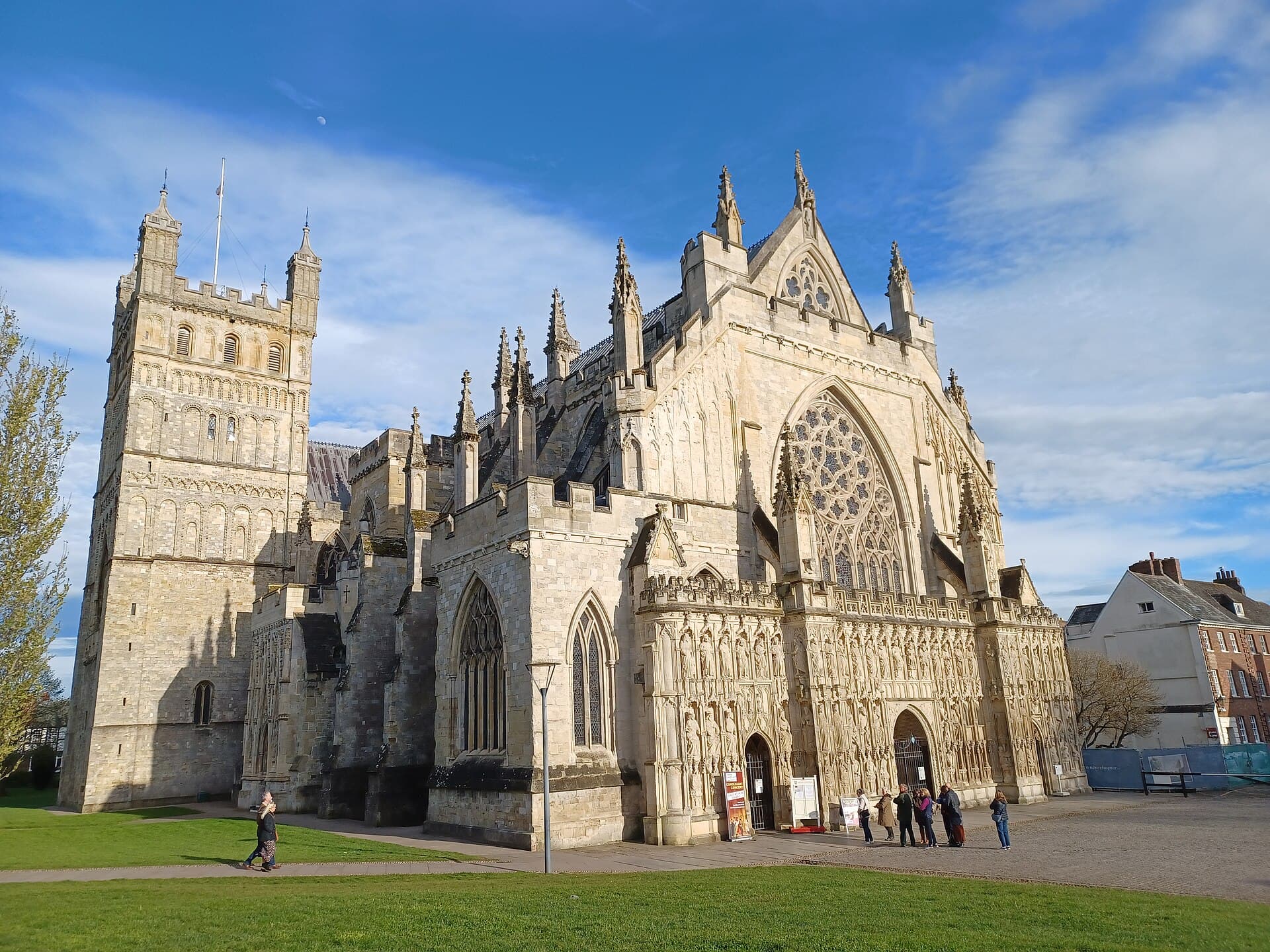 Simon Burchell / CC BY-SA 4.0, via Wikimedia Commons
Self-guided audio walking tour of Exeter — GPS route, offline playback, story-driven narration in 32 languages.
“Where Roman foundations meet medieval grandeur and underground secrets.”
Not the postcards. The stories even locals don't know — whispered in your ear, right where they happened.
Beneath the soaring vaulted ceiling of Exeter Cathedral lies a profound history, far older than the Gothic structure above.
Exeter holds a unique subterranean network, unlike any other open to the public in Britain.
The Exeter Ship Canal holds a surprising distinction in British engineering history.
Discover every secret of Exeter
Every address, every reveal in full — in your ear, right where it happened.
You pick your stops. You walk. The voice reveals what the others miss.


Your self-guided audio tour of Exeter is ready — pick your landmarks, choose your language, and start the moment you arrive.
BuyLume has a built-in augmented-reality guide. Hold your phone up and its camera shows the street ahead of you, with a glowing arrow laid over the real view that always points to your next stop — no map to puzzle over, no wrong turns. Like everything in Lume, it works fully offline.
Exeter, a city in Devon, England, offers a compelling blend of ancient history and contemporary life. Its origins stretch back to Roman times, around 50 AD, when a legionary fortress was established, later evolving into a civilian settlement. Today, Exeter is a lively hub, known for its magnificent Gothic cathedral, well-preserved Roman walls, and a unique network of medieval underground passages.
The city's compact center makes it ideal for exploration on foot, with pedestrianized streets leading past historic buildings and modern shops. Beyond its historical core, Exeter embraces the outdoors, with numerous green spaces, riverside walks along the River Exe, and easy access to the wider Devon countryside and coastline. In 2019, Exeter was recognized as a UNESCO City of Literature, acknowledging its continuous thousand-year history of book-making and promoting reading.
## From Roman Stronghold to Medieval Powerhouse Exeter's story begins around 50 AD with the arrival of the Roman II Augusta Legion, who established a fortified camp on a ridge overlooking the River Exe. By the late 2nd century, these early defenses were replaced by a substantial bank and stone wall, enclosing a much larger area of approximately 92 acres. These Roman walls, some sections still standing up to 2.5 meters high, were built using durable purple volcanic trap stone, quarried from the extinct volcano at Rougemont.
Throughout the Anglo-Saxon and medieval periods, the city walls were continuously repaired and strengthened, serving as crucial defenses during numerous sieges, including those by Vikings and William the Conqueror. The city's strategic importance continued, becoming an influential Anglo-Saxon 'burh' and later a Royal town. Within these walls, the three great institutions of medieval life—the castle, the cathedral, and the guildhall—flourished, making Exeter the economic, social, and political heart of the region for two millennia.
## The Rise of Exeter Cathedral The founding of Exeter Cathedral, dedicated to Saint Peter, dates back to 1050. The present Gothic structure, largely completed by around 1400, is renowned for its architectural features. It contains the longest uninterrupted medieval vaulted ceiling in the world, stretching approximately 96 meters (315 feet). The cathedral also houses an early set of misericords (carved seats), an astronomical clock, and a unique minstrels' gallery adorned with twelve carved angels playing medieval instruments.
## Underground Innovation and Maritime Ambition Beneath Exeter's streets lies a remarkable network of medieval underground passages, the only ones of their kind open to the public in Britain. These tunnels, with the earliest dating to the 13th century, were not for defense but were an advanced feat of engineering, built to house lead pipes that supplied fresh water to the city from natural springs. The first passage, begun in 1346, brought water to Exeter Cathedral, with a second phase in 1492 extending the supply to the city's residents.
Exeter's ambition extended to its waterways as well. The Exeter Ship Canal, one of the oldest artificial waterways in the UK, was first constructed in the 1560s. It was built to bypass weirs on the River Exe, allowing ships to reach the city and establishing the first pound locks in Britain. This engineering marvel facilitated trade and further cemented Exeter's importance as a regional center.
Begin your exploration at Exeter Cathedral, a masterpiece of Decorated Gothic architecture. Marvel at the longest uninterrupted medieval vaulted ceiling in the world and seek out the intricate misericords and the unique Minstrels' Gallery. Afterwards, delve into the city's subterranean past with a guided tour of Exeter's Underground Passages, a fascinating medieval water system unlike any other in Britain.
Walk along sections of the Roman City Wall, which has protected Exeter for nearly two millennia, offering glimpses of its ancient origins. Explore the historic Quayside, a lively area with independent eateries and opportunities for watersports and riverside walks along the Exeter Ship Canal. Do not miss the Royal Albert Memorial Museum (RAMM), which offers free entry and houses extensive collections detailing Devon's history and global cultures. For a breath of fresh air, stroll through Northernhay Gardens or Rougemont Gardens, offering tranquil green spaces and views of the city.
The best time to visit Exeter for warm-weather activities is from late June to late August, when the average daily temperature is around 16°C (61°F) and highs can reach 21°C (70°F). July is typically the clearest and driest month. Spring and early autumn, or 'shoulder seasons,' offer a good balance of pleasant weather, fewer crowds, and better value on accommodations. Winter brings a festive atmosphere, especially during the Christmas Market, with the cathedral illuminated by twinkling lights.
Exeter is easily accessible, with direct train services from London Paddington taking just over two hours to Exeter St David's station. Exeter Airport offers flights from various European destinations, though Bristol or London airports may provide more international options.
The city center is compact and pedestrian-friendly, making walking the ideal way to explore. For longer distances, the Stagecoach bus network connects major attractions. If you plan to explore the wider Devon area, a car can be useful, though Park & Ride options are available for city access. Exeter is generally considered a safe city with good healthcare services, including the Royal Devon and Exeter Hospitals.
Exeter in Korean, in Chinese or in Hebrew — and 29 more languages, every stop narrated by a native voice. The widest language range of any self-guided audio tour.
Available in: