Château de Falaise
William the Conqueror's birth at Falaise Castle is well-documented, but the circumstances of his parents' meeting are less regal than you might imagine.
Full story unlocks in the tour
 Viault / CC BY-SA 3.0, via Wikimedia Commons
Self-guided audio walking tour of Falaise — GPS route, offline playback, story-driven narration in 32 languages.
“Where medieval might meets modern remembrance.”
Not the postcards. The stories even locals don't know — whispered in your ear, right where they happened.
William the Conqueror's birth at Falaise Castle is well-documented, but the circumstances of his parents' meeting are less regal than you might imagine.
The formidable stone keeps of Falaise Castle have stood for centuries, but one tower bears a distinctly English name, hinting at a period when loyalties shifted dramatically.
Just a short distance from Falaise lies a natural geological formation with a dramatic name, and local legend attributes its creation to a rather fiery dispute.
Discover every secret of Falaise
Every address, every reveal in full — in your ear, right where it happened.
You pick your stops. You walk. The voice reveals what the others miss.


Your self-guided audio tour of Falaise is ready — pick your landmarks, choose your language, and start the moment you arrive.
BuyLume has a built-in augmented-reality guide. Hold your phone up and its camera shows the street ahead of you, with a glowing arrow laid over the real view that always points to your next stop — no map to puzzle over, no wrong turns. Like everything in Lume, it works fully offline.
Falaise, a historic town in Normandy, France, offers a compelling journey through a thousand years of history. It is known as the birthplace of William the Conqueror, the first Norman King of England, whose imposing 12th-century castle commands the town's skyline. Beyond its medieval roots, Falaise also played a pivotal role in the closing stages of World War II, lending its name to the decisive 'Falaise Pocket' battle.
Despite suffering extensive damage during the 1944 Allied bombings, Falaise has been meticulously rebuilt, blending its ancient heritage with a resilient modern appeal. Visitors can explore medieval fortifications, poignant WWII memorials, and a lively town center. Falaise provides a unique opportunity to delve into significant chapters of European history, set against the backdrop of the lush Norman countryside.
Falaise's history is inextricably linked to the powerful Dukes of Normandy. The town's name itself, derived from the Old German word 'falisa,' means 'rock,' a clear reference to the rocky outcrop upon which its famous castle stands. The first stronghold on this site dates back to the late 10th century. It was here, around 1028, that William the Conqueror, then known as William the Bastard, was born to Robert I, Duke of Normandy, and Herleva. William's birth at Falaise cemented the town's place in history as the ancestral seat of the Norman dukes.
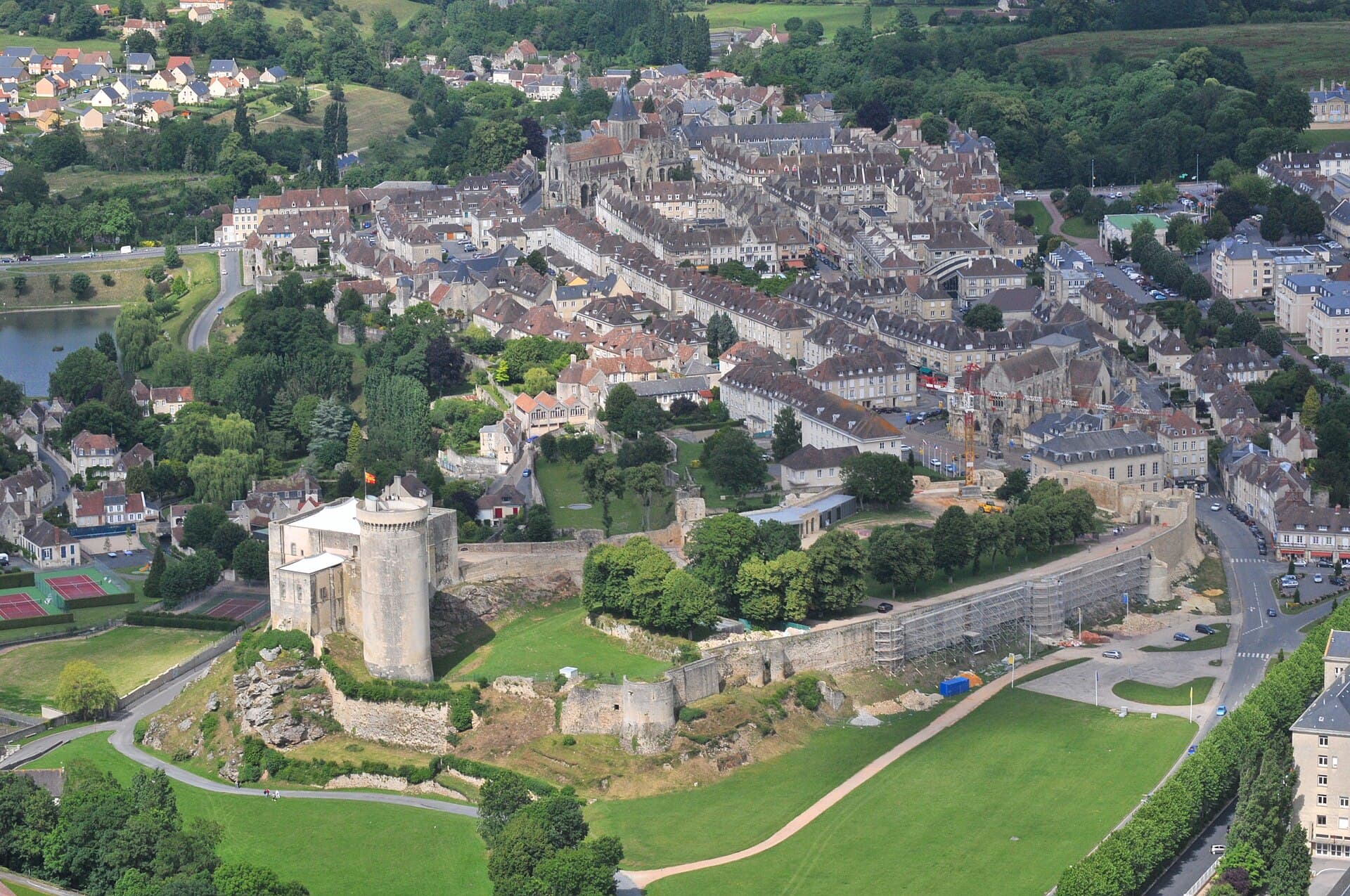
The castle itself underwent significant transformations over the centuries. William's son, Henry I of England, began rebuilding the stone castle around 1123. Later, Henry II added a second quadrangular keep, and Philip II of France, after annexing Normandy in the 13th century, constructed the large round tower, now known as the Talbot Tower after an English commander who repaired it during the Hundred Years' War. The castle remained a vital fortress, changing hands multiple times during Anglo-French conflicts.
The medieval period also saw Falaise flourish as an economic center, thanks in part to the Guibray Fair. However, the castle eventually lost its military importance in the 17th century and fell into disrepair, only to be recognized as a historical monument in 1840 and undergo restoration in the 1870s.
Falaise's more recent history is marked by the devastation of World War II. In August 1944, the town became the focal point of the Battle of the Falaise Pocket, a decisive engagement in the Battle of Normandy. Allied forces encircled and trapped a large German army, leading to immense casualties and the eventual destruction of much of Army Group B. Two-thirds of Falaise was destroyed by Allied bombing during this period. The town's liberation by Canadian and Polish soldiers was a turning point in the Normandy campaign. Falaise has since been rebuilt, with memorials and museums dedicated to preserving the memory of these events and the civilians who endured them.
The imposing Château de Falaise, William the Conqueror's birthplace, offers an immersive experience with augmented reality displays that bring its medieval past to life. Wander through the keeps and ramparts for sweeping views of the town and surrounding valleys.
Explore the medieval town center, where remnants of its fortified past, including a 2 km long wall, can still be found. The Place Guillaume-le-Conquérant features an equestrian statue of William, a central point to observe local life. Visit the Église Saint-Gervais-Saint-Protais and the Église de la Trinité, both notable for their architectural details.
For a poignant look at more recent history, the Falaise Memorial – Civilians in Wartime Museum offers a unique perspective on civilian life during World War II, particularly the Battle of the Falaise Pocket. Another unexpected delight is Automates Avenue, a museum showcasing over 300 automatons in recreated Parisian street scenes.
The best time to visit Falaise is during the spring and early autumn (May, June, September), when the weather is mild and crowds are generally smaller. Average temperatures during these months range from 19°C to 24°C (66°F to 75°F), ideal for exploring. Summer (July and August) brings warmer temperatures, longer daylight hours, and a lively atmosphere, with many attractions open and the annual Medieval Festival in August. While winter is quieter, some sites may have reduced hours.
Falaise is located about 35 kilometers southeast of Caen. While there is no train station in Falaise, regular bus services connect it to Caen, which has train connections from Paris Saint-Lazare and Montparnasse stations. Hiring a car is recommended for exploring the wider region, including the Falaise Pocket battle sites. Ample free parking is available throughout the town, particularly near the castle and town center.
The local tourist office, Pays de Falaise Tourist Office, is a valuable resource for planning your stay, offering information on lodging, restaurants, and cultural events. Falaise hosts a market every Saturday in the town center.
Falaise in Korean, in Chinese or in Hebrew — and 29 more languages, every stop narrated by a native voice. The widest language range of any self-guided audio tour.
Available in: