Fidenza Cathedral's Facade
Look closely at the intricate carvings on the cathedral's facade, and you'll find a story that goes beyond typical religious iconography.
Full story unlocks in the tour
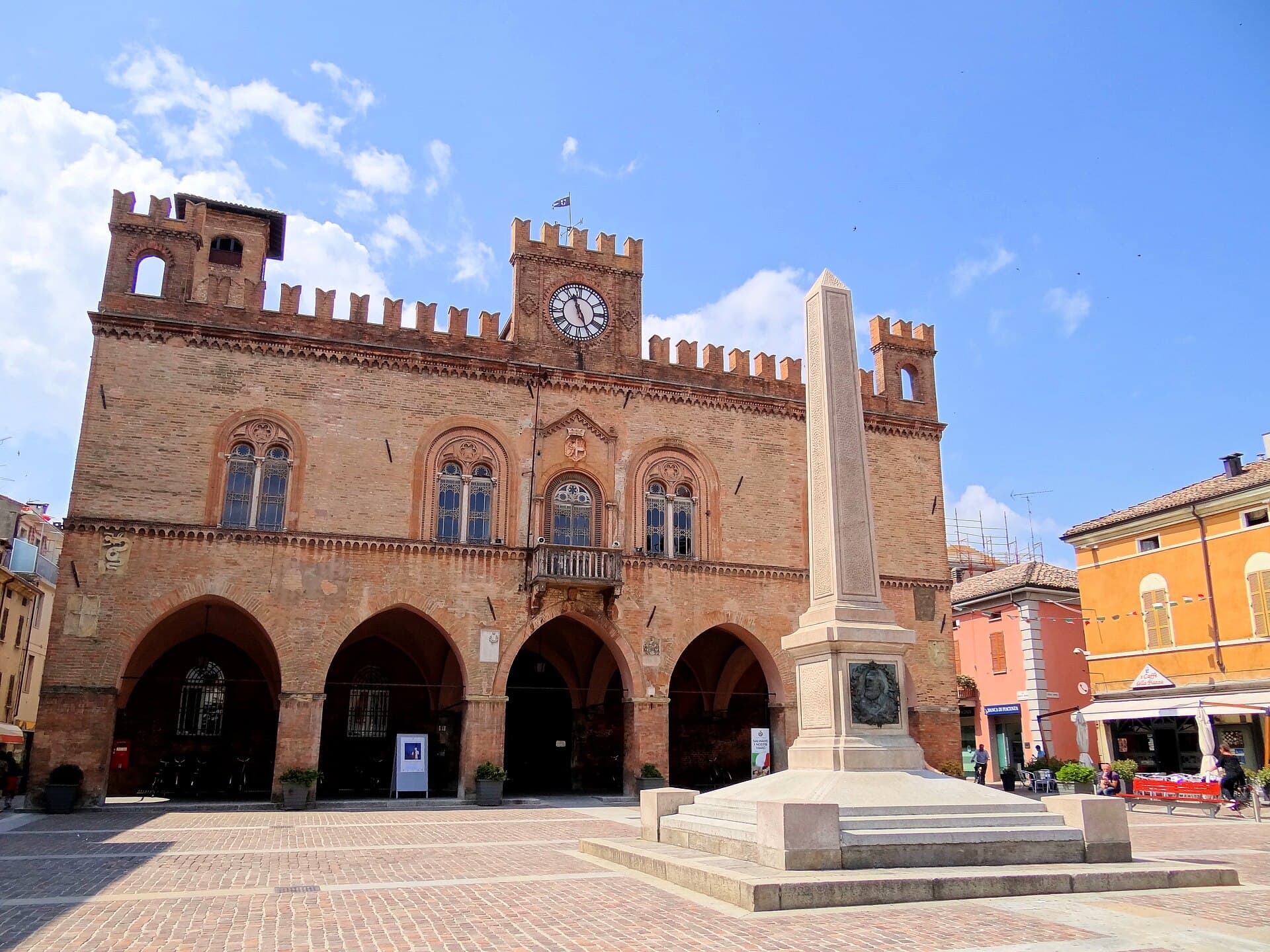 Bjørn Christian Tørrissen / cc by-sa 3.0, via Wikimedia Commons
Self-guided audio walking tour of Fidenza — GPS route, offline playback, story-driven narration in 32 languages.
“Where ancient pilgrimage routes meet unexpected modern style.”
Not the postcards. The stories even locals don't know — whispered in your ear, right where they happened.
Look closely at the intricate carvings on the cathedral's facade, and you'll find a story that goes beyond typical religious iconography.
The relics of Saint Domninus are said to rest in the cathedral's crypt, but a modern discovery casts a curious shadow on the legend.
Near the cathedral, you can see remnants of Fidenza's Roman past, but these aren't just any old ruins.
Discover every secret of Fidenza
Every address, every reveal in full — in your ear, right where it happened.
You pick your stops. You walk. The voice reveals what the others miss.
Your self-guided audio tour of Fidenza is ready — pick your landmarks, choose your language, and start the moment you arrive.
BuyLume has a built-in augmented-reality guide. Hold your phone up and its camera shows the street ahead of you, with a glowing arrow laid over the real view that always points to your next stop — no map to puzzle over, no wrong turns. Like everything in Lume, it works fully offline.
Fidenza, a city in Italy's Emilia-Romagna region, offers a captivating blend of ancient history, spiritual journeys, and unexpected modern flair. Situated along the historic Via Emilia and the ancient pilgrimage route of the Via Francigena, Fidenza has been a crossroads of cultures and commerce for millennia. Its roots stretch back to a Roman settlement known as Fidentia, a name that speaks to its historical role as a place of 'confidence' or 'trust.'
Today, Fidenza is recognized for its magnificent Romanesque cathedral, a masterpiece of medieval art that continues to draw pilgrims and art enthusiasts alike. Yet, beyond its prominent landmarks, the city invites a slower exploration, revealing layers of history from Roman ruins to medieval fortifications and elegant 19th-century architecture. With a population of around 27,000, Fidenza maintains an authentic Italian charm, providing a tranquil escape from more crowded tourist destinations.
The city also presents a striking contrast between its venerable past and a surprising contemporary identity as a fashion destination, thanks to the nearby Fidenza Village outlet. This unique juxtaposition of old and new, tradition and trend, makes Fidenza a truly intriguing stop for those seeking a multifaceted Italian experience. Whether you're tracing the footsteps of ancient pilgrims, admiring architectural wonders, or indulging in the region's renowned culinary delights, Fidenza offers a journey rich in discovery.
## From Roman Outpost to Medieval Pilgrimage Hub Fidenza's story begins in the 2nd century BC as the Roman settlement of Fidentia, a strategic military camp and later a municipium that gained Roman citizenship. Its location on the Via Aemilia, a vital Roman consular road, cemented its role as a perpetual transit and trade hub. Evidence of this Roman past can still be seen in the archaeological remains of a 1st-century AD Roman bridge near the cathedral.
In the 5th century, the city suffered destruction by Constantine I, a precursor to a turbulent medieval period. From the 7th century, after the discovery of the relics of Saint Domninus, the city became known as Borgo San Donnino, a name it held for over a thousand years. Saint Domninus, martyred in 304 AD, became the city's patron saint, and his veneration transformed Borgo San Donnino into a crucial stop on the Via Francigena, the ancient pilgrimage route to Rome. The construction of the Fidenza Cathedral, dedicated to Saint Domninus, began in the 12th century and stands as a testament to this period of spiritual importance.
## A History of Conflict and Rebirth The medieval era was marked by frequent conflicts. From 1092 to 1102, Borgo San Donnino even served as the capital of the Kingdom of Italy under Conrad of Lorraine. However, it faced repeated conquests and destructions, notably by Parma in 1199 and again in 1268, when the city was nearly razed. Despite these setbacks, Fidenza was rebuilt around 1300 and subsequently came under the discontinuous lordship of the Visconti of Milan from 1346 to 1447. The Visconti family also left their mark with the construction of the Porta San Donnino, a medieval gate and tower erected in 1364.
## Modern Transformations Fidenza's more recent history includes periods under French rule during the Napoleonic Wars, its annexation to the Kingdom of Sardinia-Piedmont in 1859 during Italian unification, and a significant expansion program under the Fascist government. In 1927, the city officially reverted to its ancient Roman name, Fidenza. Tragically, Fidenza suffered extensive damage from Allied bombings in May 1944 during World War II, and experienced massacres by German occupation troops in 1945 before its liberation. Despite these trials, the city has been rebuilt and today thrives as an agricultural center with light industries, while also embracing its heritage and a modern identity as a cultural and shopping destination.
The undisputed centerpiece of Fidenza is its Cathedral (Duomo), a magnificent 12th-century Romanesque masterpiece dedicated to Saint Domninus. Its lower facade is particularly striking, adorned with intricate sculptures by Benedetto Antelami and his school, depicting scenes from the life of the saint and other symbolic narratives. Inside, the cathedral features a simple yet well-proportioned interior with a central nave, two aisles, and a crypt believed to house the saint's relics.
Adjacent to the cathedral, explore the archaeological remains of the Roman bridge (1st century AD) and the medieval tower (Porta San Donnino), the last surviving gate of the ancient city walls. The tower also hosts the headquarters of the European Association of the Via Francigena. A short walk will bring you to the Teatro Girolamo Magnani, a beautiful 19th-century theater named after a local opera conductor. Its elegant foyer and rich decorations are a highlight.
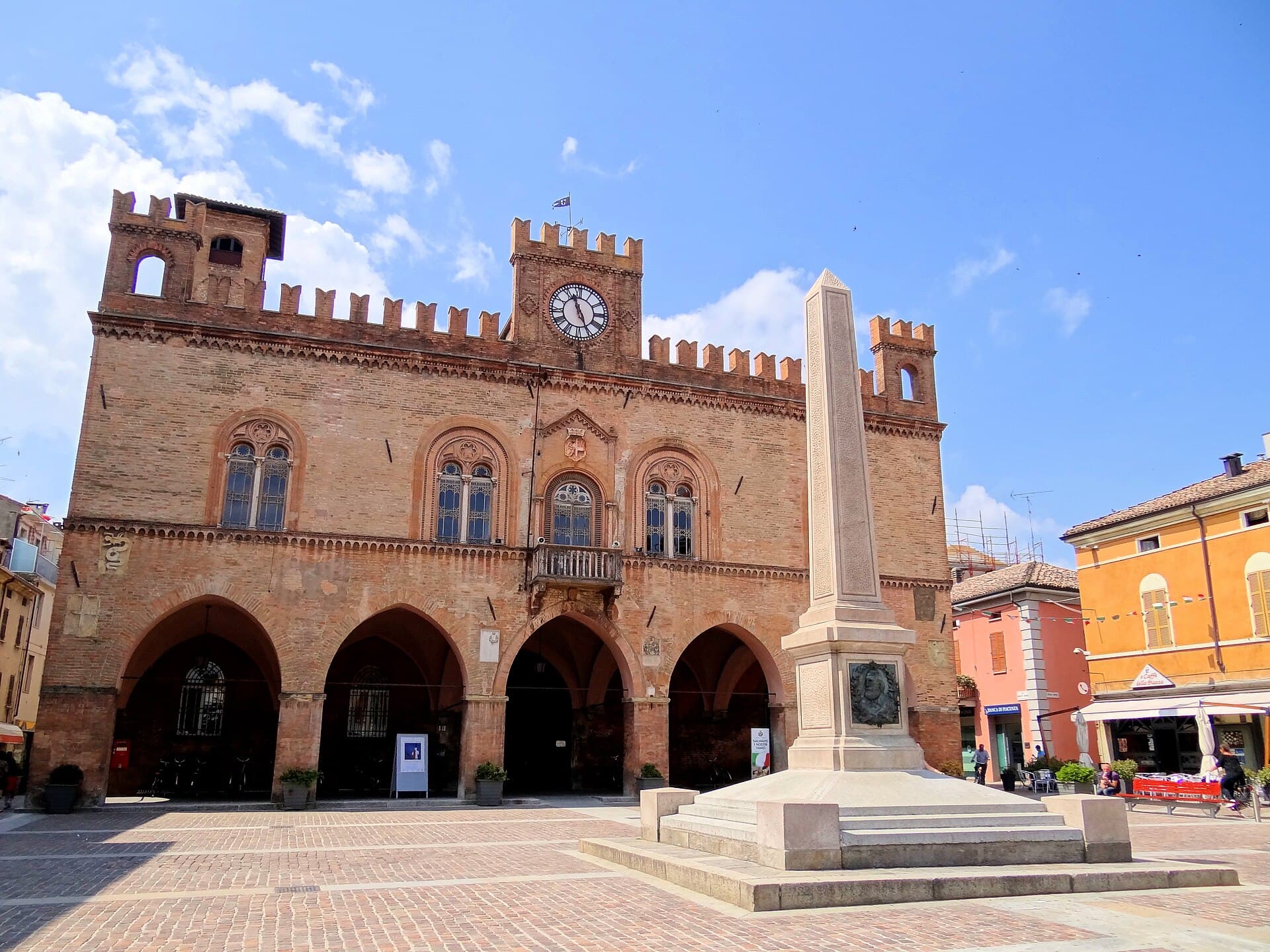
For a deeper dive into local history, visit the Museo del Duomo, located next to the cathedral, which houses religious artworks and historical documents. The Palazzo Comunale (Town Hall), with its neo-Gothic facade, is another notable architectural sight. Beyond the historical core, Fidenza offers the Fidenza Village outlet, a contemporary shopping destination featuring luxury brands in an architecturally themed setting. For nature enthusiasts, the Stirone River Regional Park provides opportunities for outdoor routes and fossil hunting.
Fidenza is a year-round destination, but the most comfortable weather for exploring is during spring (April to June) and early autumn (September to October). During these months, temperatures are mild and pleasant, ideal for walking the historic streets and enjoying outdoor activities. Summers (July and August) are generally warm, with average temperatures around 25°C and highs reaching 30°C or more, making light clothing and sun protection essential. Winters (January and December) are cool, with average temperatures around 4-5°C, and can experience night frosts. While precipitation is moderate throughout the year, May and November can be slightly rainier. The Fidenza Village outlet is open year-round, making it a viable attraction in any season.
Fidenza is well-connected and easily accessible. It has its own train station with direct services to major Italian cities like Parma, Piacenza, and Milan. The town is also located along the A1 motorway and SS9 road, making it convenient to reach by car. If arriving by air, the nearest major airport is likely Parma or Bologna.
For getting around the city center, comfortable walking shoes are highly recommended to navigate the cobbled streets. While cash (Euros) and bank cards are widely accepted, especially in the Fidenza Village outlet, smaller shops in the city center may close for a lunch break, typically from 1:00 PM to 3:30 PM or 4:00 PM. When visiting religious sites like the Fidenza Cathedral, modest clothing (shoulders and knees covered) is appropriate. The main tourist information office, IAT-R Fidenza Casa Cremonini, is located in Piazza Duomo and provides maps, guides, and assistance, including for pilgrims on the Via Francigena. Another info point is available at Fidenza Village. Fidenza is generally considered safe for tourists, but standard precautions are always advisable.
Fidenza in Korean, in Chinese or in Hebrew — and 29 more languages, every stop narrated by a native voice. The widest language range of any self-guided audio tour.
Available in: