Ganzhou Floating Bridge
Imagine a bridge that breathes with the river, a structure that has served its community for over 850 years, yielding to the water's embrace.
Full story unlocks in the tour
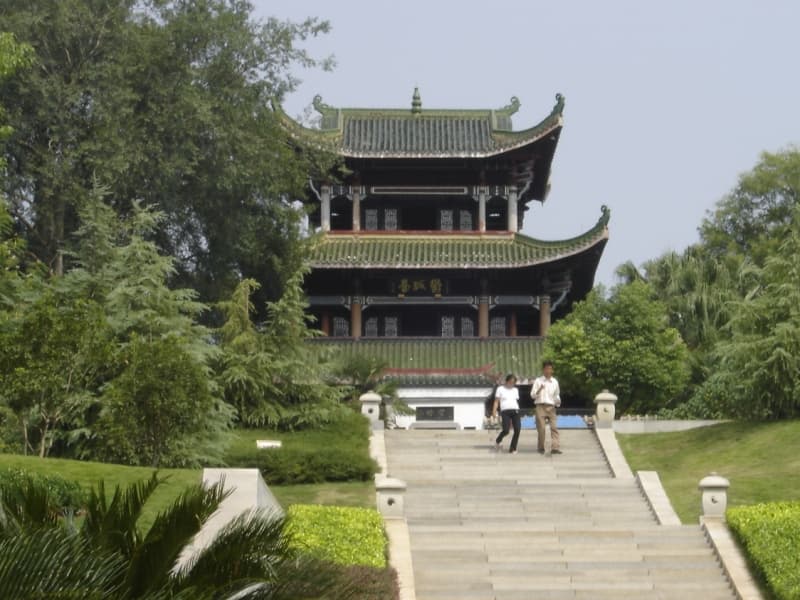 Liangxiao / CC BY-SA 3.0, via Wikimedia Commons
Self-guided audio walking tour of Ganzhou — GPS route, offline playback, story-driven narration in 32 languages.
“Where ancient ramparts meet flowing rivers, and Hakka heritage flourishes.”
Not the postcards. The stories even locals don't know — whispered in your ear, right where they happened.
Imagine a bridge that breathes with the river, a structure that has served its community for over 850 years, yielding to the water's embrace.
Beyond ancient artifacts, this museum safeguards a surprising world record, revealing a prehistoric past that can make one feel remarkably small.
While many ancient city walls have crumbled into memory, Ganzhou's defy the passage of time, still performing their original, crucial function.
Discover every secret of Ganzhou
Every address, every reveal in full — in your ear, right where it happened.
You pick your stops. You walk. The voice reveals what the others miss.


Your self-guided audio tour of Ganzhou is ready — pick your landmarks, choose your language, and start the moment you arrive.
BuyLume has a built-in augmented-reality guide. Hold your phone up and its camera shows the street ahead of you, with a glowing arrow laid over the real view that always points to your next stop — no map to puzzle over, no wrong turns. Like everything in Lume, it works fully offline.
Ganzhou, a city in the south of Jiangxi Province, offers a compelling journey where ancient narratives and Hakka culture intertwine. Situated at the convergence of the Zhang and Gong rivers, which form the Gan River, Ganzhou has served as a strategic nexus for over two millennia, connecting central China with its southern reaches. It is a city recognized as a national historical and cultural center by the State Council, providing a distinctive window into traditional Chinese life.
Often known as the "Cradle of Hakka Culture," Ganzhou is home to the largest population of Hakka people globally, a Han Chinese subgroup whose unique heritage has been forged by centuries of migration. Their influence resonates in the region's traditions, dialect, and distinctive architecture, particularly the fortified earthen weiwu, or enclosed houses. Beyond its cultural significance, Ganzhou is also recognized as the "Orange Capital of the World," celebrated for its navel oranges. The city presents a captivating blend of historical monuments, cultural encounters, and natural splendor, from ancient city walls to tranquil riverbanks.
The story of Ganzhou stretches back over 2,200 years, with human settlers inhabiting the region four or five millennia ago. The first administrative entity, Gannan County, was established in 201 AD by Emperor Gaozu of Han. Its strategic location at the convergence of the Zhang and Gong rivers, forming the vital Gan River, swiftly transformed it into an important river port and trade hub connecting the central plains with the southeast coast.
During the Sui Dynasty (581–618 AD), the area was reorganized as Qianzhou, a name that transitioned to Ganzhou in the late 12th century under the Southern Song Dynasty. The Song Dynasty (960–1279) marked a "Golden Age" for Ganzhou, witnessing its growth into one of the country's largest and most prosperous cities. This period saw the construction of the enduring city walls and the unique "Fu-Shou" drainage system, testaments to advanced engineering. Immigration from the north, particularly after the fall of the Northern Song capital, significantly bolstered the local population.
Ganzhou is recognized as the "Cradle of Hakka Culture," a designation it earned as a primary settlement for Hakka people who migrated from regions near the Yellow River to escape conflict and disasters. This migration, beginning in the Eastern Jin Dynasty (317-420), led to the development of a distinct Hakka culture, including their unique language, customs, and the iconic weiwu (enclosed houses). More than 600 of these fortified earthen buildings, some dating back to the Ming Dynasty, still stand today, reflecting a communal and defensive way of life. In the 20th century, the discovery of extensive tungsten deposits transformed Ganzhou into a global center for tungsten mining and processing, fueling its industrial growth. Today, Ganzhou continues to balance its ancient heritage with modern development, preserving its cultural sites while embracing economic diversification.
Ganzhou offers a rich array of historical and cultural sights. Begin with the Song Dynasty City Walls, a remarkably preserved 3.6-kilometer (2.2-mile) long structure that still shields the city from floods. Walk along its ramparts to appreciate centuries of engineering and vistas of the river. Nearby, the Bajing Pavilion has watched over the confluence of the rivers for centuries, inspiring poets and scholars.
A truly unique experience awaits at the Ganzhou Floating Bridge, also known as the Dongjin Pontoon Bridge. This ancient structure, composed of linked wooden boats, has been a part of daily life for over 850 years and offers a glimpse into traditional river transport. For a deeper immersion into local culture, visit the Hakka Culture City, which exhibits Hakka buildings, ancestral halls, and a museum dedicated to their history. The Tongtian Cliff is another compelling site, considered a treasury of ancient grotto art in South China, featuring 279 stone cases and stone Buddhas carved into the cliffs.
For a broader understanding of the region, the Ganzhou Museum houses not only historical artifacts but also an impressive collection of dinosaur egg fossils, holding a Guinness World Record. Finally, a walk along the Riverside Promenade provides a tranquil setting to observe local life and enjoy the convergence of the rivers.
Ganzhou experiences a subtropical humid monsoon climate with generous rainfall. The annual average temperature hovers around 19°C (66°F). The most agreeable times to visit Ganzhou are during spring and autumn. These seasons offer pleasant weather, with fewer intensely hot summer days or cold winter days. Significant precipitation typically begins in May, so avoiding the peak rainy season can enhance your journey.
Ganzhou is accessible through various transportation methods. The Beijing-Kowloon (Hong Kong) rail line traverses Ganzhou, and scheduled flights connect Ganzhou with Guangzhou. High-speed trains link Ganzhou to many cities, with Ganzhou West station serving as a common arrival point. Within the city, shared electric scooters are available, and taxi rides are generally affordable. Bus operating hours typically extend from early morning until late evening, though English signage can be limited, so having destinations written in Chinese or utilizing a navigation app is advisable.
Accommodation options span from reasonably priced homestays to hotels. Local cuisine is a highlight, with affordable and satisfying snacks readily available. While exploring, remember that Ganzhou is a city where ancient heritage merges with contemporary life, so be prepared for both historical sites and modern urban elements.
Ganzhou in Korean, in Chinese or in Hebrew — and 29 more languages, every stop narrated by a native voice. The widest language range of any self-guided audio tour.
Available in: