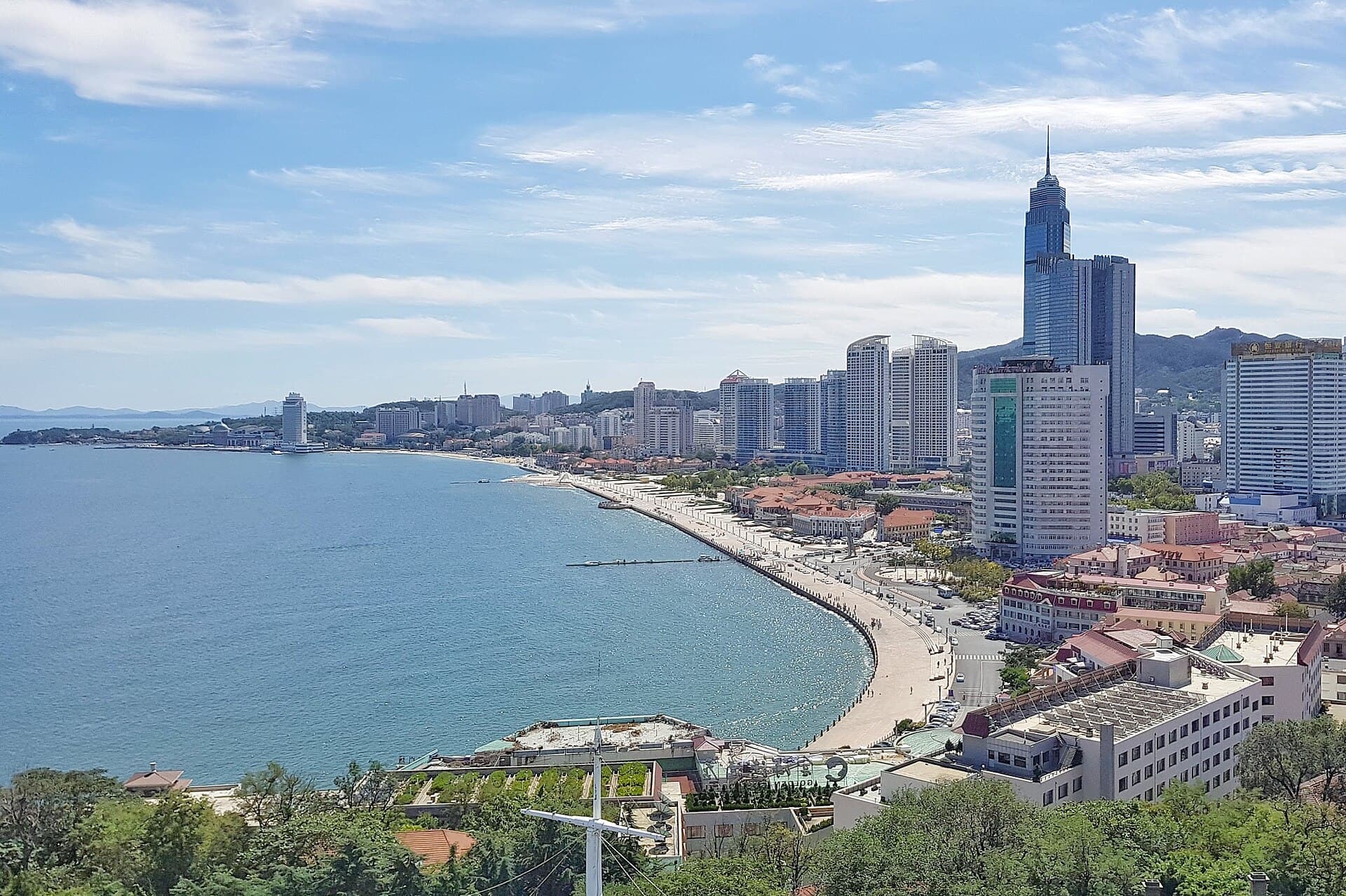
Yantai Hill Park
Yantai's name, meaning 'Smoke Watchtower,' stems from a 14th-century warning system. But the hill itself holds a more recent, surprising secret about international relations.
Full story unlocks in the tour
 HaoLinFotos / CC BY-SA 4.0, via Wikimedia Commons
Self-guided audio walking tour of Yantai — GPS route, offline playback, story-driven narration in 32 languages.
“Where the East China Sea meets a forgotten European past, and grapes tell a century-old story.”
Not the postcards. The stories even locals don't know — whispered in your ear, right where they happened.
Yantai's name, meaning 'Smoke Watchtower,' stems from a 14th-century warning system. But the hill itself holds a more recent, surprising secret about international relations.
Yantai is recognized as the birthplace of modern Chinese winemaking, thanks to the Changyu Pioneer Wine Company. But the company's founder had a surprising connection to an Austro-Hungarian diplomat.
This legendary site is woven into Chinese mythology, said to be where the Eight Immortals landed. Yet, its most captivating phenomenon is a fleeting optical illusion that still draws visitors.
Discover every secret of Yantai
Every address, every reveal in full — in your ear, right where it happened.
You pick your stops. You walk. The voice reveals what the others miss.


Your self-guided audio tour of Yantai is ready — pick your landmarks, choose your language, and start the moment you arrive.
BuyLume has a built-in augmented-reality guide. Hold your phone up and its camera shows the street ahead of you, with a glowing arrow laid over the real view that always points to your next stop — no map to puzzle over, no wrong turns. Like everything in Lume, it works fully offline.
Yantai, a coastal city on the Shandong Peninsula, offers a unique blend of maritime allure, historical intrigue, and viticultural innovation. Known historically as Chefoo, its name, meaning 'Smoke Watchtower,' originates from 14th-century beacon towers used to warn of pirate attacks. Today, Yantai is a significant port city, balancing the energy of a modern urban center with the relaxed pace of a seaside resort.
The city's strategic location, where the Bohai Sea meets the Yellow Sea, has shaped its identity as a hub for trade and defense. Beyond its scenic coastline, Yantai is celebrated as the birthplace of modern Chinese wine production, often recognized as the 'International Vine and Wine City' of Asia. Its mild, monsoon-influenced climate contributes to its pleasant atmosphere, making it an inviting destination for those seeking both relaxation and discovery.
Human activity in the Yantai area dates back to the Neolithic period, with emperors like Qin Shi Huang and Han Wu Di recorded as having visited the region. The city's evocative name, Yantai, meaning 'Smoke Watchtower,' emerged in 1398 during the Ming Dynasty, when locals constructed watchtowers on Mount Qi to light signal fires and send smoke signals, often using wolf dung as fuel, to warn of approaching Japanese pirates.
A pivotal moment in Yantai's history arrived in 1861 when, following the Treaty of Tianjin, it was opened as a treaty port under its then-European name, Chefoo. This designation spurred profound change, attracting foreign consulates and trading firms from 17 nations, which led to the establishment of a distinct architectural quarter around Yantai Hill. While Yantai was a treaty port, it uniquely had no foreign concession or settlement, meaning these European-style buildings were integrated differently into the city's fabric. The city's port flourished, exporting local products like vermicelli and lace.
Modern industry also began to emerge during this period, most notably with the founding of the Changyu Pioneer Wine Company in 1892. This marked the beginning of modern viticulture in China, establishing Yantai as the country's oldest and most established wine region. After the establishment of the People's Republic of China, Yantai was officially awarded city status in 1950. Its true transformation into a globalizing metropolis began in 1984 when it was designated one of China's first 14 coastal open cities, attracting significant foreign investment and expanding its port into a major hub for trade.
Begin your exploration at Yantai Hill Park, a scenic retreat and historical archive on the northern coast. Climb to the lighthouse for expansive views of the harbor and city skyline, and explore the well-preserved 19th-century European colonial buildings that once housed foreign consulates. Delve into China's winemaking heritage at the Changyu Wine Culture Museum, which traces the history of the country's first modern winery, founded in 1892.
For a touch of mythology, visit Penglai Pavilion, dramatically situated on a cliff overlooking the sea. This historic site is associated with the 'Eight Immortals' and is known for its occasional mirages. Experience authentic local life at the Xingfu Night Market in the Zhifu District, a lively hub for street food and local snacks. For a unique marine experience, the Haichang Whale Shark Ocean Park offers high-tech displays and marine biology exhibits. Don't miss the picturesque Yangma Island, a popular spot for its clear waters and natural beauty. Finally, stroll along Chaoyang Street to soak in the historic treaty port architecture and sample local Jiaodong seafood cuisine.
The most pleasant times to visit Yantai for general outdoor activities are from late April to early June and from mid-September to late October. During these periods, the weather is mild with comfortable temperatures and less rainfall. Summer, from late June to early September, is warm and humid, with increased rainfall, particularly in July and August. While ideal for beaches and seafood festivals, it can also be muggy. Winters, from November to March, are cold and dry, with January being the coldest month. If you're seeking sunshine, September is often the sunniest month.
Yantai is considered a very safe city with low crime rates, making it suitable for solo travelers. The local currency is the Chinese Yuan (RMB). Mobile payment apps like Alipay and WeChat are widely used and highly recommended, as most shops and vendors prefer digital transactions. While cash is accepted, carrying a small amount for emergencies is advisable, as foreign credit cards are not widely accepted directly.
Public transportation in Yantai is primarily by bus, with over 50 routes covering the city and suburbs. Bus lines 10 and 17 are particularly useful for tourists, connecting the railway station to coastal areas and attractions. Taxis are also readily available and relatively inexpensive. Yantai Penglai International Airport (YNT) is located 43 kilometers from the city center, with shuttle buses and taxis providing transport. Yantai Railway Station, in the Zhifu district, offers high-speed and normal-speed train services to major Chinese cities.
Yantai in Korean, in Chinese or in Hebrew — and 29 more languages, every stop narrated by a native voice. The widest language range of any self-guided audio tour.
Available in: