Liugong Island
This island, a tranquil retreat today, once held a crucial, yet sorrowful, position in China's naval past.
Full story unlocks in the tour
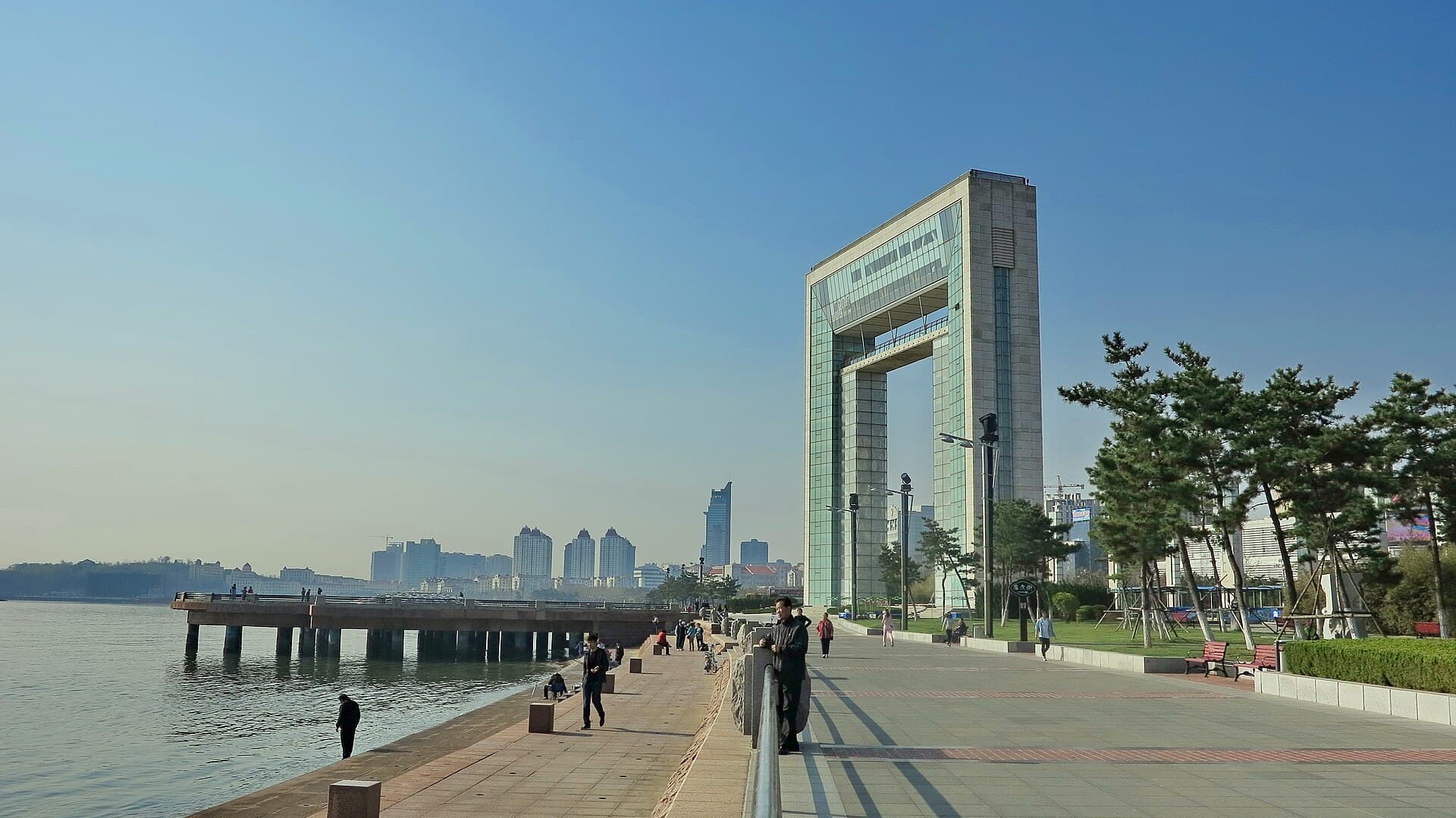 Nyx Ning / CC BY-SA 3.0, via Wikimedia Commons
Self-guided audio walking tour of Weihai — GPS route, offline playback, story-driven narration in 32 languages.
“Where the sea breathes ancient stories and the coast bears the marks of time.”
Not the postcards. The stories even locals don't know — whispered in your ear, right where they happened.
This island, a tranquil retreat today, once held a crucial, yet sorrowful, position in China's naval past.
A thoroughfare that seems lifted from an animated film, with its inclines descending directly to the sea.
Beyond the contemporary urban sprawl, certain villages preserve a singular, environmentally conscious building method.
Discover every secret of Weihai
Every address, every reveal in full — in your ear, right where it happened.
You pick your stops. You walk. The voice reveals what the others miss.


Your self-guided audio tour of Weihai is ready — pick your landmarks, choose your language, and start the moment you arrive.
BuyLume has a built-in augmented-reality guide. Hold your phone up and its camera shows the street ahead of you, with a glowing arrow laid over the real view that always points to your next stop — no map to puzzle over, no wrong turns. Like everything in Lume, it works fully offline.
Weihai, a coastal city situated at the easternmost point of China's Shandong Peninsula, offers a singular combination of natural splendor, profound history, and contemporary urban life. Surrounded by the Yellow Sea on three sides, it unfurls a long shoreline graced with sandy stretches, rugged bluffs, and picturesque promenades. Recognized for its remarkably clean air and unspoiled surroundings, Weihai has garnered accolades as China's first "National Hygienic City" and a recipient of the UN Habitat Scroll of Honor Award.
Supporting a population of nearly 3 million, Weihai maintains a relaxed, resort-like ambiance, drawing travelers who seek both quietude and outdoor adventure. Its strategic proximity to the Korean Peninsula also infuses the city with a blend of cultural influences, apparent in its culinary traditions and local offerings. From exploring historical naval locations to savoring fresh seafood by the sea, Weihai presents a refreshing escape for those yearning to experience a different aspect of China.
Prior to the 14th century, Weihai existed as a modest fishing settlement. Its strategic significance expanded considerably in 1398 during the Ming Dynasty when it was established as a military stronghold, christened Weihaiwei, meaning "Imposing Maritime Guard," to defend against pirate incursions. Defensive structures, including walls nearly 3.2 kilometers in circumference, began construction in 1403.
In the late 19th century, Weihai evolved into a crucial naval base for the Beiyang Fleet, China's inaugural modern navy, formed in 1871 during the Qing Dynasty. This era, however, also marked a sorrowful chapter in its chronicles. During the First Sino-Japanese War (1894–95), Weihaiwei was the site of a significant naval engagement, which culminated in the defeat of the Beiyang Fleet and the city's capture by Japanese forces in 1895.
Following the Sino-Japanese War, Weihaiwei was leased to the United Kingdom from 1898 to 1930, with Port Edward (now part of Huancui District) serving as its capital. A Royal Navy base was established on Liugong Island during this period. The British voluntarily returned the territory to China in 1930, though Liugong Island was leased back to the UK until 1940. Weihaiwei was occupied by the Japanese again from 1938 to 1945.
After the Communist revolution, Weihaiwei City was established in 1949, and its name was shortened to Weihai. In 1987, Weihai was elevated to a prefecture-level city and designated as one of China's "open" coastal cities, encouraging foreign investment and leading to swift growth and contemporary urban planning.
Weihai presents a varied array of attractions, merging historical weight with natural grandeur. Liugong Island is a worthwhile visit, celebrated for its role in China's modern naval history and offering museums, sea vistas, and walking paths. Plan for a 3-4 hour visit, including round-trip boat journeys. For those who appreciate beaches, the Weihai International Bathing Beach provides expansive sandy expanses and clear waters, perfect for unhurried strolls or aquatic pursuits. Nearby, Torch 8th Street is a favored location for its distinctive, anime-like aesthetic, with brightly colored homes and undulating slopes descending to the sea, ideal for photography.
Those who appreciate nature can explore Weihai Swan Lake National Park in Rongcheng, a vital wintering ground for thousands of swans, often referred to as the "Oriental Swan Kingdom." Chengshantou, the easternmost point of the Shandong Peninsula, is known as China's "Cape of Good Hope" and offers dramatic coastal scenery and the first sunrise in China. For a blend of nature and local culture, the Chishan Scenic Area in Rongcheng features a large red-faced sea deity statue, ancient temples, and coastal views. In spring, Chishan is also recognized for its cherry blossoms. Within the city, Weihai Park and Huancuilou Park offer pleasant green spaces for repose.
The most favorable times to visit Weihai are during the spring (April to June) and autumn (September to November) months. In these periods, the weather is agreeable, with average temperatures ranging from 16°C to 26°C, making outdoor activities comfortable. Spring brings the Cherry Blossom Festival, while autumn offers lively colors. While summers (July and August) are warm and suitable for beach activities, they are also the wettest and most humid months. Winters (December to February) are cold and windy, with average temperatures around 0-2°C.
Weihai is generally considered a secure city for travelers, with minimal crime rates. The local currency is the Renminbi (CNY). China operates largely as a cashless society, so it is essential to configure mobile payment applications like Alipay or WeChat Pay, which support international credit cards, prior to your arrival. Public transportation primarily relies on an extensive and economical bus system, as Weihai does not possess a metro. Taxis are also readily available and reasonably priced; ride-hailing applications like DiDi (accessible via Alipay) can help bridge language differences.
English is not widely spoken, so a translation application is highly recommended. Acquiring a local SIM card upon arrival will facilitate access to maps and translation tools. Tap water is not potable; always opt for bottled or boiled water. Tipping is not customary in China.
Weihai in Korean, in Chinese or in Hebrew — and 29 more languages, every stop narrated by a native voice. The widest language range of any self-guided audio tour.
Available in: