Passage souterrain du Palais de Gatchina
Sous l'imposant Palais de Gatchina se cache un passage secret, autrefois le terrain de jeu d'un empereur qui adorait les surprises.
L'histoire complète se débloque dans le tour
 Usadboved / CC BY-SA 4.0, via Wikimedia Commons
Visite audio autoguidée de Gatchina — parcours GPS à pied, lecture hors ligne, narration en 32 langues.
“Au-delà de sa façade impériale, Gatchina résonne des échos de tsars excentriques et de merveilles architecturales.”
Pas les cartes postales. Les histoires que même les habitants ignorent — soufflées à l'oreille, là où elles se sont passées.
Sous l'imposant Palais de Gatchina se cache un passage secret, autrefois le terrain de jeu d'un empereur qui adorait les surprises.
L'un des palais de Gatchina a été construit avec un matériau humble et surprenant, conçu pour ne durer que quelques décennies.
Une cabane en rondins d'apparence rustique dans le parc dissimule un intérieur opulent.
Découvrez tous les secrets de Gatchina
Chaque adresse, chaque révélation en entier — dans ton oreille, là où elle s'est passée.
Tu choisis tes lieux. Tu marches. La voix te révèle ce que les autres ignorent.


Votre visite audioguidée de Gatchina vous attend — choisissez vos lieux, votre langue, et lancez-vous dès votre arrivée.
AcheterLume intègre un guide en réalité augmentée. Levez votre téléphone : sa caméra montre la rue devant vous, avec une flèche lumineuse posée sur l'image réelle qui pointe toujours vers votre prochain arrêt — aucune carte à déchiffrer, aucun mauvais virage. Comme tout dans Lume, ça fonctionne entièrement hors-ligne.
Gatchina, la plus grande ville de la région de Leningrad en Russie, témoigne de l'ambition impériale et de l'innovation architecturale. Située à environ 45 kilomètres au sud-ouest de Saint-Pétersbourg, elle offre une alternative séduisante aux domaines impériaux plus fréquentés. Contrairement aux palais aux teintes pastel de Tsarskoïe Selo ou de Peterhof, le Palais de Gatchina présente une apparence austère, presque fortifiée, rappelant un château médiéval, avec ses dix tours et ses douves. Ce caractère unique reflète les personnalités de ses résidents les plus notables, en particulier l'Empereur Paul Ier et Alexandre III, qui cherchaient refuge et une existence plus privée entre ses murs.
La ville et son grand ensemble palais-et-parc sont reconnus comme un site du patrimoine mondial de l'UNESCO, préservant des siècles d'histoire et d'urbanisme. Au-delà du palais principal, Gatchina abrite le distinctif Palais du Prieuré, une merveille architecturale construite en pisé, et de vastes jardins paysagers à l'anglaise parsemés de lacs pittoresques, d'îles et de pavillons intrigants. Gatchina invite les visiteurs à plonger dans un chapitre plus calme et plus énigmatique de l'histoire impériale russe, offrant un mélange de beauté naturelle, d'ingéniosité architecturale et d'anecdotes captivantes.
Les origines de Gatchina remontent à un petit village nommé Hotchino, habité par des habitants de Novgorod au tournant du XVe siècle. Après des périodes d'occupation par la Livonie et la Suède, Gatchina redevint une colonie russe en 1721 après la Grande Guerre du Nord. Son histoire impériale commença en 1765 lorsque l'Impératrice Catherine la Grande acquit le terrain et l'offrit à son favori, le Comte Grigory Orlov. Au cours des 15 années suivantes, l'architecte italien Antonio Rinaldi conçut et construisit le magnifique palais de 600 pièces et aménagea l'un des premiers parcs paysagers à l'anglaise de Russie.
À la mort d'Orlov en 1784, Gatchina passa au fils de Catherine, le futur Empereur Paul Ier. Paul Ier, connu pour ses excentricités et sa fascination pour la chevalerie, transforma Gatchina en résidence impériale officielle après son accession au trône en 1796. Il agrandit le palais avec l'aide de l'architecte Vincenzo Brenna et commanda l'unique Palais du Prieuré pour les Chevaliers de Malte, dont il devint le Grand Maître. Sous son règne, Gatchina acquit la réputation de 'palais-forteresse' et de centre de la vie de cour.
Au XIXe siècle, Gatchina continua d'être un important domaine impérial. L'Empereur Alexandre III, cherchant un environnement plus sûr pour sa famille après l'assassinat de son père, fit de Gatchina sa résidence principale, ce qui lui valut le surnom de 'l'ermite de Gatchina'. Il modernisa le palais de manière extensive, bien que lui et sa famille vécurent dans des pièces relativement simples. La ville devint également un centre d'innovation, avec les premières lampadaires électriques de Russie, la ligne téléphonique vers le Palais d'Hiver, le monorail, l'aéroport militaire et l'école de pilotes, tous apparaissant ici. Gravement endommagé pendant la Seconde Guerre mondiale, le palais subit une restauration extensive, commençant en 1976 et rouvrant partiellement comme musée en 1985. En 1990, le Palais et le Parc de Gatchina, ainsi que le centre historique de la ville, furent désignés site du patrimoine mondial de l'UNESCO.
Le palais et le parc témoignent des secrets politiques et personnels de la dynastie Romanov. L'extérieur austère du Palais de Gatchina, contrastant avec les résidences impériales plus décoratives, reflète son rôle de retraite sécurisée. À l'intérieur, les salles restaurées de Paul Ier, de l'Impératrice Maria Fiodorovna et d'Alexandre III offrent des aperçus de leurs vies. Le vaste parc, méticuleusement conçu comme un jardin paysager à l'anglaise, présente de nombreuses folies, pavillons et cours d'eau, chacun avec sa propre histoire. De ses humbles débuts en tant que domaine de chasse à son statut de résidence impériale vitale et de centre d'innovation, l'histoire de Gatchina est un récit riche tissé des fils du pouvoir, de l'intimité et du progrès.
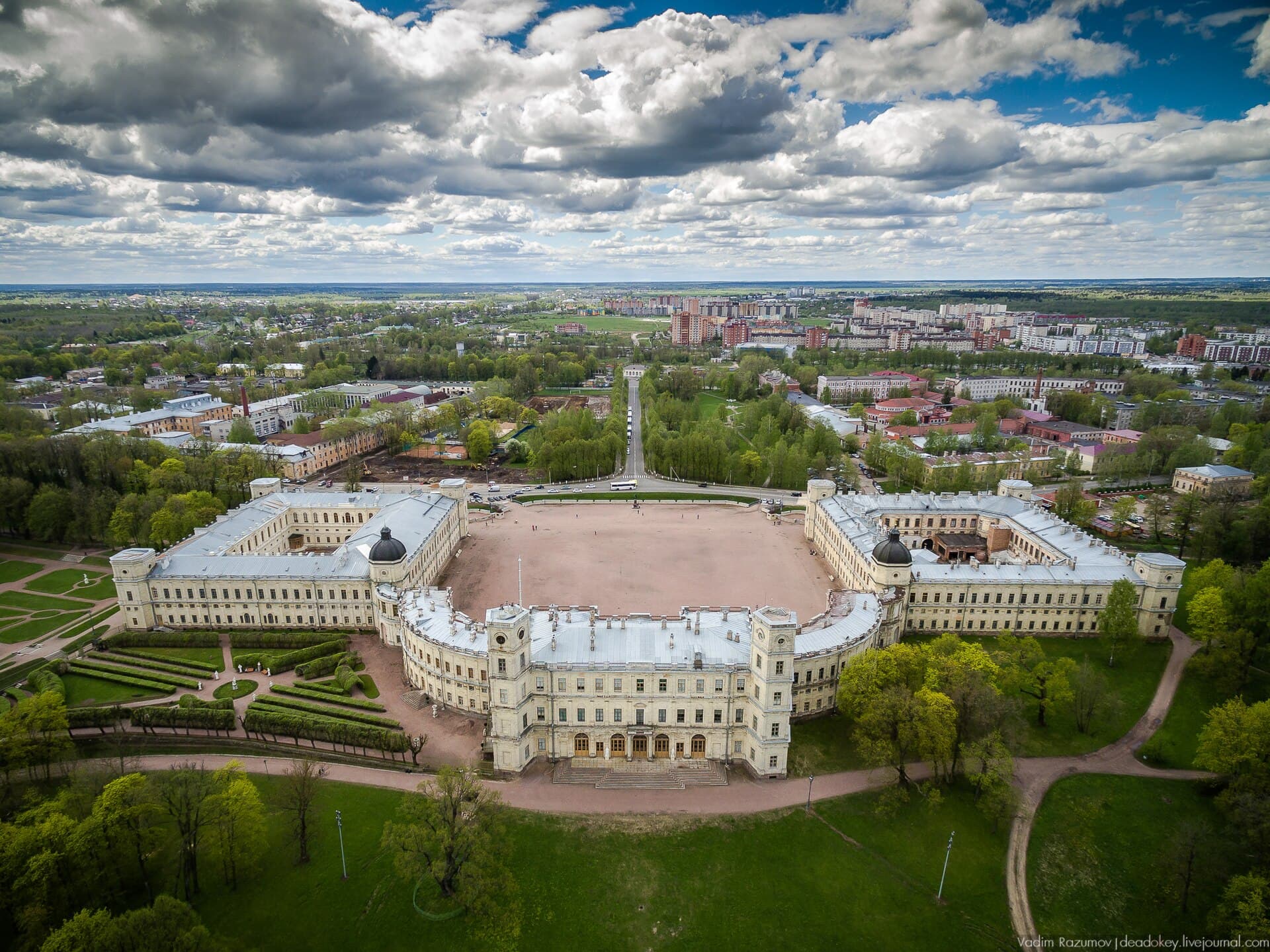
L'attraction principale de Gatchina est le Grand Palais de Gatchina, un site du patrimoine mondial de l'UNESCO qui mêle architecture classique et l'aspect imposant d'un château médiéval. Explorez les appartements d'État opulents, y compris la Salle du Trône Supérieure de Paul Ier et la Salle Blanche, et ne manquez pas les chambres personnelles de Paul Ier et de l'Impératrice Maria Fiodorovna. Pour une expérience unique, aventurez-vous dans le Passage Souterrain qui mène du palais à la Grotte de l'Écho sur la rive du Lac d'Argent, un tunnel de 130 mètres de long autrefois utilisé par l'Empereur Paul Ier.
Autour du palais s'étend le vaste Parc du Palais de Gatchina, l'un des plus grands parcs paysagers d'Europe, couvrant 700 hectares. Promenez-vous dans ses jardins à l'anglaise, découvrez diverses îles, ponts et pavillons tels que la Maison de Bouleau (un extérieur rustique dissimulant un intérieur somptueux), le Portail du Masque et le Pavillon de Vénus sur l'Île de l'Amour. Vous pouvez également monter les 191 marches de la Tour de Signal Ouest pour des vues imprenables sur le parc et la ville.
Une autre curiosité distinctive est le Palais du Prieuré, à quelques pas du palais principal. Cette structure unique, construite selon la technologie du pisé, ressemble par certains angles à une chapelle gothique et par d'autres à une forteresse, et servit autrefois aux Chevaliers de Malte. Sa tour offre de superbes vues sur le parc et le Grand Palais. N'oubliez pas de visiter la Cathédrale Pavlovsky, la principale et la plus belle église de Gatchina.
La période la plus agréable pour visiter Gatchina pour les activités par temps chaud s'étend de fin juin à mi-août, lorsque les températures maximales moyennes quotidiennes dépassent 17°C (63°F). Juillet est généralement le mois le plus chaud, avec une moyenne maximale de 22°C (72°F). Bien que les étés soient confortables, préparez-vous à des pluies occasionnelles, surtout en juillet et août, il est donc conseillé d'emporter un imperméable léger ou un parapluie. Pour moins de foule et de magnifiques feuillages, envisagez de visiter en automne. Les jours de semaine, en particulier le matin ou en fin d'après-midi, offrent également une expérience plus sereine. Les hivers sont froids et neigeux, janvier étant le mois le plus froid, avec une moyenne de -9°C (15°F).
Gatchina est facilement accessible pour une excursion d'une journée depuis Saint-Pétersbourg. Le moyen le plus pratique de se rendre à Gatchina est de prendre un train de banlieue (elektrichka) depuis la gare Baltiysky (station de métro Baltiyskaya) jusqu'à la gare Gatchina-Baltiyskaya. Le trajet dure moins d'une heure, et la gare est directement en face de l'entrée principale du Grand Palais. Alternativement, des minibus (marshrutka K-18, K-18A, K-100, K-431, K-546, K-631) et des bus (100, 431) circulent régulièrement depuis les stations de métro Moskovskaya ou Prospekt Veteranov.
Une fois à Gatchina, de nombreuses attractions, en particulier au sein de l'ensemble palais et parc, sont facilement explorables à pied. Des bus locaux sont disponibles pour se déplacer dans la ville, et des taxis peuvent être réservés via des applications comme Yandex Go. Louer une voiture pourrait être inutile si vous prévoyez de rester à Gatchina, car le stationnement près des attractions peut être limité. Le Palais de Gatchina est généralement ouvert de 10h à 18h, les billetteries fermant à 17h, mais notez que la sécurité pourrait ne pas autoriser l'entrée avant 11h. Il est généralement fermé le lundi et le premier mardi de chaque mois. Le Palais du Prieuré a des horaires d'ouverture différents, souvent fermé le lundi et le mardi, il est donc conseillé de vérifier les horaires à l'avance. Un audioguide est recommandé pour améliorer votre compréhension de l'histoire du palais.
Gatchina en coréen, en chinois ou en hébreu — et dans 29 autres langues, chaque étape narrée par une voix native. La plus large gamme de langues de tous les audioguides autoguidés.
Disponible en :