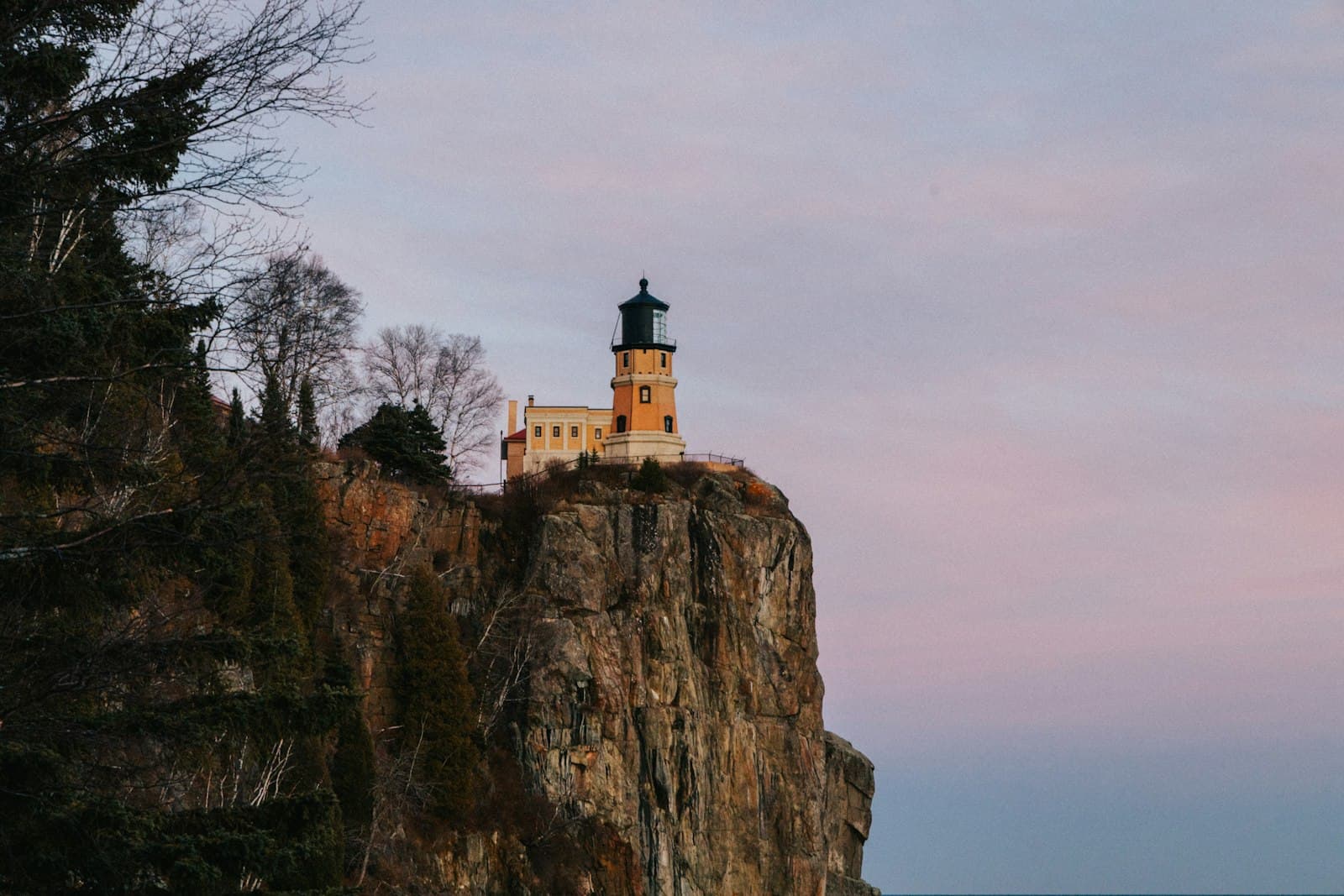
The French name for this harbor town translates to "Great Marsh," which seems fitting for a lakeside community. Yet, a small detail makes the name a bit of a puzzle.
Photo: Blake Harbison / UnsplashGrand Marais
Self-guided audio walking tour of Grand Marais — GPS route, offline playback, story-driven narration in 32 languages.
“Where Lake Superior's edge meets a creative pulse and untamed expanses.”
Grand Marais, as no one tells it.
Not the postcards. The stories even locals don't know — whispered in your ear, right where they happened.
The prominent Grand Marais Lighthouse has stood sentinel over the harbor for well over a century, but its construction wasn't exactly a straightforward process. In fact, initial plans for a lighthouse here were deemed unnecessary.
This distinctive landform, popular with photographers and rock-hounds, is more than just a beautiful sight. It's a geological marvel with a unique ecological secret.
Discover every secret of Grand Marais
Every address, every reveal in full — in your ear, right where it happened.
You pick your stops. You walk. The voice reveals what the others miss.


How long do you have in Grand Marais?
Your self-guided audio tour of Grand Marais is ready — pick your landmarks, choose your language, and start the moment you arrive.
BuyThe story of Grand Marais
Grand Marais, the county seat of Cook County, Minnesota, is a welcoming harbor town along Lake Superior's North Shore. With a population just over 1,300, it's a place where the untamed beauty of the wilderness converges with a flourishing arts and culture scene. The town's singular character is shaped by its dramatic landscape, including the Sawtooth Bluff and Artist's Point, a distinctive tombolo extending into Lake Superior.
Recognized as a gateway to the expansive Superior National Forest and the Boundary Waters Canoe Area Wilderness, Grand Marais offers a blend of outdoor adventure and creative inspiration. French Canadian voyageurs gave the village its name, meaning "Great Marsh" or "sheltered water area," referencing its natural harbor. Today, Grand Marais remains a cherished destination, drawing visitors with its scenic setting and lively community spirit.
The town also serves as a center for traditional crafts and contemporary art, home to institutions like the Grand Marais Art Colony and the North House Folk School. From its foundational fishing roots to its present-day reputation as an artistic haven, Grand Marais offers a captivating experience for those seeking both quiet reflection and creative energy along the shores of Lake Superior.
Early Inhabitants and Fur Trade
The history of Grand Marais stretches back thousands of years, with nomadic hunter-gatherers being the first to discover this part of the North Shore. Evidence of their presence includes a 7,000-year-old stone spearpoint found on a local beach. The Ojibwe people, who called the area Gichi-biitoobiig (meaning "great duplicate water" or "parallel body of water" due to its two bays), were long-term inhabitants, fishing the abundant waters of Lake Superior in summer and gathering wild rice inland in the fall. They also practiced maple sugaring in the spring and hunted and trapped for furs and food in the winter.
In the 1700s, French Canadian voyageurs arrived, establishing Grand Marais as a busy fur trading station. These early European traders relied heavily on the Ojibwe and Cree people for survival and knowledge of the land. The strategic location of Grand Marais, with its natural, sheltered harbor, made it a crucial stop along the fur trade routes.
Growth and Industry
The 1854 Treaty of La Pointe opened the North Shore to settlement, and Richard B. Godfrey, an independent fur trader, became Grand Marais' first postmaster in 1856. However, significant development didn't begin until Henry Mayhew and Sam Howenstine arrived in 1871, often considered the founders of the city. A bill for harbor improvements was passed in 1873, and by 1883, breakwaters were completed, creating the first harbor of refuge on the North Shore.
Grand Marais flourished as a lumber town between 1885 and 1910, with a rail line connecting it to Seney and a peak population of approximately 3,000. The harbor teemed with activity, handling pulpwood logs and relying on steamships like the America for provisions and transportation before roads were established. Commercial fishing also thrived in the early 20th century, with Grand Marais serving as an important center for the industry.
A Center for Arts and Culture
After the lumber boom concluded around 1911, and the commercial fishing industry faced challenges, Grand Marais began to evolve. In the 1920s, fishermen started renting their huts to tourists, marking the beginning of the town's shift towards tourism. A pivotal moment in Grand Marais' cultural history was the establishment of the Grand Marais Art Colony in 1947, the longest-lived art colony in Minnesota. It began as a summer program, drawing artists to capture the natural beauty of the North Shore, and later became a year-round non-profit organization. Today, Grand Marais is recognized for its lively arts scene, with numerous galleries and institutions like the North House Folk School continuing to foster creativity and traditional crafts.
Begin your exploration of Grand Marais with a stroll along the harbor and out to the Grand Marais Lighthouse on Artist's Point. This easy, one-mile walk offers expansive views of Lake Superior and is a prime spot for sunset photography. Artist's Point itself is a fascinating geological feature, a tombolo with unique plant life. While at the harbor, look for the replica fish house, a nod to the town's commercial fishing past, and the historic Nee-Gee fishing tug.
Immerse yourself in the local arts scene at the Grand Marais Art Colony, Minnesota's oldest art colony, which offers workshops and exhibitions. Nearby, the North House Folk School teaches traditional northern crafts like boatbuilding and basketry. For a deeper dive into local history, visit the Cook County Historical Museum, housed in the former lighthouse keeper's dwelling.
Beyond the immediate harbor area, the Gunflint Trail Scenic Byway begins in Grand Marais, offering a route into the expansive Superior National Forest for hiking and wilderness exploration. Just a short drive away, Judge C.R. Magney State Park is home to the mysterious Devil's Kettle waterfall, where half of the Brule River seemingly disappears into a pothole. For winter or summer recreation, Lutsen Mountains, about 20 minutes southwest, offers skiing and an alpine slide, along with aerial gondola rides providing wide-ranging views.
The best time to visit Grand Marais for warm-weather activities is from mid-July to late August, when average daily high temperatures are above 60°F, peaking around 68°F in August. This period offers comfortable conditions for exploring the outdoors, with less cloud cover. Late September and early October bring a final surge of visitors for the brilliant fall colors along the North Shore. If you plan to visit during this time, booking accommodations well in advance is recommended.
Winters are freezing, snowy, and windy, with January being the coldest month, averaging lows of 8°F and highs of 24°F. While some locals cherish the off-season (especially November and April), be prepared for limited dining and lodging options during these times. Grand Marais receives moderate precipitation annually, with June typically being the wettest month and February the driest.
Grand Marais is approximately 264 miles from Minneapolis, with a drive taking around 4 hours and 50 minutes. The North Shore drive from Duluth is scenic but can be slow, so allow ample time, especially if you plan to make stops. Weather conditions, including fog, wind, rain, or winter elements, can impact travel time, so check forecasts before departing.
Within Grand Marais, many attractions, shops, and restaurants are within walking distance of the harbor. For transportation to nearby towns or Duluth, Arrowhead Transit provides bus service with scheduled routes and a Dial-A-Ride option within city limits. Booking accommodations, especially during peak summer and fall color seasons, is highly recommended well in advance, as hotels and campgrounds fill up quickly and prices can be higher. Dining options range from casual to fine dining, with many establishments offering fresh Lake Superior fish. Business hours, particularly in winter and shoulder seasons, can be limited, so it's advisable to confirm hours directly with individual businesses.
- What does "Grand Marais" mean?
- The name "Grand Marais" is French for "Great Marsh" or "sheltered water area." While there isn't a prominent marsh in the immediate vicinity today, the name likely refers to a small marsh that existed in early fur-trading times or the harbor's natural protection.
- Is Grand Marais an art town?
- Yes, Grand Marais is well-known for its lively arts and culture scene. It is home to the Grand Marais Art Colony, the longest-lived art colony in Minnesota, and the North House Folk School, which teaches traditional crafts.
- How far is Grand Marais from Duluth?
- Grand Marais is approximately 110 miles northeast of Duluth along Highway 61. The drive is scenic and takes about two hours, but can be longer with stops or adverse weather.
- What is the best time of year to see fall colors?
- The fall color season along the North Shore, including Grand Marais, typically peaks in late September and early October. It's a very popular time to visit, so booking accommodations in advance is recommended.
- Are there public transportation options in Grand Marais?
- Yes, Arrowhead Transit provides local bus service within Grand Marais and to nearby communities like Grand Portage, Tofte, and Duluth. They offer scheduled routes and a Dial-A-Ride service.
- What is Artist's Point?
- Artist's Point is a distinctive landform in Grand Marais, a tombolo formed by lava and connected to the mainland by sand and gravel. It's a popular spot for walking, photography, and observing Lake Superior.