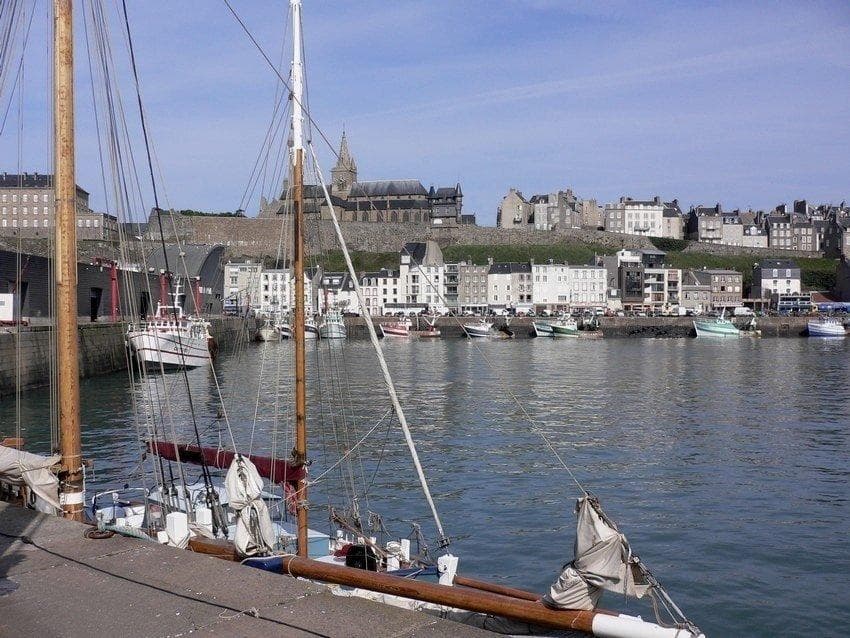
Granville, FranceSoyrana / CC BY-SA 3.0, via Wikimedia Commons
FR

Granville

Self-guided audio walking tour of Granville — GPS route, offline playback, story-driven narration in 32 languages.

Where ancient ramparts meet the rhythm of the tides and haute couture.

The secrets of Granville

Granville, as no one tells it.

Not the postcards. The stories even locals don't know — whispered in your ear, right where they happened.

3 secrets below. Many more wait inside the tour.
Plat Gousset Beach

The name of Granville's central beach, "Plat Gousset," might sound like a simple description, but it carries a subtle, almost melancholic, nod to a particular kind of visitor.

Full story unlocks in the tour
Christian Dior's Childhood Home

The iconic fashion designer Christian Dior often spoke of his childhood home in Granville as a profound influence on his work. Yet, after his family sold it, the villa faced an unexpected, drastic fate.

Full story unlocks in the tour
Pointe du Roc

This dramatic headland, a historic defensive point, conceals a secret beneath its surface that connects it to a renowned scientific breakthrough.

Full story unlocks in the tour
The full tour

Discover every secret of Granville

Every address, every reveal in full — in your ear, right where it happened.

Get the key to Granville

You pick your stops. You walk. The voice reveals what the others miss.

Granville — A large body of water with a city in the background
Photo: Nicolas Sokoloff / Unsplash
Granville — a view of the ocean from a cliff
Photo: Anna Mateeva / Unsplash
Granville — aerial view of city buildings during daytime
Photo: Erwan Hesry / Unsplash
Choose your time

How long do you have in Granville?

Your self-guided audio tour of Granville is ready — pick your landmarks, choose your language, and start the moment you arrive.

Buy
About Granville

The story of Granville

Granville, sometimes called the “Monaco of the North,” is a lively seaside town on the Normandy coast in the Manche department of France. This inviting city offers a unique blend of resort elegance, enduring architecture, and a strong maritime spirit. Its historic upper town, known as Haute Ville, rises from a rocky promontory overlooking the sea, encircled by 15th-century ramparts. Below, a bustling fishing port and sandy beaches complete the scene.

Once a strategic military outpost, Granville evolved into a refined 19th-century seaside resort. Today, it remains a cherished destination for families, food lovers, and those interested in maritime heritage. The town's picturesque old quarter, its connection to the artistic legacy of Christian Dior, and its ferry links to the nearby Chausey Islands make it a compelling stop for anyone exploring Normandy's west coast. Whether you seek a family beach holiday, a culinary weekend, or a historical escape, Granville offers a dynamic experience.

Granville is also recognized for its environmental efforts, having been awarded the global Green Destinations label.

History

Granville's origins trace back to the 11th century when the Grant family received these lands from William the Conqueror. However, the town truly began to take shape as a fortified point during the Hundred Years' War. In 1439, English forces, recognizing the strategic importance of the rocky promontory, constructed a fortress there to blockade Mont-Saint-Michel, then the last French stronghold in Normandy. This fortification, encompassing the area now known as the Upper Town, included digging a 7-meter trench that temporarily made it an island. French troops recaptured the citadel in 1442.

Throughout the centuries, Granville's maritime identity deepened. By the 16th century, its sailors were embarking on regular cod fishing expeditions to Newfoundland. The town also became a base for corsairs, leading to a massive bombardment by the English fleet in 1695 in retaliation for successful raids. During the French Revolution, in 1793, Granville withstood a fierce siege by the Vendean army. The port's current appearance largely dates from after 1856, following the inauguration of its wet dock and lock.

The arrival of the Paris-Granville railway line in 1870 marked a significant turning point, opening the town to mass tourism from the capital. This led to the development of Granville as a seaside resort, complete with casinos and other leisure facilities. The town is also the birthplace of renowned fashion designer Christian Dior, born in 1905, whose childhood home is now a museum. During World War II, the Germans occupied Granville from June 1940 and constructed the Batterie du Roc, a formidable defensive network on Pointe du Roc as part of the Atlantic Wall. This battery included casemates for 105mm guns and platforms for 155mm guns, along with other structures. American forces liberated Granville on July 30, 1944. Today, Granville remains France's leading port for shellfish harvesting, particularly scallops and whelks.

What to see

Begin your exploration in the Haute Ville (Upper Town), a historic quarter enclosed by 15th-century ramparts on a rocky promontory. Wander through its winding streets, past old houses, artists' studios, and sea-view cafés. Highlights include the Church of Notre-Dame du Cap Lihou, with its Gothic and Romanesque architecture, and scenic viewpoints along the ramparts. At the tip of the headland, explore the remnants of La Batterie du Roc, a World War II German defensive position that offers wide views of the sea and the Chausey Islands.

Descend to the lower town to enjoy Plat Gousset Beach, a central, family-friendly expanse with a historic boardwalk, a sea pool visible at low tide, and traditional beach cabins. Adjacent to the beach is the Casino de Granville, an historic building adding a touch of old-world glamour. A short walk from the town center, the Musée Christian Dior is located in the couturier's childhood home, Les Rhumbs, set within a beautiful garden overlooking the sea. For a deeper dive into local history and art, visit the Musée d'Art et d'Histoire de Granville, housed in an 18th-century palace in the upper town. Finally, consider a ferry trip to the Chausey Islands, an archipelago of granite islets and tidal beaches just off the coast.

When to visit

Granville experiences a temperate maritime climate, with mild winters and warm, but not excessively hot, summers. The best time for warm-weather activities is from late June to mid-September, when average daily high temperatures are above 67°F (19°C). July and August are the warmest months, with average highs around 72°F (22°C), making them ideal for exploring beaches and outdoor attractions. Spring offers fresh, floral scenery, while autumn brings golden light and fewer crowds. While precipitation occurs year-round, the driest period is from April to August, though short showers can still occur. Winters are cool and damp, with temperatures rarely dropping below 38°F (3°C), offering a different kind of beauty with sea mists and stormy waves.

Practical

Granville is easily accessible by train and car. Trains from Paris Montparnasse take approximately 3 hours, with regular services connecting via Argentan or Rennes. By car, Granville is about an hour from Mont-Saint-Michel and 4 hours from Paris. There are several car parks throughout the town, including near the port and beaches, though parking near Plat Gousset beach can be challenging and may require payment.

For local transportation, the town is best explored on foot, especially the historic Upper Town. Markets are a lively part of Granville life; a general market is held every Saturday morning both outdoors and in the covered market, and an organic market takes place on Cours Jonville on Tuesday afternoons. The local currency is the Euro. While many places accept card payments, it's always useful to carry some cash for smaller purchases or local markets.

Good to know
What is Granville known for?
Granville is known for its historic fortified Upper Town, its lively fishing and pleasure ports, its beaches, and as the childhood home of fashion designer Christian Dior. It's also famous for its annual carnival, which is one of the largest in Europe and recognized by UNESCO.
Why is Granville called the "Monaco of the North"?
Granville is often referred to as the "Monaco of the North" due to its dramatic setting on a rocky promontory overlooking the sea, reminiscent of its Monegasque counterpart.
Can you visit Christian Dior's childhood home?
Yes, Christian Dior's childhood home, Villa Les Rhumbs, is now the Christian Dior Museum. It features annual thematic fashion exhibitions and is surrounded by a beautiful garden overlooking the sea.
Are there beaches in Granville?
Yes, Granville has several beaches, including Plat Gousset, a central, family-friendly beach with a historic boardwalk and a sea pool. Other nearby beaches include Hacqueville and Saint-Pair-sur-Mer.
What are the Chausey Islands?
The Chausey Islands are an archipelago of granite islands and tidal beaches located off the coast of Granville. Ferries regularly depart from Granville to Grande Île, the only inhabited island, which is car-free and ideal for walking and photography.
What historical significance does Pointe du Roc hold?
Pointe du Roc is a historically significant headland in Granville. It was fortified by the English during the Hundred Years' War and later became a key part of the German Atlantic Wall defenses during World War II, with remnants of bunkers still visible today.
On the map
Granville
€9.90
No booking · activate anytime · 12h to walk it
Load on Wi-Fi, then walk offline — no roaming abroad
Get the key to Granville