Lower Castle (Unteres Schloss)
The Lower Castle conceals a detail from its reconstruction following a devastating fire.
Full story unlocks in the tour
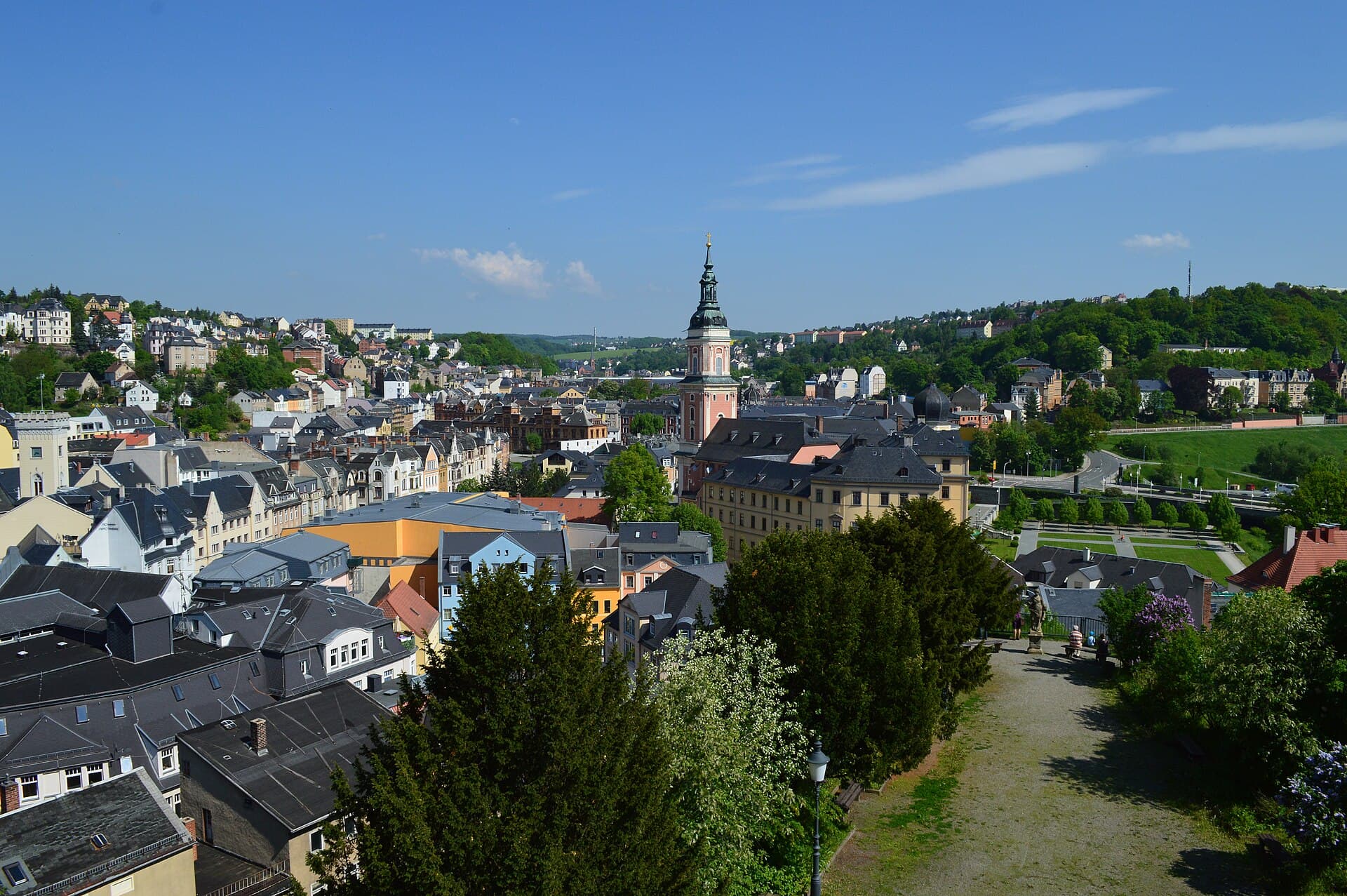 Steffen Löwe / CC BY-SA 4.0, via Wikimedia Commons
Self-guided audio walking tour of Greiz — GPS route, offline playback, story-driven narration in 32 languages.
“Where a princely past meets the tranquil flow of the White Elster.”
Not the postcards. The stories even locals don't know — whispered in your ear, right where they happened.
The Lower Castle conceals a detail from its reconstruction following a devastating fire.
Beyond its meticulously designed landscapes, the Princely Greiz Park harbors a surprising ecological detail.
The elegant Sommerpalais was not the initial summer retreat for the rulers of Greiz.
Discover every secret of Greiz
Every address, every reveal in full — in your ear, right where it happened.
You pick your stops. You walk. The voice reveals what the others miss.


Your self-guided audio tour of Greiz is ready — pick your landmarks, choose your language, and start the moment you arrive.
BuyLume has a built-in augmented-reality guide. Hold your phone up and its camera shows the street ahead of you, with a glowing arrow laid over the real view that always points to your next stop — no map to puzzle over, no wrong turns. Like everything in Lume, it works fully offline.
Greiz, often called the "Pearl of the Vogtland," is a town in eastern Thuringia, Germany, situated on the White Elster river. It was once the capital of the Principality of Reuss-Greiz, the smallest principality in Germany, until 1918. The town's identity is defined by its two prominent castles, the Upper Castle (Oberes Schloss) and the Lower Castle (Unteres Schloss), along with the elegant Sommerpalais and the expansive Princely Greiz Park.
Greiz offers a unique blend of historical architecture, particularly from the Gründerzeit period and in the Art Nouveau (Jugendstil) style, reflecting its past prosperity as a center for textiles and paper manufacturing. The White Elster river meanders through the town, contributing to its scenic valley setting and providing pleasant views from surrounding hills.
Beyond its architectural and natural beauty, Greiz is a cultural hub, hosting a triennial of caricatures and comic art at the Sommerpalais. It also serves as a gateway to the extensive hiking and cycling trails of the Vogtland region.
The origins of Greiz can be traced back to its Slavic roots, with its original name "Grouts" meaning "gord," or a fortified place. The first written mention of the settlement dates to 1209. Its strategic location at the confluence of the White Elster River and its tributary, the Göltzsch, played a significant role in its early development as a commercial center.
From the 12th century, Greiz was governed by advocati (Vögte), eventually coming under the possession of Gera in 1236 before being recognized as a town in the 13th century. The House of Reuss, a German ruling dynasty, profoundly shaped Greiz's destiny. In 1564, the Reuss territory was divided, leading to the establishment of separate lines for Lower Greiz, Upper Greiz, and Gera. Heinrich the Elder received Lower Greiz and built what would become the Lower Castle.
Greiz suffered devastating fires that largely destroyed the town in 1494 and almost entirely again in 1802. Following the 1802 fire, the Lower Castle was rebuilt in a Classicist style, and in 1809, Prince Heinrich XIII moved the principality's residence there from the Upper Castle. The town served as the capital of the Principality of Reuss-Greiz until 1918. In 1919, the two Reuss areas (Greiz and Gera/Schleiz) merged to form the Volksstaat Reuss, which then became part of Thuringia in 1920.
The 19th and early 20th centuries saw Greiz flourish as a center for textile and paper manufacturing, leading to the construction of numerous villas and impressive architecture from the Gründerzeit period and in the Art Nouveau style. The town's historical significance is also marked by an 18th-century innovation: in 1765, Melchior Bauer presented a theoretical concept for aeroplane construction in Greiz.
During World War II, Greiz did not suffer extensive damage, though three of its five bridges were destroyed. Today, Greiz is the capital of the district of Greiz and continues to preserve its considerable heritage while offering a diverse range of cultural activities.
Greiz is notable for its distinct architectural ensemble, featuring three princely residences. The Upper Castle (Oberes Schloss), situated on a 50-meter-high slate rock, offers expansive views over the White Elster valley and the historic center. It now houses a museum with exhibitions detailing the region's history.
In the town center, the Lower Castle (Unteres Schloss) showcases later-period princely architecture. Since 1929, the Lower Castle has housed a museum, allowing visitors to explore faithfully restored private rooms of the princely family and admire intricate stucco decorations.
The Fürstlich Greizer Park (Princely Greiz Park), a 45-hectare English landscape garden, is an essential visit. It features a formal flower garden, a historic pinetum with rare conifers, and a large lake. Within the park stands the Sommerpalais (Summer Palace), an early Classicist building constructed between 1769 and 1779, which served as the summer residence for the Reuss elder line. Today, it houses the state collection of books and copper engravings, as well as the SATIRICUM, an archive of caricatures.
The historic Old Town (Altstadt Greiz) itself contains nearly 60 listed buildings, with notable Art Nouveau (Jugendstil) ensembles along streets like Thomasstraße and Burgstraße. For expansive views, ascend to the Weißes Kreuz (White Cross) viewpoint at Hirschstein.
The most pleasant time to visit Greiz for comfortable temperatures and outdoor activities is during May, June, July, August, and September. During this period, daytime temperatures typically range from 18°C to 24°C (65°F to 75°F). July is the warmest month, with an average high of 24°C (75°F) and around 6.5 hours of sunshine per day. While July is also the wettest month, rainfall is generally moderate. Late June to late August is particularly recommended for warm-weather activities.
Greiz is accessible via the White Elster river valley, approximately 100 kilometers east of Erfurt. The town's compact historic center is easily explored on foot, with prominent views of the Upper Castle aiding in navigation. The Tourist Information office, located in the Lower Castle, provides maps, information on local attractions, and assistance with accommodation and guided tours. They also offer tickets for the Upper and Lower Castle museums and the Vogtlandhalle.
For those interested in outdoor pursuits, Greiz is a starting point for various hiking and cycling routes, including sections of the Vogtland Panoramaweg, the Elsterperlenweg, and a Greiz circular route. Cyclists can also utilize the Elsterradweg, which features both flat and hilly sections. The Greiz-Werdau forest and Waldhaus area offer shaded walking paths and animal enclosures, suitable for family excursions.
Greiz in Korean, in Chinese or in Hebrew — and 29 more languages, every stop narrated by a native voice. The widest language range of any self-guided audio tour.
Available in: