The Saalfeld Fairy Grottoes are celebrated as the world's most colorful grottoes, yet their brilliant spectrum of hues is not entirely a work of nature.
Michael Sander / CC BY-SA 3.0, via Wikimedia CommonsSaalfeld
Self-guided audio walking tour of Saalfeld — GPS route, offline playback, story-driven narration in 32 languages.
“Where ancient stone meets a kaleidoscope of color.”
Saalfeld, as no one tells it.
Not the postcards. The stories even locals don't know — whispered in your ear, right where they happened.
One of Saalfeld's medieval city gates, the Blankenburg Gate, once served an unexpected purpose beyond its defensive role.
Saalfeld Castle, now a district administrative building, shares a connection with one of Europe's most prominent royal lineages.
Discover every secret of Saalfeld
Every address, every reveal in full — in your ear, right where it happened.
You pick your stops. You walk. The voice reveals what the others miss.


How long do you have in Saalfeld?
Your self-guided audio tour of Saalfeld is ready — pick your landmarks, choose your language, and start the moment you arrive.
BuyThe story of Saalfeld
Saalfeld, officially Saalfeld/Saale, is a town in Germany, positioned along the Saale River, approximately 48 kilometers south of Weimar. Known as the "Stone Chronicle of Thuringia," it stands as one of the region's most ancient towns, with its origins reaching back to the 7th century. Saalfeld maintains a compact, easily traversable historic core, embraced by medieval walls, inviting a passage through centuries of German history.
The town is particularly acclaimed for its Feengrotten, or Fairy Grottoes, which the Guinness Book of Records recognizes as the world's most colorful grottoes. Beyond these subterranean marvels, Saalfeld's historical heart showcases a Renaissance Town Hall, Gothic churches, and enduring fragments of its past as a ducal residence. Alongside neighboring Rudolstadt and Bad Blankenburg, Saalfeld forms a tri-city expanse with a collective population of around 70,000 people, set within the picturesque Saale valley.
Saalfeld's story extends over eleven centuries, earning it the designation "Stone Chronicle of Thuringia." The settlement likely began around the 7th century as a Thuringii stronghold known as Hoher Schwarm or Sorbenburg. The town received its first official mention in 899 CE, cementing its standing as one of Germany's earliest urban centers.
In 1071, Archbishop Anno II of Cologne established a Benedictine abbey in Saalfeld, which grew into a significant ecclesiastical focal point in eastern Thuringia until its destruction during the German Peasants' War in 1526. The town was acquired by Landgrave Balthasar of Thuringia, a member of the House of Wettin, in 1389. Under Wettin governance, Saalfeld's economy flourished, bolstered by nearby mines, river transport on the Saale, and fishing. The Gothic Saint John hall church was erected, reaching completion in 1514, and the Gothic town hall was finished in 1537, reflecting the town's prosperity.
Saalfeld became a ducal residence in 1675 when Duke Albert V of Saxe-Coburg chose it as his home, leading to the construction of Saalfeld Castle from 1677 onwards, on the former Benedictine abbey grounds. The castle served as the abode for four generations of the Saxe-Coburg-Saalfeld branch of the Wettin dynasty until 1825. The town played a part in the Napoleonic Wars; on October 10, 1806, the Battle of Saalfeld unfolded, where Prince Louis Ferdinand of Prussia fell in action against Napoleon's forces.
During the 19th century, industrial growth was spurred by the opening of the Leipzig-Probstzella railway, enhancing Saalfeld's importance as a transportation junction. In World War II, as a railway intersection and Wehrmacht garrison town, Saalfeld endured significant impact from strategic bombing. After the war, it became an Inner-German border station on the Saal Railway, recognized for its continued use of steam locomotives during the GDR era, drawing railway enthusiasts.
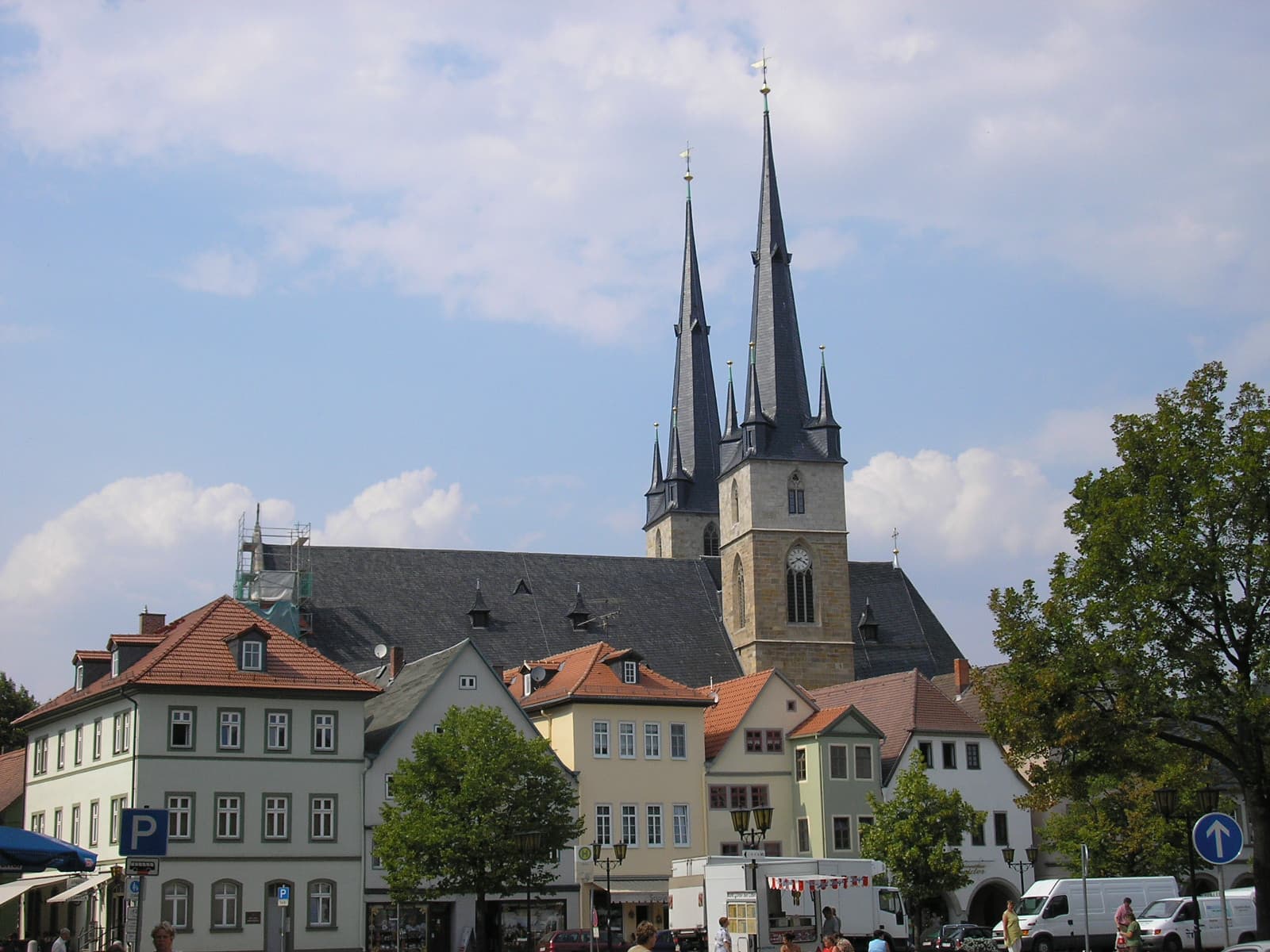
A walk through Saalfeld's compact historic center reveals why it is called the "Stone Chronicle." The Market Square, encircled by gabled merchant houses and public buildings, serves as the town's beating heart. The Renaissance Town Hall, constructed between 1529 and 1537, stands as an early example of Thuringian-Saxe Renaissance architecture. Nearby, St. John's Church (Johanneskirche), a prominent Gothic edifice completed in 1514, features ribbed vaulting and stained-glass windows.
Sections of Saalfeld's medieval fortifications are still visible, including well-preserved town walls, bastions, and four historic gates: the Darrtor, Blankenburger Tor, Oberes Tor, and Wetzelstor. The Darrtor, the oldest gate tower from the 14th century, offers expansive views over the old town and the Saale valley. The Hoher Schwarm castle ruins, a former residential tower from around 1300, remain a Saalfeld landmark.
No journey to Saalfeld is complete without experiencing the Saalfelder Feengrotten, or Fairy Grottoes, situated about 1.5 kilometers outside of town. These former alum slate mines are recognized by the Guinness Book of Records as the world's most colorful grottoes. The complex includes a show mine, an adventure forest, and the Grottoneum museum, providing an engaging experience of mining history and the caves' natural splendor.
The most favorable time to visit Saalfeld for warm-weather pursuits is from late June to late August. In July, average high temperatures hover around 73°F (23°C) and lows around 56°F (13°C). This period offers agreeable weather for exploring the town and its surrounding natural beauty. However, July also experiences the highest rainfall, with an average of 2.3 inches (94.56 mm) of precipitation. Spring (April–June) and fall (September–October) are also considered opportune for pleasant weather, fewer crowds, and local festivals across Germany.
Saalfeld is an easily walkable town, particularly its historic center. For those venturing further, regular buses and taxis are available. The town serves as a key rail junction, with Saalfeld station providing Intercity-Express trains connecting to cities like Berlin and Munich. For dining, Saalfeld presents a variety of restaurants, including establishments offering traditional Thuringian cuisine. Options include Hotel Anker, which serves classic German dishes and locally caught trout, and various places offering Greek, Asian, and Italian fare. Accommodation choices in Saalfeld cater to diverse preferences, from hotels like Hotel Anker and Hotel & Restaurant Bergfried to guesthouses and holiday apartments. Many hotels provide modern amenities and are commended for their welcoming service and proximity to local points of interest.
- What is Saalfeld primarily known for?
- Saalfeld is internationally recognized for its Feengrotten (Fairy Grottoes), which the Guinness Book of Records lists as the world's most colorful grottoes. It is also acknowledged as one of Thuringia's most ancient towns and the ancestral seat of the Saxe-Coburg and Gotha branch of the House of Wettin.
- How old is the town of Saalfeld?
- Saalfeld is among Thuringia's oldest towns, with its origins potentially dating back to the 7th century around a Thuringii fortress. It received its first official mention in 899 CE.
- What historical event occurred in Saalfeld in 1806?
- On October 10, 1806, the Battle of Saalfeld unfolded during the Napoleonic Wars, where Prince Louis Ferdinand of Prussia was killed in action against French forces led by Marshal Lannes.
- Are there preserved medieval structures in Saalfeld?
- Yes, Saalfeld retains portions of its medieval fortifications, including town walls, bastions, and four historic gates: the Darrtor, Blankenburger Tor, Oberes Tor, and Wetzelstor. The Hoher Schwarm castle ruins also date from the 13th century.
- What kind of food can I anticipate in Saalfeld?
- In Saalfeld, you can anticipate hearty Thuringian cuisine, including the region's iconic Thüringer Rostbratwurst. Many restaurants offer a blend of classic and contemporary German dishes, as well as international fare.
- What is meant by "The Stone Chronicle of Thuringia"?
- "The Stone Chronicle of Thuringia" is a poetic descriptor for Saalfeld, reflecting its long and profound history spanning over eleven centuries, evident in its numerous well-preserved historical buildings and medieval street plan.