Pelkor Chöde Monastery's Kumbum Stupa
This multi-tiered stupa holds a secret within its walls, a testament to religious harmony rarely seen.
Full story unlocks in the tour
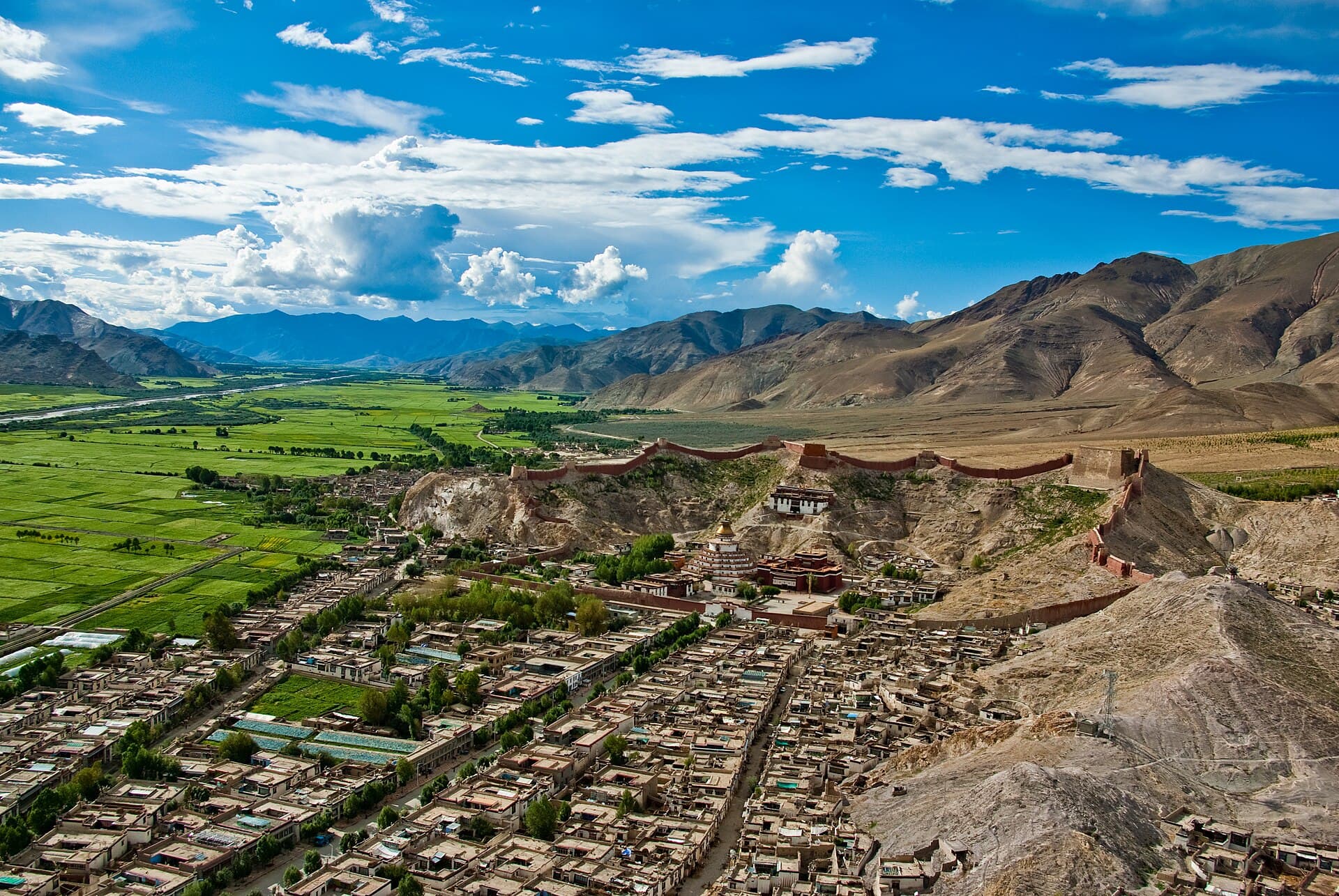 Antoine Taveneaux / CC BY-SA 3.0, via Wikimedia Commons
Self-guided audio walking tour of Gyantse — GPS route, offline playback, story-driven narration in 32 languages.
“Where ancient fortresses stand sentinel over sacred art.”
Not the postcards. The stories even locals don't know — whispered in your ear, right where they happened.
This multi-tiered stupa holds a secret within its walls, a testament to religious harmony rarely seen.
The imposing fortress of Gyantse Dzong holds a dramatic tale of defiance against overwhelming odds.
Beyond the town's historic structures, the fertile valley reveals a surprising seasonal transformation.
Discover every secret of Gyantse
Every address, every reveal in full — in your ear, right where it happened.
You pick your stops. You walk. The voice reveals what the others miss.
Your self-guided audio tour of Gyantse is ready — pick your landmarks, choose your language, and start the moment you arrive.
BuyLume has a built-in augmented-reality guide. Hold your phone up and its camera shows the street ahead of you, with a glowing arrow laid over the real view that always points to your next stop — no map to puzzle over, no wrong turns. Like everything in Lume, it works fully offline.
Gyantse, situated in the Nyang Chu valley at an altitude of approximately 4,040 meters (13,255 feet), is a town where historical significance intertwines with a serene, traditional atmosphere. Once Tibet's third-largest city and a crucial trading hub connecting Lhasa, Shigatse, and India, it retains much of its ancient character with narrow streets and whitewashed houses. The town's strategic position, between the Gangdis Mountains and the Himalayas, made it an important center for both commerce and defense throughout its long history.
Often referred to as the 'City of Heroes,' Gyantse gained renown for the fierce resistance its inhabitants mounted against the British invasion in 1904. This enduring spirit is palpable as you explore its landmarks, which offer expansive views of the fertile valley and surrounding mountain ranges. Gyantse provides a quieter and more authentic experience for travelers seeking to immerse themselves in Tibetan culture and history.
The history of Gyantse stretches back to at least the 9th century. Murals within the Kumbum Stupa indicate that a castle was established on a mountain range above the city by Pelkhor Tsen, nephew of King Langdarma. However, details from these early years remain scarce. Gyantse truly rose to prominence in the 14th century, becoming a significant trade center along routes that linked Tibet with India, Nepal, and Bhutan. Its strategic location in the Nyang Chu valley ensured its importance in both politics and defense.
During the 14th and 15th centuries, Gyantse saw significant construction. The Gyantse Dzong, or fortress, was built around 1390, serving as a military stronghold and administrative center for local kings. The Pelkor Chöde Monastery and its iconic Kumbum Stupa were also constructed during this period, beginning in the late 14th century and completed by the mid-15th century. The Kumbum, commissioned by a Gyantse prince in 1427, became a vital center for the Sakya school of Tibetan Buddhism. Uniquely, Pelkor Chöde Monastery became a rare example of religious harmony, housing colleges of the Sakya, Gelug, and Kadam orders of Tibetan Buddhism under one roof.
Gyantse's most famous historical event is arguably the battle that took place at its fortress during the British invasion of Tibet in 1904. Led by Colonel Francis Younghusband, the British expedition faced determined resistance from local forces. Despite being outnumbered and outgunned with antiquated weapons, Tibetan soldiers and civilians held out for days, earning Gyantse the moniker 'City of Heroes.' This confrontation marked a significant military encounter in modern Tibetan history. While the British ultimately breached the fortress, the bravery shown by the defenders remains a powerful symbol of Tibetan resilience.
In the 1950s, a powerful flood caused significant damage to many buildings in Gyantse, though some were later restored. Today, Gyantse continues to be an important stop on the Friendship Highway, connecting Lhasa and Shigatse. It remains a place where traditional Tibetan life can be observed, offering a glimpse into a profound cultural heritage.
The main attractions in Gyantse offer a compelling look into Tibetan history and spirituality. The Pelkor Chöde Monastery is a sprawling complex known for its unique blend of Tibetan Buddhist traditions and remarkable architecture. Its centerpiece is the magnificent Kumbum Stupa, a multi-level structure considered one of Tibet's greatest architectural masterpieces. This 32-meter-high stupa contains 77 chapels adorned with over 10,000 murals and numerous statues, representing different spiritual stages of Buddhist practice. The murals, many showing a strong Nepali influence, are considered representative works of mature Buddhist art from the 14th and 15th centuries.
Dominating the town's skyline is Gyantse Dzong, a 14th-century fortress that served as a military stronghold and administrative center. While the fortress itself is not always open for interior exploration, climbing to its top offers expansive views of Gyantse town, the Pelkor Chöde Monastery, and the fertile Nyang Chu valley. A small museum within the Dzong recounts the fort's role in the 1904 British invasion. Beyond these main sites, the Gyantse Old Town with its whitewashed houses and narrow streets provides a glimpse into traditional Tibetan life. The Karola Glacier, a striking natural sight with ice and snow-capped mountains over 7,000 meters tall, is also accessible from the road between Lhasa and Gyantse.
The most pleasant time to visit Gyantse is between April and November. During these months, the weather is generally comfortable with clear skies, making it ideal for exploring and photography. While daytime temperatures can be pleasant and even warm in summer, nights can be dramatically cooler, so layers are advisable. The summer monsoon season, from June to September, brings most of the year's rainfall, but also transforms the surrounding valley with blooming rapeseed fields in late summer. Winter visits (November to March) are colder and drier, with fewer tourists and often clear weather, which can be good for photographers.
Gyantse is located approximately 260 km southwest of Lhasa and 90 km southeast of Shigatse, making it a common stop on overland tours. Most visitors arrive by private car or group tour from Lhasa, a scenic drive that takes about 6 hours and includes stops at Yamdrok Lake and the Karola Glacier. Public buses are infrequent.
Accommodation in Gyantse is generally basic, with no luxury hotels available. The Gyantse Hotel is a 3-star option offering various room types and dining, with 24-hour hot water and free Wi-Fi. Gyantse Jianzang Hotel is considered a good budget choice. Given Gyantse's altitude of around 4,000 meters, acclimatizing in Lhasa (approximately 3,650 meters) for a few days beforehand is recommended to prevent altitude sickness. It's advisable to stay hydrated, keep warm, and avoid strenuous activities upon arrival. While 5G is available in the city, rural areas may have limited 4G coverage. Some small shops may only accept cash, so carrying some RMB is useful.
Gyantse in Korean, in Chinese or in Hebrew — and 29 more languages, every stop narrated by a native voice. The widest language range of any self-guided audio tour.
Available in: